Articles
Chinese metaphysics guides
Start with clear, careful guides that explain the tradition, the practical use case, and the limits of each method.
Showing 15 of 147 articles
Featured articles
Recently published
BaZi
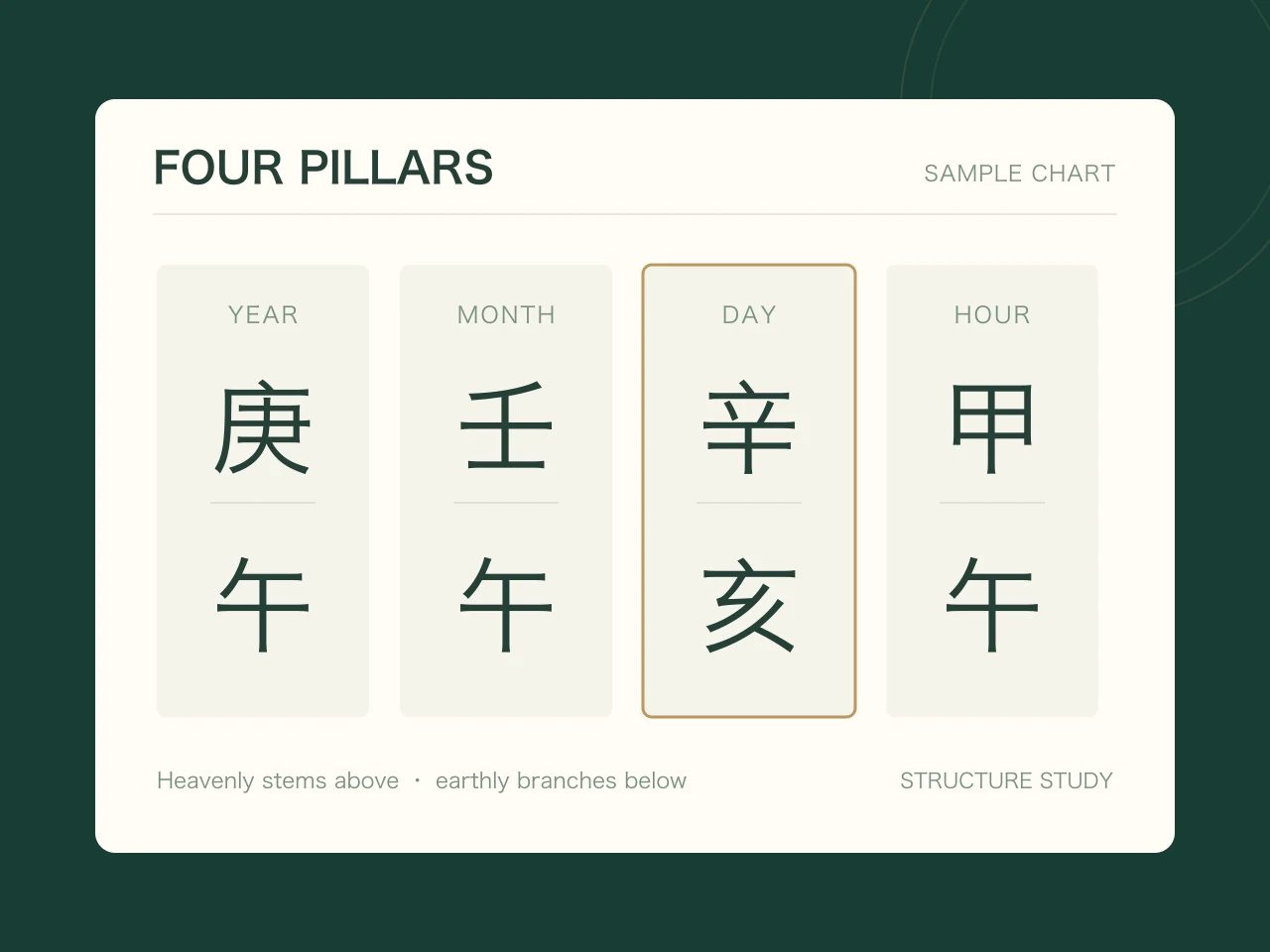
Born in a Leap Month: The Month Pillar Splits the Month
A leap month holds no 中氣, so it always swallows exactly one 節 — and the month pillar turns on day 14, 15 or 16. All 74 leap months from 1900 to 2100, counted.
BaZi
Tai Yuan: Two Rules Share One Name
One rule adds a stem and three branches to the month pillar; a Ming compilation counts back three hundred days instead. Both are called the fetal-origin pillar, and they land on different months.

Feng Shui
Bagua Map Placement: Which Wall, and Which North
The bagua map is pinned to the front door in one version and to the compass in another. What a sector contains, how much floor the centre gets, and where the two stop overlapping.
Article library
All articles

Staircase Feng Shui: Four Rules and What They Measure
Stairs facing the door, stairs mid-house, and the odd-number rule, restated as measurements: riser arithmetic from floor height, a four-metre footprint, and a stack effect that reverses in summer.
Read article
How to Measure Which Way Your Home Faces
Three methods for the one input every direction-based method needs: a phone compass, a noon shadow, and the building's own plan. Each fails in a different way, and the cheapest one fails most often indoors.
Read article
Twins and BaZi: When Two People Share One Chart
Four characters come from a date and a two-hour window, so most twin pairs receive the same chart. Enumerating every minute of 2026 shows how often a pair really splits, which four boundaries can separate them, and what the shared chart still says.
Read article
Na Yin: The 60-Jiazi Element That Is Not Your Day Master
Na Yin attaches one of thirty sound-images and an element to each of the sixty stem-branch pairs, which is why 甲子 reads as 海中金. It is also where the phrase "I am a metal person" comes from — and it is not the element a BaZi chart is read from.
Read article

Shop Feng Shui Layout: Read the Customer Route Before the Compass
A shop layout is a set of movement decisions you can observe on one visit: the threshold, the browse loop, the service queue, and the exit. The compass reading is recorded separately and never overrules a measured problem.
Read article
Cashier Position: Three Queues, One Sightline Height, One Counter Height
A till is a queueing system before it is a corner. The service rate sets the wait, a 1.4 m shelf hides everyone below 1.2 m, and only 915 mm of counter is fixed by code.
Read article
Restaurant Feng Shui Layout: Protecting Two Routes on One Floor
In a restaurant the customer route and the staff route share one floor, and most bad-feng-shui complaints are collisions between them. The pass, the seating, the queue, and the light are all checkable.
Read article
Storefront Entrance Feng Shui: Sign Distance, Glass, and Door Force
A shop entrance is three measurements before it is a direction: the cap height the sign needs at its distance, the brightness at which glass becomes a mirror, and the door force.
Read article

Garden Tree Placement: Distance, Roots, and the Shade You Get
A tree keeps growing after it is planted, so the position is decided at mature size: canopy spread, root spread, and the distance the trunk needs from the wall. The traditional reading is used as a list of positions worth checking.
Read article
Garden Water Features: Flow, Noise, and the Overflow Path
A water feature is a pump, a basin, and a weekly job before it is a direction. Four figures — volume, turnover, noise at one metre, and minutes per week — decide whether it is still pleasant in year three.
Read article
Courtyard Layout: Enclosure, Paths, and Usable Area
A courtyard behaves according to the ratio of wall height to open width, not according to its outline. Measure that ratio first, then decide how much floor the path is allowed to spend and which low point takes the water.
Read article
Garden Gates and Paths: Four Measurements Before Style
A gate is four measurements: the clear opening the widest load needs, the quarter circle the leaf sweeps, the 180 mm riser ceiling, and the angle the opening frames. Only the last is a design choice.
Read article
Choose a useful path
Match the guide to the decision you actually need to make
The article library prioritizes durable guides that work well as starting points. Choose by the question you have and the facts you can confirm; you do not need to apply every traditional rule to yourself.
1. Start with the real problem
Use the BaZi guides for calendar assumptions and chart structure; use home or office guides for a space you can inspect. Safety, moisture, structure, electricity, consent, and professional obligations always take priority over a traditional preference.
2. Read method before recommendation
Open the topic overview first, then choose an article that matches the room, information, or decision involved. Before using a checklist or calculator, see what you need to prepare and when the result does not apply.