A water feature is a machine with a mood
Water is the part of a garden that people describe in feelings and then maintain in chores. The feeling is real — moving water masks traffic noise, and a still surface reflects sky into a shaded corner — but every effect it produces comes from a pump, a basin, and a power supply that have to keep working. Treating the feature as a machine first is not a rejection of the atmosphere. It is the only way the atmosphere survives the second summer.
So the design question is not where water would look most auspicious. It is which of the four water jobs you actually want — sound, reflection, wildlife, or the look of water — because each one points at a different basin, a different pump, and a different weekly cost.
Four numbers before the first stone
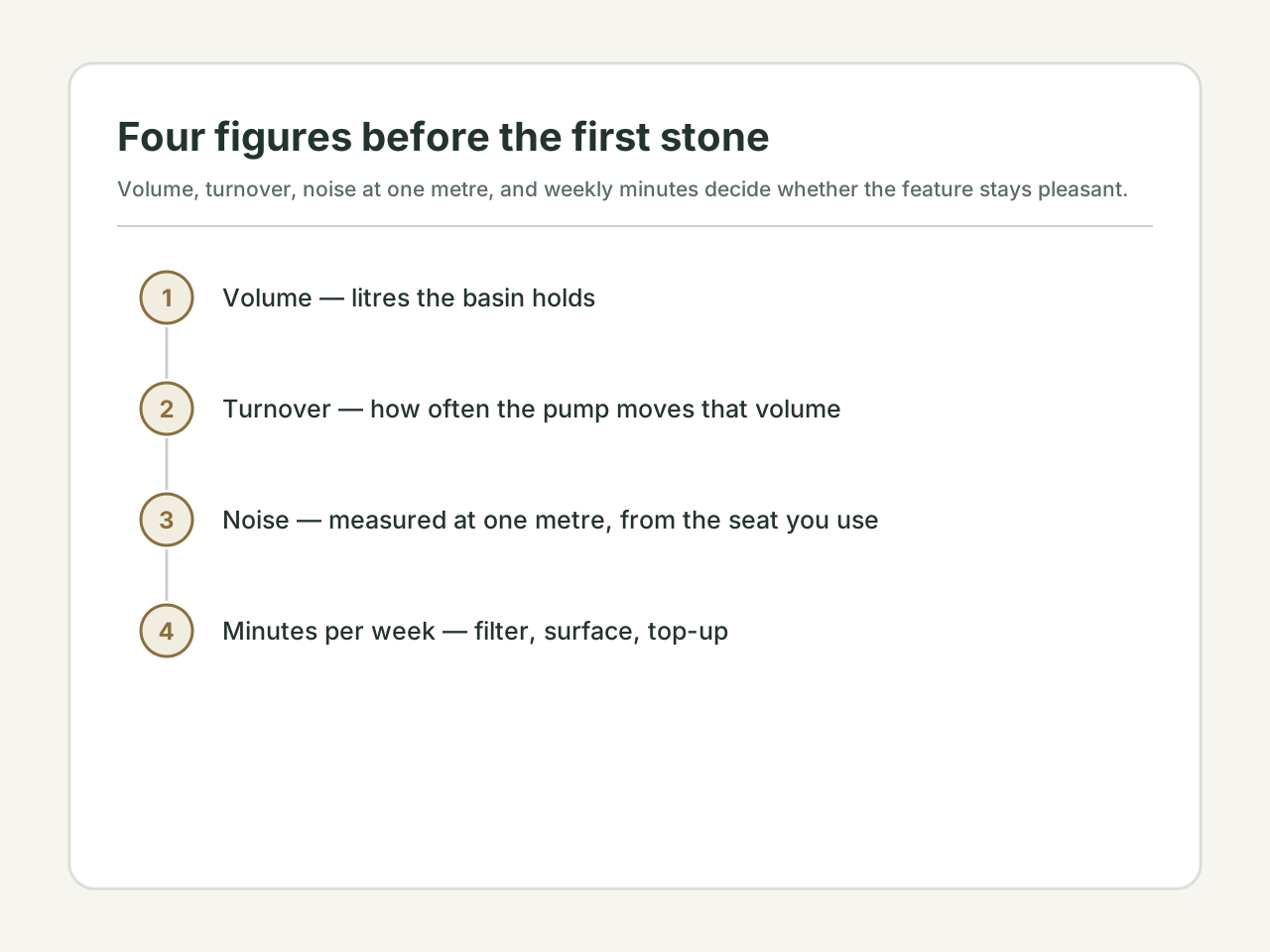
Before siting anything, settle four figures. How many litres the basin holds. How often the pump turns that volume over. How loud the falling water is at one metre. And how many minutes a week the filter and the surface will take. All four can be estimated on paper, and all four are hard to change later.
The volume is simple geometry. Turnover is the number that decides whether the water stays clear: a small basin with a slow pump turns green within weeks, while the same pump on a larger volume keeps up. Noise at one metre is the number nobody measures and everybody regrets, because a feature sized for a large garden is a feature you cannot sit beside.
Turnover is the whole design
A pond or basin is a small ecosystem with a load it can absorb. Fish, fallen leaves, and warm weather all raise that load, and the pump is what keeps it below the point where algae take over.
- Estimate volume in litres: length × width × average depth × 1000 for a rectangular basin.
- Aim to turn the full volume over every one to two hours in a stocked pond.
- Size the filter for the load at the end of summer, not the load on planting day.
- Keep the pump intake off the bottom so it does not become a leaf trap.
- Plan a power route with a residual-current device, and a way to switch it off without reaching into water.
The measurement nobody takes
Sound falls off with distance, but it also changes character. A thin sheet of water over a lip is pleasant at three metres and irritating at one, while a deep drop is the reverse. The only reliable test is a temporary rig: a hose, a bucket, and a plank at the height you intend, listened to from the seat you actually use.
Two rules come out of that test in almost every garden. Keep the fall under about thirty centimetres unless the basin is large enough to absorb the splash. And put the feature where its sound competes with something you want masked — a road, a neighbour’s air conditioner — rather than where you want quiet conversation.
The overflow path decides where the water ends up
Every basin overflows eventually: after rain, after a blocked outlet, after a pump fails. The overflow path matters more than the outline, because the water will follow it whether or not you designed it. If the low side of the basin faces the house, the overflow ends up in the strip beside the wall — the same strip that is hardest to dry and most expensive to repair.
Set the overflow to discharge to a garden bed, a gravel-filled pit, or a drain, and check the fall with a spirit level rather than by eye. Then check the basin edge: a rim that sits below the surrounding soil turns the feature into a silt trap after the first storm.
What water facing the door is warning about
The classical caution about water running toward the entrance is usually repeated as a warning about money leaving the house. Taken literally it is hard to defend. Taken as a description of the physical situation, it is unusually accurate: water directed at a doorway splashes the threshold, erodes the ground beside it, and in cold weather freezes across the path people use most.
That gives a rule you can act on without deciding whether you believe the fortune part. Point the fall of the water away from the door, keep the splash zone at least a metre from the threshold, and make sure the route from gate to door is not the lowest line in the garden. If the site already drains that way, the feature belongs on the other side.
The weekly cost, counted honestly
The number that decides whether a feature stays pleasant in year three is minutes per week, not litres per hour.
- Clear the intake and skimmer weekly in summer; twice weekly under trees.
- Top up for evaporation and check the level after every hot spell.
- Test the pump on the coldest week you expect; a pump left idle can seize.
- Keep a spare impeller and a spare fuse, because both fail at the worst time.
- Decide in advance what happens when you travel: a timer, a neighbour, or a switch-off plan.
- Count the cost of electricity at the pump rating for the hours it actually runs.
Disclaimer: This content is for informational and cultural reference purposes only. It does not constitute professional medical, legal, financial, or psychological advice. Readers should exercise their own judgment and consult qualified professionals for specific concerns.
Sources and review basis
Traditional references explain historical vocabulary and context. Official practical sources support only the observable safety, comfort, or environmental points noted in the article; they do not validate metaphysical claims.
Traditional reference
Huangdi Zhaijing (黄帝宅经)Wikisource digital text · Accessed 2026-07-14
Historical context for traditional residential orientation and spatial vocabulary. Modern recommendations are judged against real conditions.
Practical source
US EPA: MoldUnited States Environmental Protection Agency · Accessed 2026-07-14
Practical guidance for moisture control and mold prevention in bathrooms, homes, and renovation work.