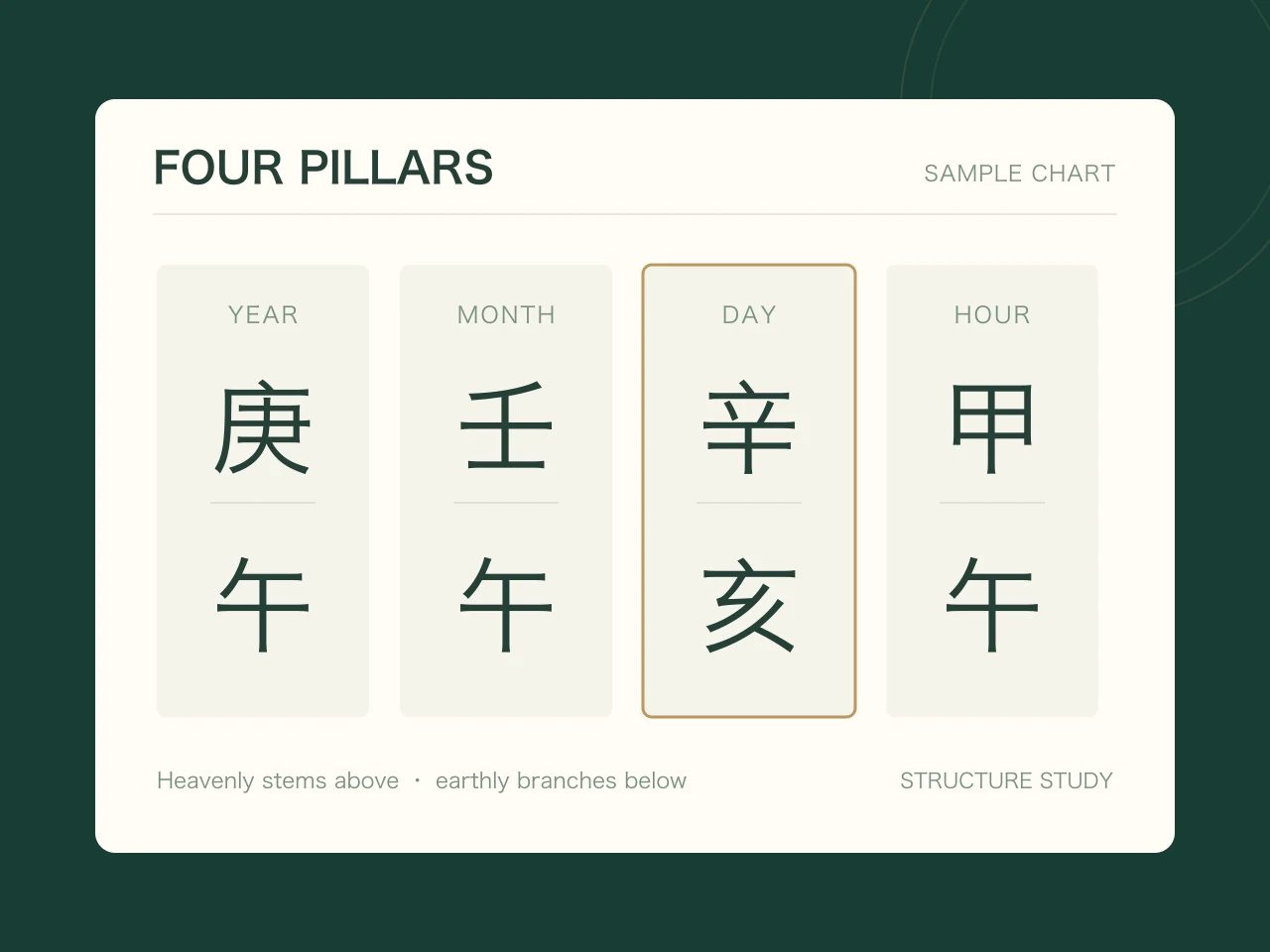
Two rules share one name
胎元 (tāiyuán), the fetal-origin pillar, is printed by most chart software and explained by almost none. The rule you will find in tutorials is two lines: advance the month pillar's stem by one place, and its branch by three.
A birth on 14 May 1990 at 10:00 gives 庚午 year, 辛巳 month, 己卯 day, 巳 hour. The month pillar is 辛巳. 辛 advances to 壬, 巳 advances to 申, and the fetal pillar is 壬申.
The Ming compilation 三命通会 has a section titled 论胎元 and gives a different method: go back three hundred days, keep the same day pillar, and call that the conception day. Its own example is a 甲子 day birth, where the conception day is the 甲子 day five cycles earlier. Three hundred is five times sixty, so the day pillar repeats by construction and the rule always finds a date.
Both offsets are one instruction
Ten stems and twelve branches cycle independently, so going back one month subtracts one from each and going back nine subtracts nine from each.
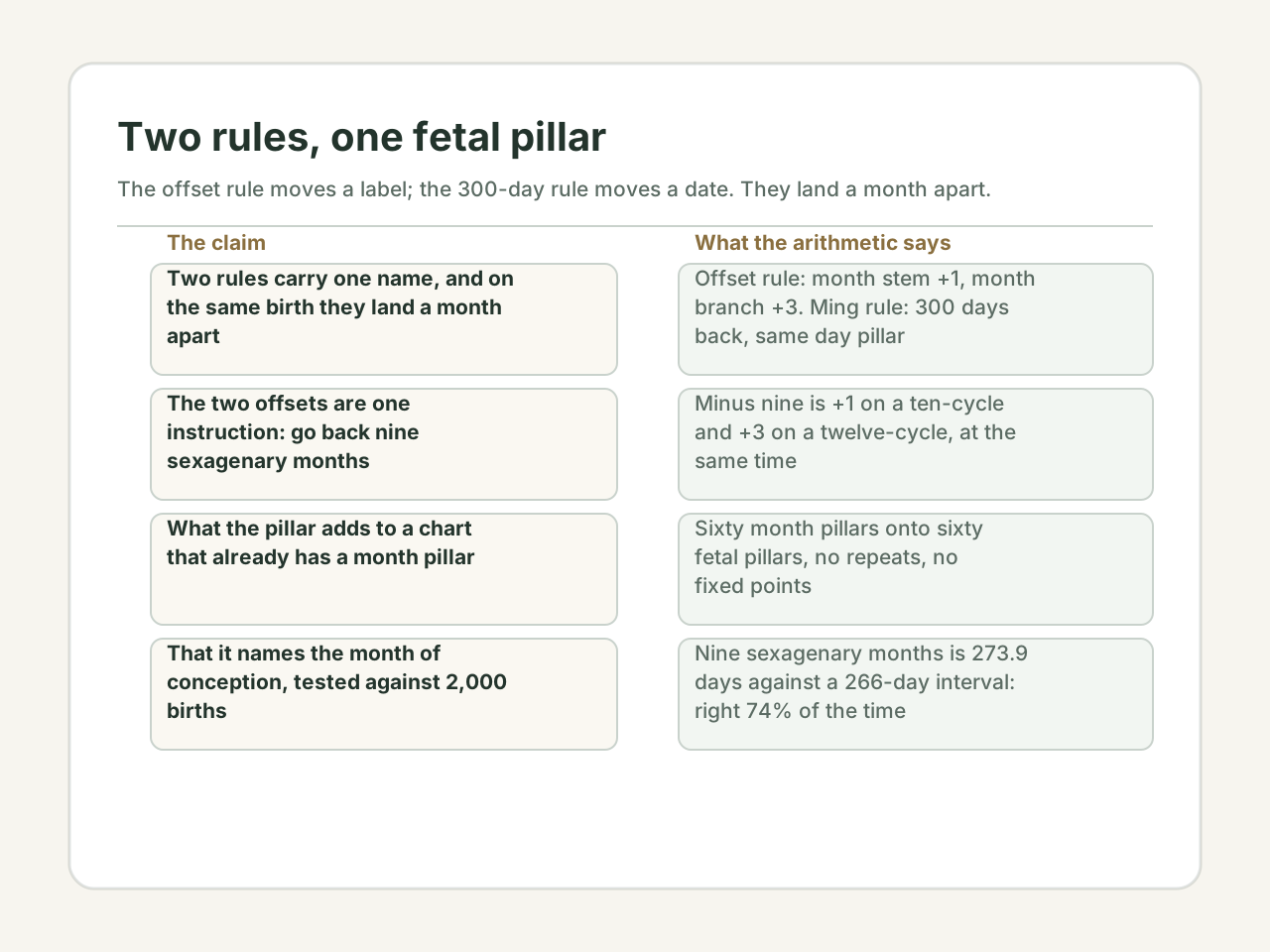
Minus nine lands where plus one lands on a ten-cycle, and where plus three lands on a twelve-cycle. The two-line rule is one sentence: go back nine sexagenary months.
That is checkable without trusting the rule. Walking back from 14 May 1990, the month pillar changes on 4 May, 4 April, 5 March, 3 February, 5 January, 6 December 1989, 7 November, 8 October, and finally 6 September 1989, where it turns to 壬申. The ninth boundary back is what the rule produced.
Sixty go in, sixty come out
Listing the month pillar for every month from 1950 to 2050 turns up all sixty sexagenary pairs. Applying the rule to each gives sixty results with no duplicates, so the map is a bijection, and it has no fixed point: adding one cannot leave a stem where it was, adding three cannot leave a branch where it was.
One structural detail is worth keeping. A legal sexagenary pair has a stem and a branch of the same parity — 甲子, 乙丑, 丙寅, never 乙子. The rule flips both parities, so the output stays legal. That is a free test on any calculator: a fetal pillar whose stem and branch disagree in parity came from broken software.
The consequence is uncomfortable. The pillar carries nothing the month pillar does not already carry, so a reading that offers it as corroboration has counted the same input twice.
The other rule is a different kind of object
The 三命通会 method does not produce a pillar at all. It produces a date, and the month that contains that date is whatever the calendar says it is. That is why the two rules can sit in the same tradition and still disagree: one is arithmetic on a label, the other is arithmetic on a day count.
Three hundred days is also not a defensible gestation. Mean human gestation from conception is 38 weeks, or 266 days; obstetric dating runs from the last menstrual period and calls week 40 the due week, which is the same interval counted fourteen days earlier. The Ming rule overshoots by thirty-four days.
The two rules, side by side
Both births below are real dates. The third column is the month that actually contains the date 266 days earlier, which is the thing both rules claim to be finding.
- On the first birth the offset rule lands on the conception month and the 300-day rule is a month early. On the second both miss, by one month and two.
- Neither is a calculation error. They answer different questions that were given the same name, and only one was ever about pregnancy.
| Birth | Offset rule | 300-day rule | Month of the 266-day date |
|---|---|---|---|
| 14 May 1990 | 壬申 | 辛未, from 18 July 1989 | 壬申 |
| 1 March 1990 | 己巳 | 戊辰, from 5 May 1989 | 庚午 |
How often the offset rule is right
Test it on 2,000 birth dates spaced a week apart from January 1990: compute the fetal pillar, then find which sexagenary month holds the date 266 days earlier.
They agree for 1,480 of the 2,000, or 74.0 per cent. In the other 26 per cent the fetal pillar named the month immediately before, never further off than that.
The pattern is arithmetic rather than luck. If a birth falls d days after its own month boundary, the conception date sits 8 + d days into the fetal month. A sexagenary month averages 30.44 days, so the date stays inside while 8 + d is no more than 30.44, which is d no more than 22.4. And 22.4 / 30.44 is 73.6 per cent of birth dates, which is the number the count produced.
What it is actually good for
Three uses survive the arithmetic.
Recovering the month pillar. The map inverts, so a fetal pillar on an old chart with no month pillar printed still gives the month pillar exactly: subtract one stem and three branches. Handed-down charts disagree about the two more often than you would expect.
Catching a broken calculator. The parity test above costs nothing and fails loudly.
Knowing what you are paying for. A separate fetal-pillar analysis is a second pass over the month pillar: it may be worth reading, but it is not additional evidence.
Boundaries
The compilation's own preface is worth quoting: the 四库全书 summary of 三命通会 closes with 胎元等論施之今日,亦多有不驗, doctrines such as the fetal pillar applied to the present day mostly do not hold up.
Three things the pillar is not. It is not 命宫 (mìng gōng), which is a different derived pillar with its own rule. It is not the natal palace of 紫微斗数 (zǐwēi dǒushù), which belongs to another system's frame. It is not the Eight Mansions life gua, which comes from the year and the sex. English translations render all of them as palace, and the collapse is where most of the confusion starts.
The sexagenary month grid has twelve months every year and no leap month, so nine sexagenary months is not nine calendar months. And nothing here dates a pregnancy or says anything about a child.
Disclaimer: This content is for informational and cultural reference purposes only. It does not constitute professional medical, legal, financial, or psychological advice. Readers should exercise their own judgment and consult qualified professionals for specific concerns.
Sources and review basis
Traditional references explain historical vocabulary and context. Official practical sources support only the observable safety, comfort, or environmental points noted in the article; they do not validate metaphysical claims.
Traditional reference
Sanming Tonghui (三命通会)Wikisource digital text · Accessed 2026-07-14
A historical compilation used to cross-check traditional BaZi concepts; it is not scientific validation.
Practical source
MedlinePlus Medical Encyclopedia: Fetal developmentUS National Library of Medicine · Accessed 2026-11-01
The source for the two gestational figures the article tests the fetal pillar against: pregnancy is dated from the first day of the last menstrual period, a normal pregnancy lasts 37 to 42 weeks, and in the 40th week it has been 38 weeks since conception. That last sentence is what turns 38 weeks into 266 days counted from conception, which is the interval the pillar is supposed to name. Cited for the interval only; the page makes no claim about charts.
Practical source
APA Dictionary of Psychology: Barnum effectAmerican Psychological Association · Accessed 2026-07-14
A psychology reference for why broad, favourable personality descriptions can feel personally accurate. It does not evaluate BaZi calculations themselves.