"I'm a metal person" is a claim about the year, not the day
The sentence usually arrives complete: 我是金命, I am a metal person. It is checkable, and it often checks out. Someone born in a 甲子 or 乙丑 year carries 海中金 — metal at the bottom of the sea — on the year pillar, and that is exactly where the label comes from.
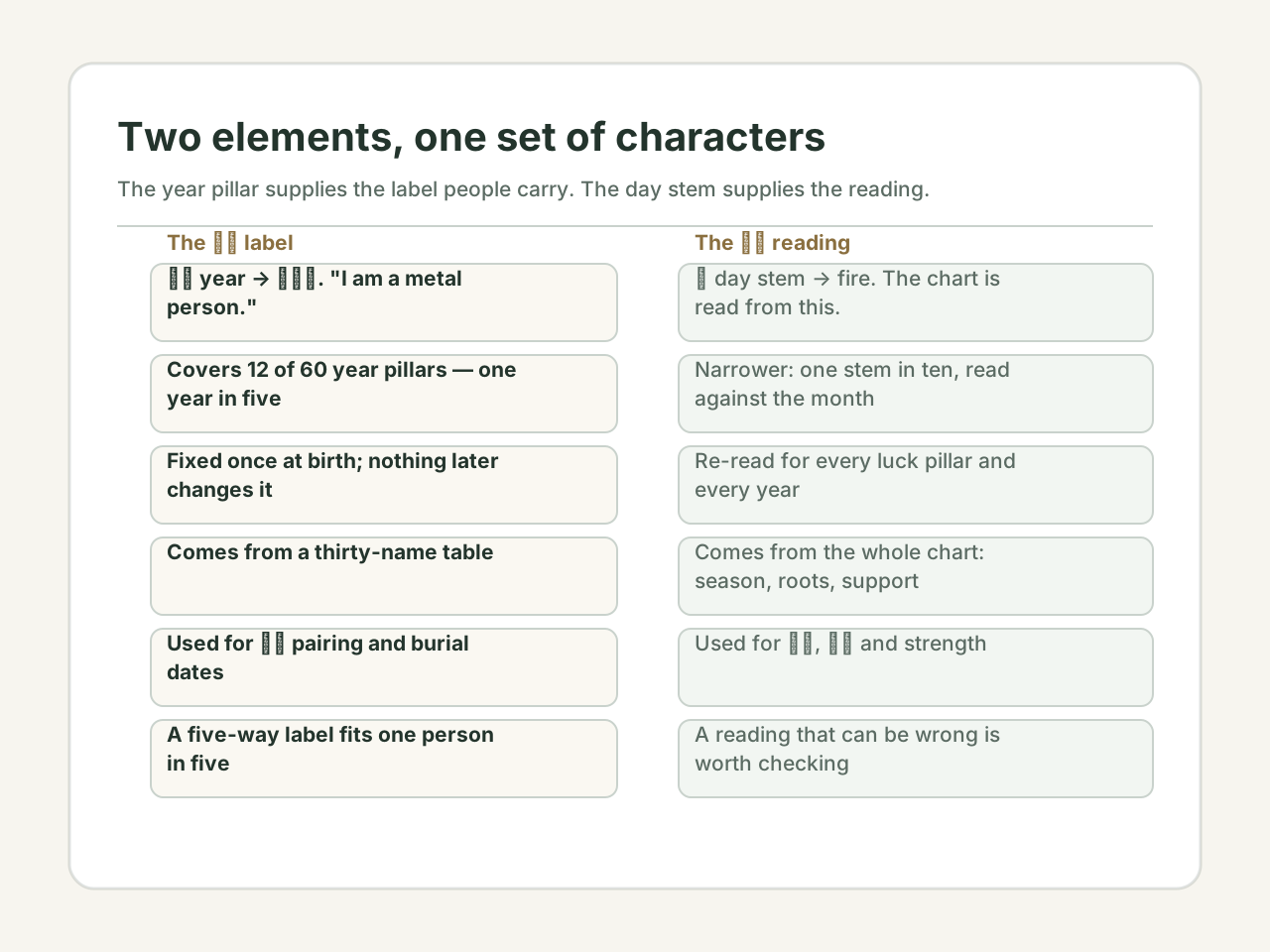
The trouble starts on the next step, when the label is used to pick a colour, a facing direction, a piece of jewellery, or an element to top up. Those decisions are normally made from a different part of the chart: the day stem, the 日主. 纳音 and the day master are two separate assignments of element to the same four characters, and nothing requires them to agree.
The table is below, with a count of how rarely 纳音 matches the elements you can read off the characters, and one chart where the two layers disagree by construction.
Thirty names for sixty pillars
纳音 (nàyīn) attaches a two-character image and an element to each of the sixty stem-branch pairs. Each name covers two consecutive pairs, so sixty collapse to thirty. The whole table is below, with the pillar pairs written beside each name so it can be used as a lookup.
Two structural facts are worth keeping. The table is exactly balanced — six names per element, twelve pillars per element — so no element is favoured by how the table was built. And the image cannot be derived from the characters in any way a reader can use: 甲子 does not contain 海中金. Every calculator that prints 纳音 is running this same thirty-row lookup.
| Metal (6) | Wood (6) | Water (6) | Fire (6) | Earth (6) |
|---|---|---|---|---|
| 海中金 甲子·乙丑 | 大林木 戊辰·己巳 | 涧下水 丙子·丁丑 | 炉中火 丙寅·丁卯 | 路旁土 庚午·辛未 |
| 剑锋金 壬申·癸酉 | 杨柳木 壬午·癸未 | 泉中水 甲申·乙酉 | 山头火 甲戌·乙亥 | 城头土 戊寅·己卯 |
| 白蜡金 庚辰·辛巳 | 松柏木 庚寅·辛卯 | 长流水 壬辰·癸巳 | 霹雳火 戊子·己丑 | 屋上土 丙戌·丁亥 |
| 沙中金 甲午·乙未 | 平地木 戊戌·己亥 | 天河水 丙午·丁未 | 山下火 丙申·丁酉 | 壁上土 庚子·辛丑 |
| 金箔金 壬寅·癸卯 | 桑柘木 壬子·癸丑 | 大溪水 甲寅·乙卯 | 覆灯火 甲辰·乙巳 | 大驿土 戊申·己酉 |
| 钗钏金 庚戌·辛亥 | 石榴木 庚申·辛酉 | 大海水 壬戌·癸亥 | 天上火 戊午·己未 | 沙中土 丙辰·丁巳 |
The element you can read off the characters is not this one
A pillar already carries two visible elements: the stem's and the branch's. 纳音 adds a third. Counting all sixty pairs against the standard stem and branch elements gives a blunt result.
Sixteen of sixty have a 纳音 element equal to the stem's. Twelve of sixty equal the branch's. Thirty-three of sixty differ from both. Exactly one pair — 癸亥, 大海水 — has all three the same.
So 纳音 is not a summary of the pillar. It is an independent assignment printed beside it, which is why a chart can show 丙 (fire) sitting on 子 (water) with 涧下水 written next to it, and none of those three statements is an error. They are three different questions answered in the same row.
One chart carries four of them
Every pillar has its own 纳音, so a full chart carries four. Across 1,600 charts sampled between 1950 and 2049 — four months and four hours for each year — the four pillars held one distinct 纳音 element 1.2% of the time, two 21.5%, three 56.3%, and four 21.1%.
In other words, in roughly 78% of charts the sentence "my element is X" is ambiguous until you name the pillar. When nobody names one, the convention is the year pillar: 年命, the element of the year you were born in.
That is a year-level fact and it behaves like one. Two people born eleven months apart in the same year share it exactly, however different their charts are.
A worked example: 12 February 1984, 12:00
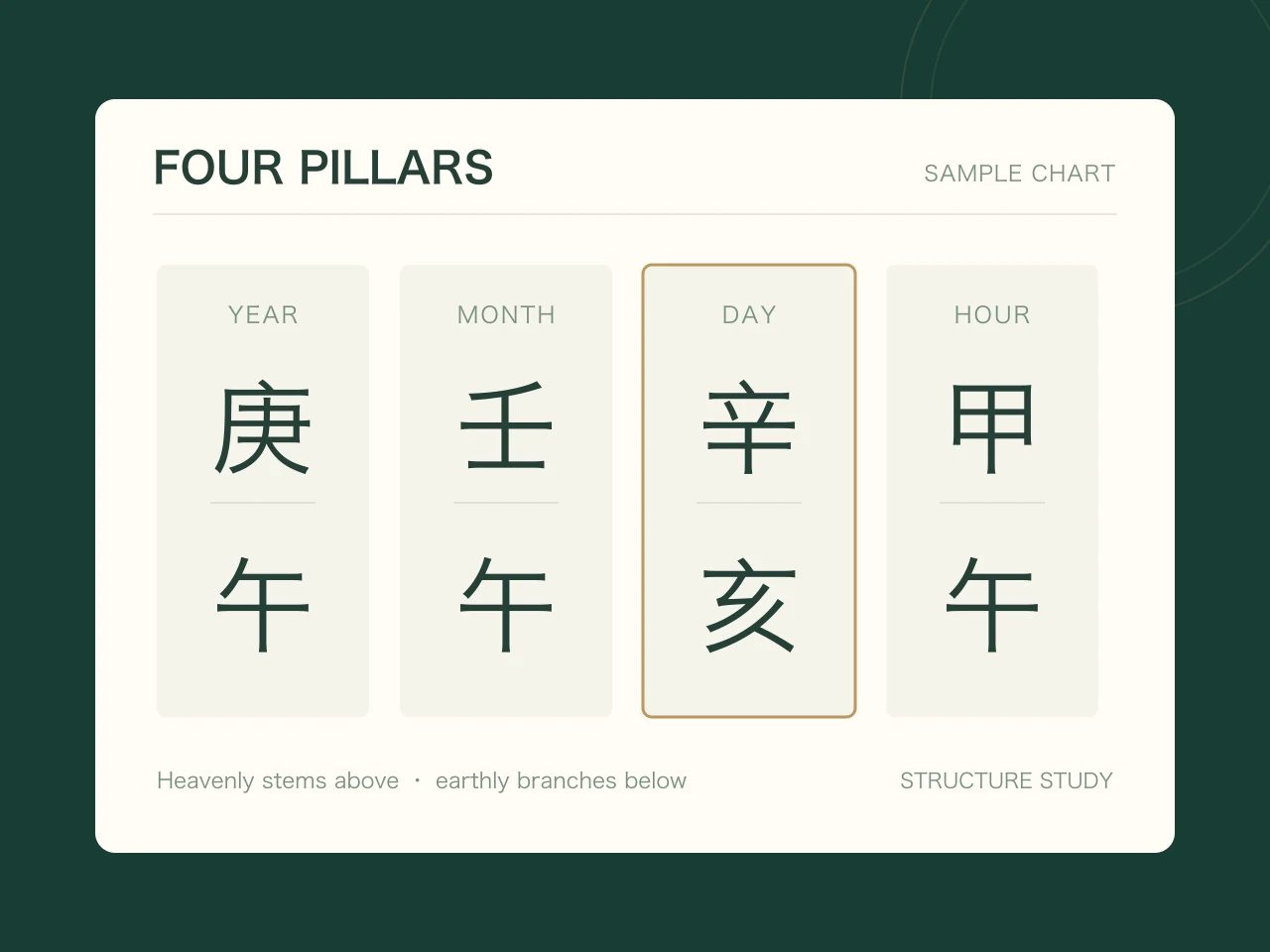
Born on 12 February 1984 at noon in Beijing, the four pillars are 甲子 丙寅 丙子 甲午. The day master is 丙, fire. The four 纳音 read:
Three things follow. The label says metal while the day master is fire, and neither is a mistake. The day pillar contradicts itself by design, because its stem and its 纳音 are answering different questions. And the chart really does contain metal, twice, so "metal person" is not even wrong about the chart — it is true of two rows out of four and silent about which row governs.
Which row governs? In the mainstream 八字 method, the day stem does. 纳音 is not used to set strength, 十神 or 用神; it is not part of that calculation at all.
- Year 甲子 → 海中金, metal. This is the row the folk label reads, and why the person is "a metal person".
- Month 丙寅 → 炉中火, fire.
- Day 丙子 → 涧下水, water — while the stem of that same pillar is 丙, fire.
- Hour 甲午 → 沙中金, metal.
Where 纳音 is genuinely used
None of this makes 纳音 a decoration. It has documented uses, and all of them sit at the level of the year.
The common thread is that 纳音 answers "what is this year made of", not "what does this person need". It has no concept of 用神 — of whether a chart is short of an element or already carries too much of it. A table that assigns an element to a year cannot tell you whether that element helps the person born in it.
- 年命 pairing in marriage matching, where two people are compared by the element and animal of their birth years.
- Burial and date-selection practice, where 纳音 supplies the element attached to a chosen day or direction.
- The sixty-jiazi tables printed in almanacs, where the name labels the year rather than describing a person.
Why a five-way label feels personal
Five elements, each covering twelve of the sixty year pillars, means each label fits about one person in five. A statement true of twenty per cent of everyone will feel accurate to almost anyone who hears it, particularly when it is phrased as an identity rather than as a description.
Psychology has a name for that: the Barnum effect, the tendency to accept broad, favourable descriptions as personally accurate. It is not evidence that 纳音 is wrong. It is evidence that agreement is not confirmation, and it explains how a label survives while separating years rather than people.
What to do with your own label
Six steps, in order. None of them costs anything.
- Find out which pillar the label came from. If nobody said, assume the year pillar — that is the convention.
- Look up all four 纳音 in the table above and write them down. Most charts give you two or three different elements.
- Look up the day stem. If it is not the element in your label, you are holding two answers to two different questions, and there is nothing to reconcile.
- If you are choosing a colour, a direction or an object, the 八字 method would use 用神 derived from the whole chart, not 纳音. Without a full chart reading, treat the label as folklore and spend nothing on it.
- If you are screening a date by 年命, keep the resolution in mind: it separates birth years, not people.
- Stop rule: if a purchase is being justified by "my element needs it", that is the moment to stop. The label was never a measurement of a deficit.
Where the boundary sits
None of this makes 纳音 fake, and the people who used it historically were not mistaken. What it cannot do is supply a 用神, which needs a full chart and a stated method, or predict an outcome.
What it can support is narrower and checkable: the label most people carry is a year-level lookup, the chart is read from the day stem, and the two are allowed to disagree. Once you know which one you are holding, the confusion stops being about which answer is right and becomes about which question you asked.
Disclaimer: This content is for informational and cultural reference purposes only. It does not constitute professional medical, legal, financial, or psychological advice. Readers should exercise their own judgment and consult qualified professionals for specific concerns.
Sources and review basis
Traditional references explain historical vocabulary and context. Official practical sources support only the observable safety, comfort, or environmental points noted in the article; they do not validate metaphysical claims.
Traditional reference
Sanming Tonghui (三命通会)Wikisource digital text · Accessed 2026-07-14
A historical compilation used to cross-check traditional BaZi concepts; it is not scientific validation.
Traditional reference
Yuanhai Ziping (渊海子平)Wikisource digital text · Accessed 2026-07-14
A classical source for Four Pillars terminology, element relationships, and the Day Master framework.
Practical source
APA Dictionary of Psychology: Barnum effectAmerican Psychological Association · Accessed 2026-07-14
A psychology reference for why broad, favourable personality descriptions can feel personally accurate. It does not evaluate BaZi calculations themselves.