Skip to content
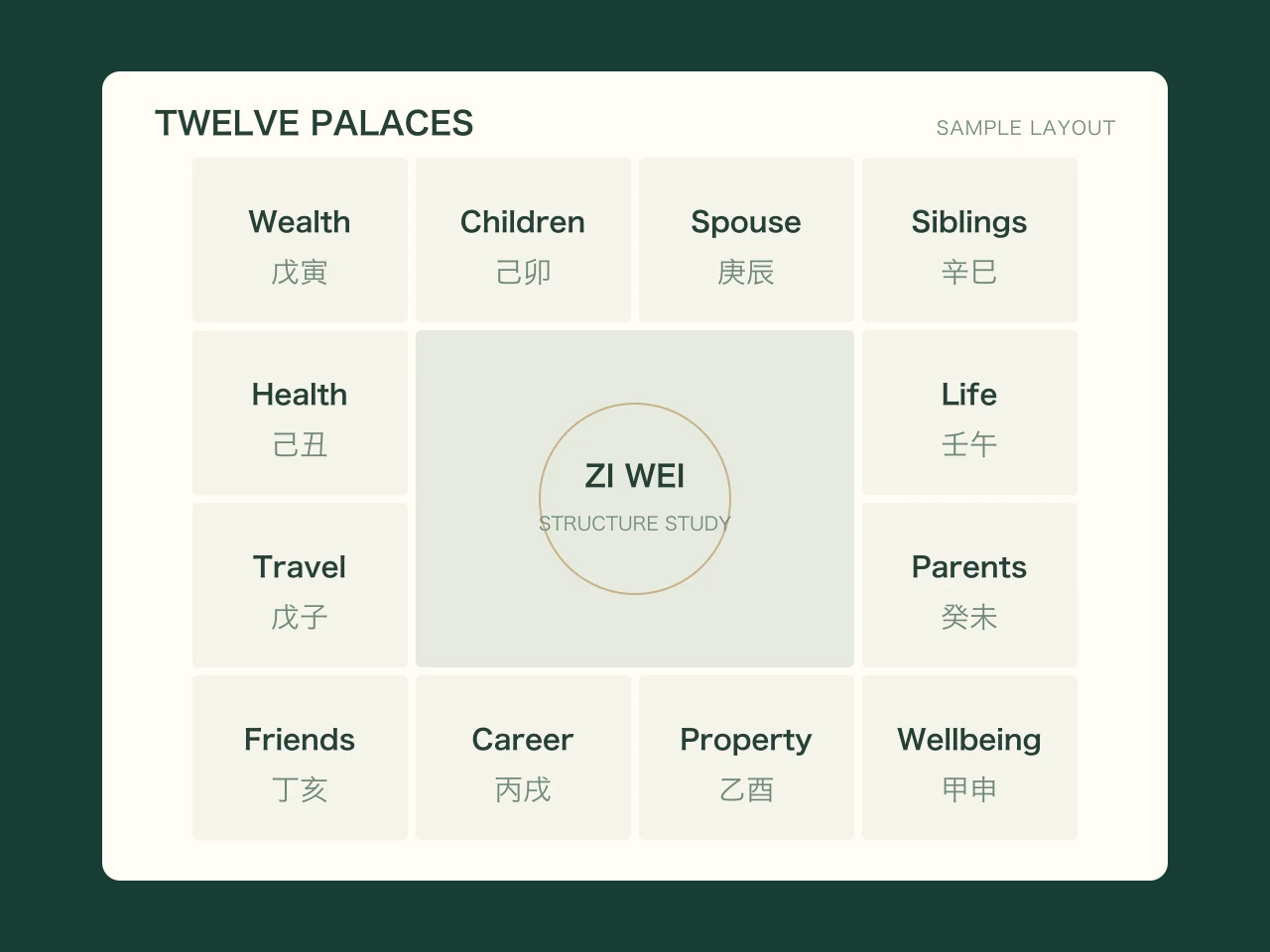
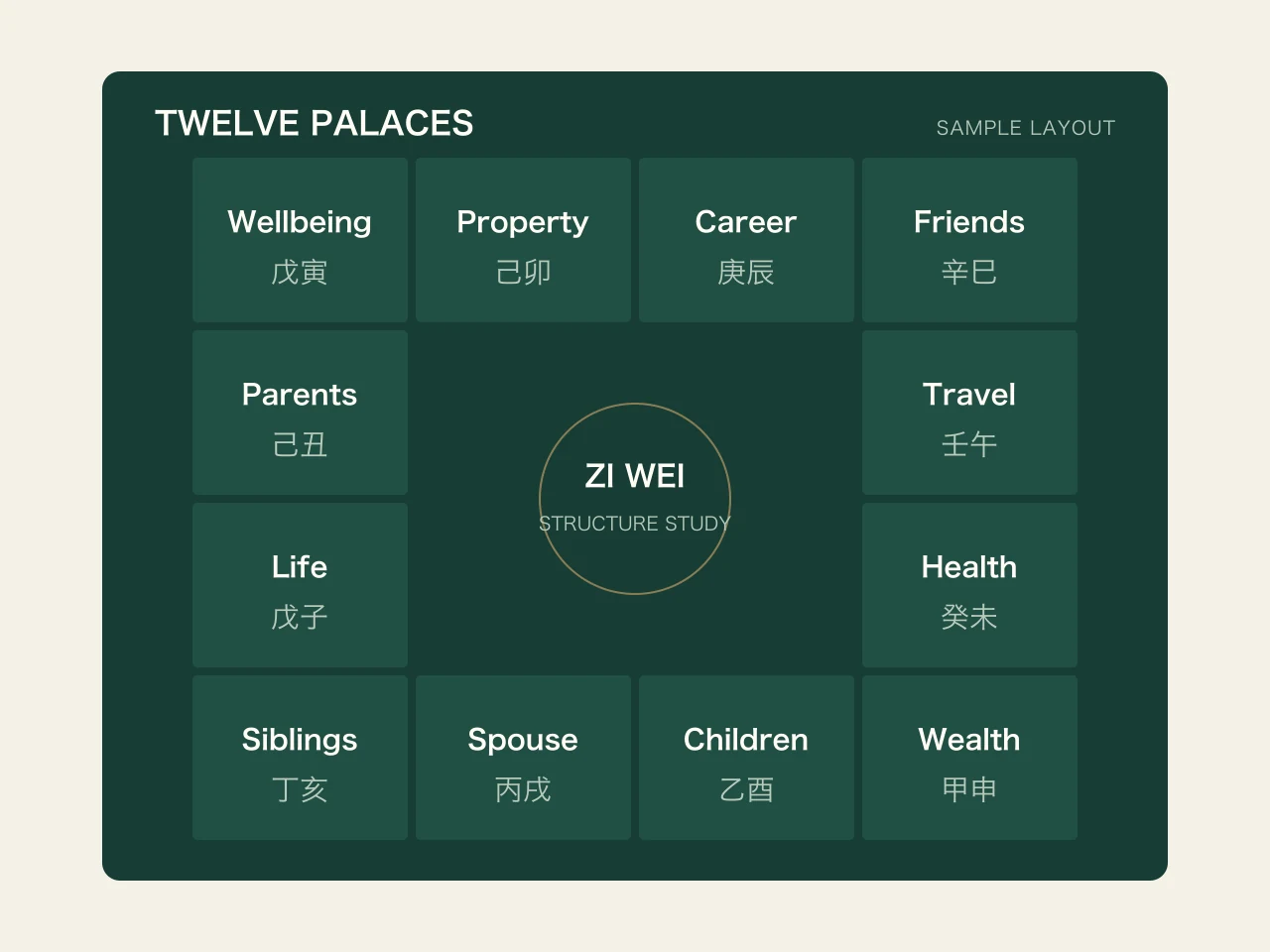
A sample Zi Wei Dou Shu layout with twelve named palaces around a central panel.

Chinese Astrology

Zi Wei Dou Shu Chart

Enter a Gregorian birth date, time branch, and traditional chart-direction rule to see 12 palaces, stems, branches, stars, transformations, body palace, and decade ranges without personality or event predictions.

Before you start

Prepare these details to see these results

Check which details are required before entering personal information. If something is missing, the page explains the effect instead of guessing for you.

What to prepare

  1. 1

    Birth date (solar)

    Builds the lunar conversion and basic twelve-palace structure.

  2. 2

    Birth time

    Determines time-dependent palace and star placements.

  3. 3

    Traditional chart-direction rule

    Sets the traditional chart-direction rule.

What you will see

  1. 1

    Complete twelve-palace chart

  2. 2

    Palaces, stems, branches, and body-palace marker

  3. 3

    Star, transformation, and decade details

What you need before you start

Zi Wei Dou Shu needs a Gregorian birth date, a traditional time period, and a sex option. The page shows chart details without judging personality or predicting events.

Birth date (solar)

required

date required

Builds the lunar conversion and basic twelve-palace structure.

Example: 1990-06-15

What to enter: Must be a valid Gregorian date no later than today.

If you leave it out: The chart cannot be generated.

Birth time

required

choose required

Determines time-dependent palace and star placements.

Example: Early Zi (00:00-01:00)

What to enter: Select one traditional time branch.

If you leave it out: A complete chart cannot be generated.

Traditional chart-direction rule

required

choose required

Sets the traditional chart-direction rule.

Example: Female-rule option

What to enter: Select one option; this is not a finding about gender identity.

If you leave it out: The chart cannot be generated.
How it works

This tool uses the details you enter on the page to produce a result. It is free to use, and your information is not sent to a third-party AI service.

What this page calculates

A Gregorian date, birth-time branch, and required two-option traditional chart-direction rule produce the twelve palaces, palace stems and branches, body-palace marker, stars, transformations, and decade ranges.

These are traditional chart details. The page does not convert them into personality, ability, health, wealth, relationship, or future-event conclusions.

What each input changes

The date supplies the calendar conversion. The birth-time branch changes time-dependent palace and star placement. The two-option traditional rule sets chart direction; it is not a finding or statement about the user’s gender identity.

The page does not collect birthplace, historical time zone, daylight-saving status, longitude, or true solar time. A boundary case therefore requires multiple candidate charts rather than a confident hidden default.

How to verify the palace grid

Check the central birth record before inspecting each palace. Keep the chosen chart method and every detail that changes between plausible times.

  • Keep the date, uncertain time range, birthplace, historical time zone, and traditional chart-direction rule.
  • Compare each palace name, stem, branch, body-palace marker, and complete star list.
  • Mark every star, transformation, decade range, and age that changes across candidate times.
  • Retain only stable chart details and do not select the chart with the most flattering wording.

What star details cannot prove

Palace names, star names, brightness, transformations, decade ranges, and ages belong to a traditional classification system. They cannot establish personality, skill, psychological state, diagnosis, income, career performance, relationship quality, or whether an event will occur.

This page therefore displays chart details without generating personality summaries or annual predictions.

Privacy and stop conditions

Your birth date, time branch, and chart-direction choice are used only for the current chart. They are not saved after you refresh or close the page and are not sent to a third-party AI service.

Stop using the chart whenever a medical, investment, employment, legal, consent, relationship-safety, or emergency decision depends on one of its details. Use records, direct communication, and qualified advice from the relevant domain instead.

Why does birth time matter for a Zi Wei chart?

The birth-time branch changes palace and star placement. If the time is unknown or crosses a boundary, generate every candidate chart and mark differences; never infer a precise time from a personality description.

Can one palace or star predict a specific event?

No. This page does not turn a palace, star, transformation, decade range, or age into an event prediction or probability.

Why does the form ask for a male-rule or female-rule option?

Traditional Zi Wei Dou Shu uses this choice for parts of chart direction. It is used only for charting and is not a statement about gender identity, personality, or social role.

What happens if my birth time is approximate?

Palace and star placement can change across a time boundary. Test the plausible time ranges, keep both charts when needed, and avoid precise conclusions that depend on one uncertain palace. Do not infer a private birth time from personality descriptions.

How should I compare charts across a possible birth-time boundary?

Generate every plausible chart using the same calendar, time-zone, and conversion method. Mark which palaces, major stars, transformations, or decade ranges change, then restrict interpretation to features that remain stable. Keep the uncertainty beside every time-dependent statement. Save all candidate charts and the unresolved time range instead of overwriting them with a preferred result. Do not choose the chart that sounds more flattering and do not infer a private birth time from personality language. If an important decision depends on one changing palace, the chart is too uncertain to support that use.

Keep reading

Related articles

Try next

Related tools