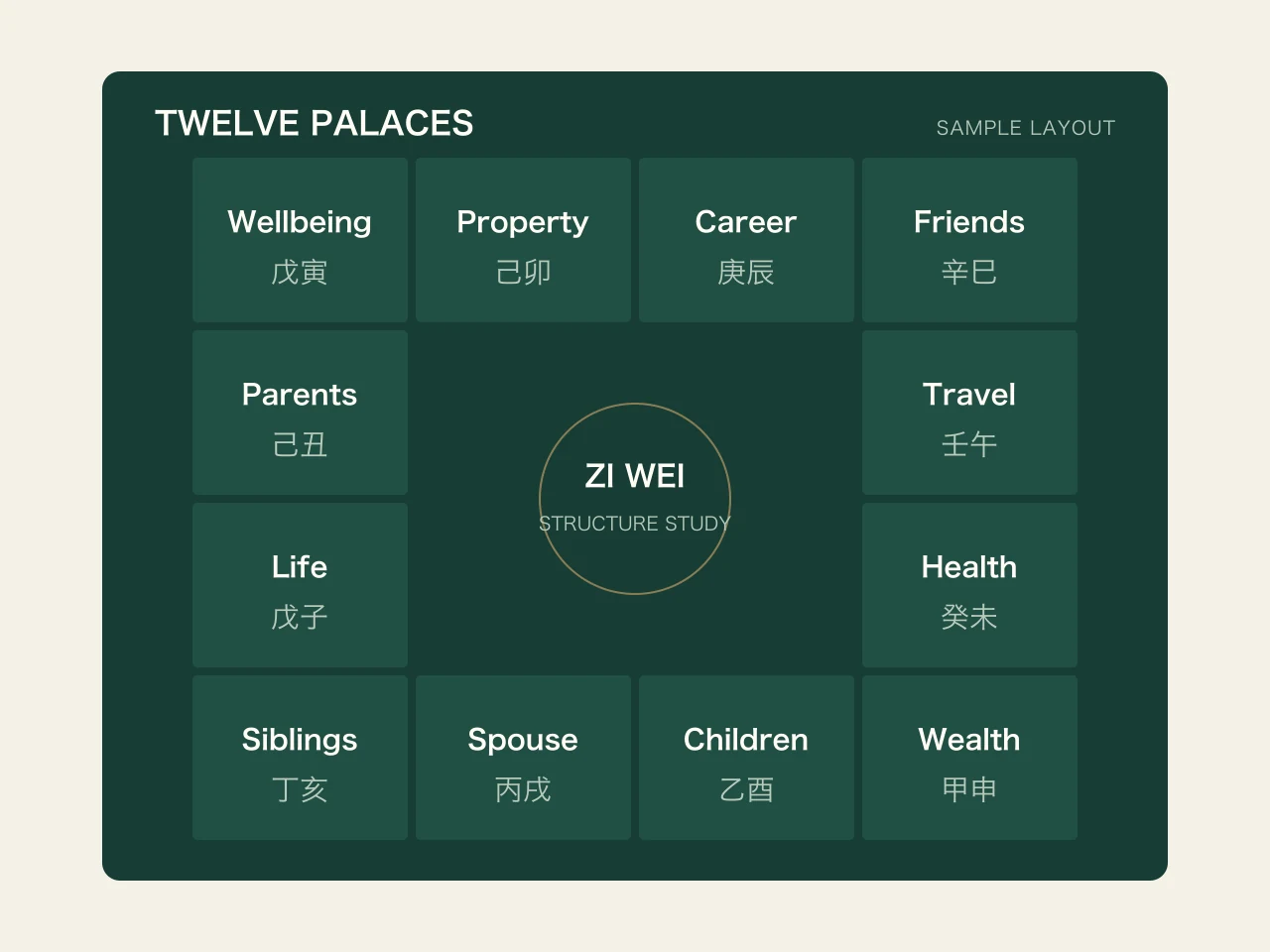
Fourteen main stars, twelve possible layouts
Popular writing on Zi Wei Dou Shu treats star combinations as ingredients: pick two, describe the dish. The system does not work that way. There are fourteen main stars (主星), and their positions are not chosen independently — once 紫微 lands in a palace, every other main star follows from fixed offsets.
The 紫微 series runs six stars: 紫微, 天机, 太阳, 武曲, 天同, 廉贞, laid out from 紫微 by the traditional step pattern. The 天府 series runs eight: 天府, 太阴, 贪狼, 巨门, 天相, 天梁, 七杀, 破军. 天府 is fixed by mirror symmetry to 紫微 across the 寅–申 axis, and the remaining seven follow in sequence.
The result is that there are only twelve possible main-star layouts. Every chart is one of them. A combination is therefore not a pairing someone assembled; it is a position inside one of twelve fixed arrangements. What makes two charts differ is the 命宫, the auxiliary stars, and the transformations — not the main stars.
What each star is actually for
Every main star carries a 化气 — a one-word function it performs — and that word is more useful than any personality adjective attached to the star. The table gives the working set.
| Star | Series | 化气 | What the function covers |
|---|---|---|---|
| 紫微 | 紫微 | 尊 | Central authority; the point others orient around |
| 天机 | 紫微 | 善 | Calculation and planning; motion before action |
| 太阳 | 紫微 | 贵 | Public standing; what is visible and given out |
| 武曲 | 紫微 | 财 | Execution; effort converted into substance |
| 天同 | 紫微 | 福 | Ease, and the capacity to enjoy what already exists |
| 廉贞 | 紫微 | 囚 | Constraint and rule; competitive edge under pressure |
| 天府 | 天府 | 库 | Storage and management; the container, not the contents |
| 太阴 | 天府 | 富 | Accumulation over time; quiet recurring gain |
| 贪狼 | 天府 | 桃花 | Appetite — for people, experience, sensation, variety |
| 巨门 | 天府 | 暗 | The obscured and the spoken; argument, analysis, suspicion |
| 天相 | 天府 | 印 | Endorsement and mediation; service to another authority |
| 天梁 | 天府 | 荫 | Shelter and seniority; protection that comes with rank or age |
| 七杀 | 天府 | 将 | Direct force applied to a single objective |
| 破军 | 天府 | 耗 | Consumption and replacement; clearing before rebuilding |
Why these are functions rather than traits
Notice how many entries describe an operation. 天府 is a container. 破军 is a cost. 天相 is an endorsement. 巨门 is what has been obscured or what has to be argued.
Read that way, a combination describes a mechanism, which means it can be checked against how someone actually operates. 'You are a natural leader' cannot be checked. 'Your execution is clean but you replace things before they pay off' can be, and the difference is the whole reason the 化气 vocabulary is worth learning.
Brightness, and why the same star is not the same star
Every main star has a brightness grade in each of the twelve branches. The full scale has seven steps: 庙, 旺, 得, 利, 平, 不, 陷. Many popular treatments collapse this to 庙旺, 利平, and 陷闲, which loses the middle and is where a good share of misreading starts.
The grade is not a quality score. It describes how freely the star's function operates in that position. 武曲 at 庙 executes cleanly; 武曲 at 陷 still executes, but the execution costs more and tends to arrive late or through friction. The function does not change. The resistance does.
This is the most common error in reading combinations: naming the stars and stopping. Two charts with 武曲破军 in the same palace can read very differently depending on grade, and grade is a property of the branch, not of the pairing.
Auxiliary stars do more differentiating than main stars
Since there are only twelve main-star layouts, whatever makes a chart individual has to come from elsewhere. It comes from the auxiliary stars, whose positions depend on birth month, hour, year stem, and year branch — inputs that vary far more than the layout does.
The 六吉 (左辅, 右弼, 文昌, 文曲, 天魁, 天钺) stabilise and extend a main star's function. The 六煞 (擎羊, 陀罗, 火星, 铃星, 地空, 地劫) test it. 禄存 marks where something is held and, by the placement rule, is always flanked by 擎羊 and 陀罗 — so the palace that holds a resource also carries the cost of defending it. 天马 adds movement, and when it meets 禄存 the pair reads as 禄马交驰.
A useful order of operations: read the palace, then the main star and its grade, then the auxiliary stars, then the transformations. Reversing that order — starting from a star name and hunting for a palace to put it in — is how combination reading goes wrong.
One layout, two people
Take 紫微 in 卯. That single placement fixes everything: 天府 in 丑, 天机 and 太阴 in 寅, 紫微 and 贪狼 in 卯, 巨门 in 辰, 天相 in 巳, 天梁 in 午, 廉贞 and 七杀 in 未, 天同 in 戌, 武曲 and 破军 in 亥.
Now put one person's 命宫 in 亥 and another's in 卯. The first has 武曲破军 as the self palace, with 紫微贪狼 in the career palace and 廉贞七杀 in the wealth palace. The second has 紫微贪狼 as the self palace, with 武曲破军 in the wealth palace and 廉贞七杀 in the career palace, and 天府 in the spouse palace. Identical stars in identical positions, and almost nothing in common in how the two charts read: the same three pairs are simply rotated one place, and the palace that carries each one changes what it means.
Add the year stem and the divergence widens. In a 甲 year the transformations are 廉贞化禄, 破军化权, 武曲化科, 太阳化忌: both stars in the first person's self palace are transformed, one toward control and one toward reputation, while the wealth palace receives 化禄 and the parents palace receives 化忌. In a 乙 year the same layout puts 天机化禄 and 太阴化忌 together in 寅, 紫微化科 in 卯, 天梁化权 in 午 — a different set of load-bearing points entirely.
What a combination can and cannot tell you
A combination describes a mechanism and its resistance. That is genuinely useful: it predicts which parts of a role will be easy and which will cost, and it holds up when checked against how someone works.
It does not predict outcomes. 武曲破军 in the self palace describes someone who builds and then replaces; it does not say the replacement succeeds, or when, or at what cost. Two people with that pairing and different auxiliary stars, different transformations, and different decades will live visibly different versions of it.
A test worth applying to any combination reading: could this sentence be false? 'You have strong leadership potential' cannot be falsified and therefore carries no information. 'Your execution is clean but you replace things before they pay off' can be checked against a history and can be argued with. Only the second kind is worth the time.
Disclaimer: This content is for informational and cultural reference purposes only. It does not constitute professional medical, legal, financial, or psychological advice. Readers should exercise their own judgment and consult qualified professionals for specific concerns.
Sources and review basis
Traditional references explain historical vocabulary and context. Official practical sources support only the observable safety, comfort, or environmental points noted in the article; they do not validate metaphysical claims.
Traditional reference
Zi Wei Dou Shu Quanshu (紫微斗數全書)Wikisource digital text · Accessed 2026-10-14
A classical source for the twelve palaces, the main stars, and the four transformations that Zi Wei Dou Shu terminology is built on.
Practical source
APA Dictionary of Psychology: Barnum effectAmerican Psychological Association · Accessed 2026-07-14
A psychology reference for why broad, favourable personality descriptions can feel personally accurate. It does not evaluate BaZi calculations themselves.