Skip to content
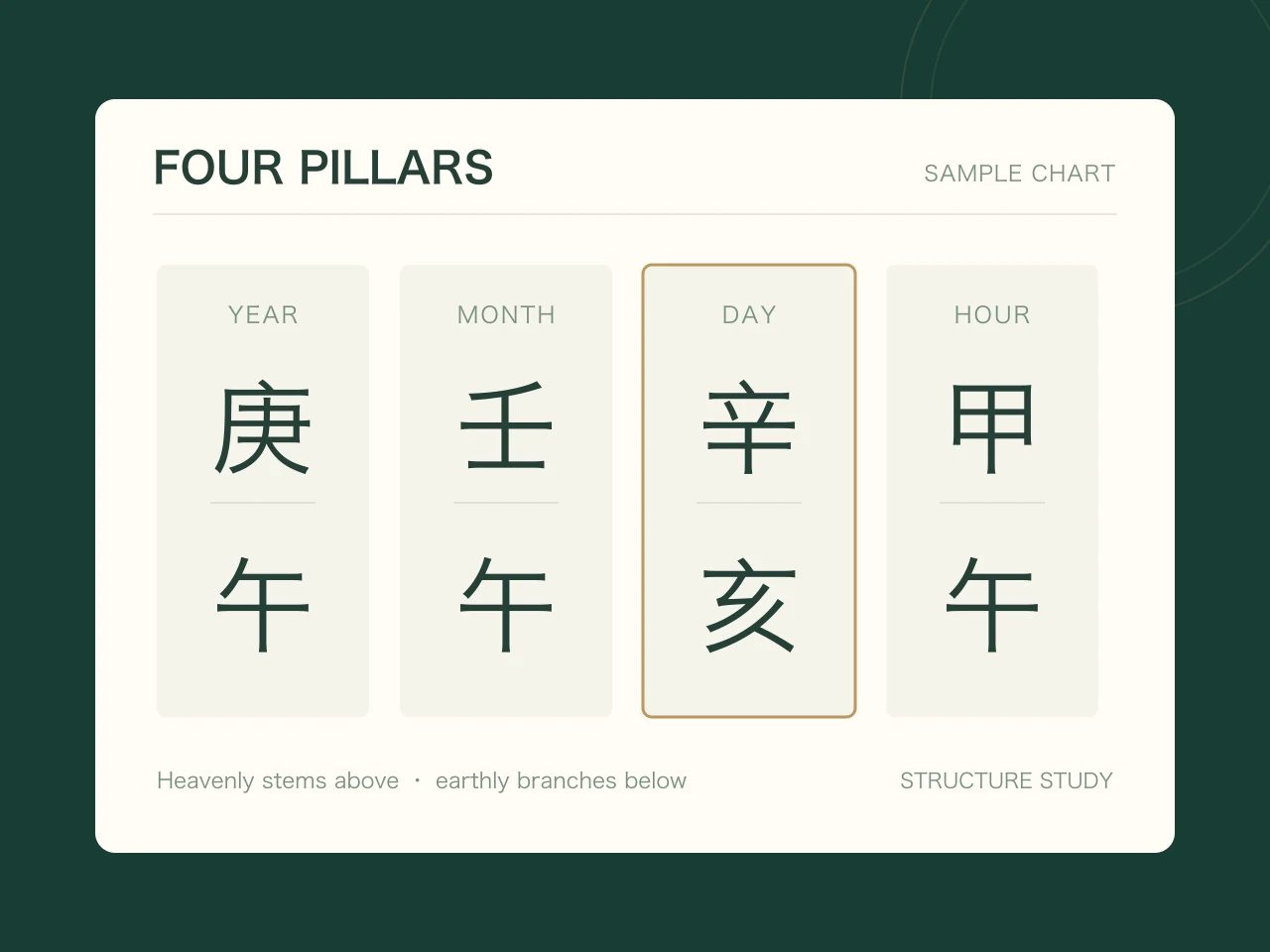
A sample Four Pillars chart with the year, month, day and hour stems above their branches.

BaZi

Bone Weight Song Calculator and Source Text

Reproduce the folk Bone Weight Song lookup from four visible table values, inspect the converted lunar fields, and read the matched historical verse with explicit limits instead of treating it as a life forecast.

Before you start

Prepare these details to see these results

Check which details are required before entering personal information. If something is missing, the page explains the effect instead of guessing for you.

What to prepare

  1. 1

    Birth date

    Establishes the calendar and timing data used by the calculation.

  2. 2

    Birth time

    Adds the time pillar or time-dependent detail when the method supports it.

What you will see

  1. 1

    Solar-to-lunar calendar conversion

  2. 2

    Traditional 60-cycle year, lunar month/day, and 12 time-period weight tables

  3. 3

    Matched historical verse with an explicit content warning

What you need before you start

Before starting, confirm that dates, times, and other details are accurate, and note which items are required or optional. Do not replace missing required information with a guess.

Birth date

required

date required

Establishes the calendar and timing data used by the calculation.

Example: 1990-06-15

What to enter: Use a valid calendar date that is not in the future.

If you leave it out: The tool cannot produce a reliable result without this required value.

Birth time

required

time required

Adds the time pillar or time-dependent detail when the method supports it.

Example: 12:00

What to enter: Use a valid local time; leave it blank only when this item is optional.

If you leave it out: The tool cannot produce a reliable result without this required value.

How it works

This tool uses the details you enter on the page to produce a result. It is free to use, and your information is not sent to a third-party AI service.

What the Bone Weight Song records

The Bone Weight Song is a folk lookup method. It maps the sexagenary lunar year, lunar month, lunar day, and two-hour birth period to four fixed table values, adds them, and uses the total to find a historical verse. The units called liang and qian are table units, not a body measurement or a scale of life quality.

Circulating verse collections contain wording differences and fatalistic claims about poverty, lifespan, family, illness, rank, and wealth. This page preserves the matched text for cultural study. It does not rewrite the verse as a modern health, financial, relationship, education, or career finding.

How to reproduce the calculation step by step

Keep the input, calendar conversion, and every lookup value together. A verse by itself cannot reveal where two calculators differ.

  • Enter a valid Gregorian date and the clock time at the birthplace. The tool does not convert a time zone, daylight-saving rule, longitude, or true solar time.
  • The entered civil date and time are converted to the lunar year, month, day, and hour branch used for the result.
  • Look up the sexagenary-year, lunar-month, lunar-day, and hour-branch values in four fixed tables and preserve each value.
  • Add the four values, round the displayed total to one decimal place, and use that key to retrieve the historical verse.
  • Save the birth details and calendar method, then check a boundary case with another calendar tool before comparing interpretations.

Which assumptions can change the table entry

The addition is simple, but the original date, calendar convention, clock boundary, and source-table edition can change the matched key.

Source of differenceReview action
Gregorian and lunar dates are mixedPreserve the original Gregorian input and the converted lunar fields; do not type a lunar date into the Gregorian field.
Birth close to 23:00 or an hour boundaryKeep the exact local clock time and compare the declared day-change and hour-branch conventions.
Time zone or daylight saving is uncertainResolve the historical local clock time first; this tool does not infer or correct it.
Leap-month handling differsRecord the converted month and the rule used by each calculator before comparing totals.
Verse wording or table edition differsTreat it as a source-history difference; do not select the more flattering entry as fact.
One total is largerUse totals only as lookup keys. A larger value is not evidence of a better life or lower risk.

How to handle harmful claims in the source verse

When a verse says that a person will be short-lived, ill, poor, separated, powerful, or inevitably wealthy, label it as pre-modern folk narrative. The lookup table has not been calibrated as a measure or probability for any of those outcomes.

Stop reading if the text causes distress. Use records and qualified help from the relevant domain for health, safety, money, law, education, work, or relationships. The verse must never delay care, justify discrimination, pressure another person, or authorize an irreversible decision.

Will this match the older calculator?

No. The older calculator estimated a value from the Gregorian month and day. This page converts to the lunar calendar and then uses four traditional lookup tables. Circulating table and verse editions can differ, so the page does not claim that one edition is the only correct text.

Does a higher bone weight mean a better or guaranteed life?

No. Bone weight is a compact folk method with historical verses, not a scientific measure or a fixed verdict. Read the calculation as cultural material and do not use it for health, financial, relationship, or career decisions.

Why can the same birth date produce a different bone-weight result?

The traditional table depends on the converted lunar year, month, day, and time branch. A time-zone, calendar, or hour-branch difference changes the total. Keep the conversion record and treat the verse as historical folk material, not a measurement of ability, health, status, or future success.

What calculation record should I keep?

Save the entered Gregorian date and local time, birthplace or time zone, the converted lunar year, month, day, and hour branch, every table weight, and the final total. Record the tool version and whether the time was approximate. This lets another calculator reproduce the number and shows exactly where a disagreement begins. Do not keep only the verse, because the verse cannot reveal a calendar or boundary error. The record remains a folk-calculation reference and does not measure ability, health, social status, or future success.

Try next

Related tools