Skip to content
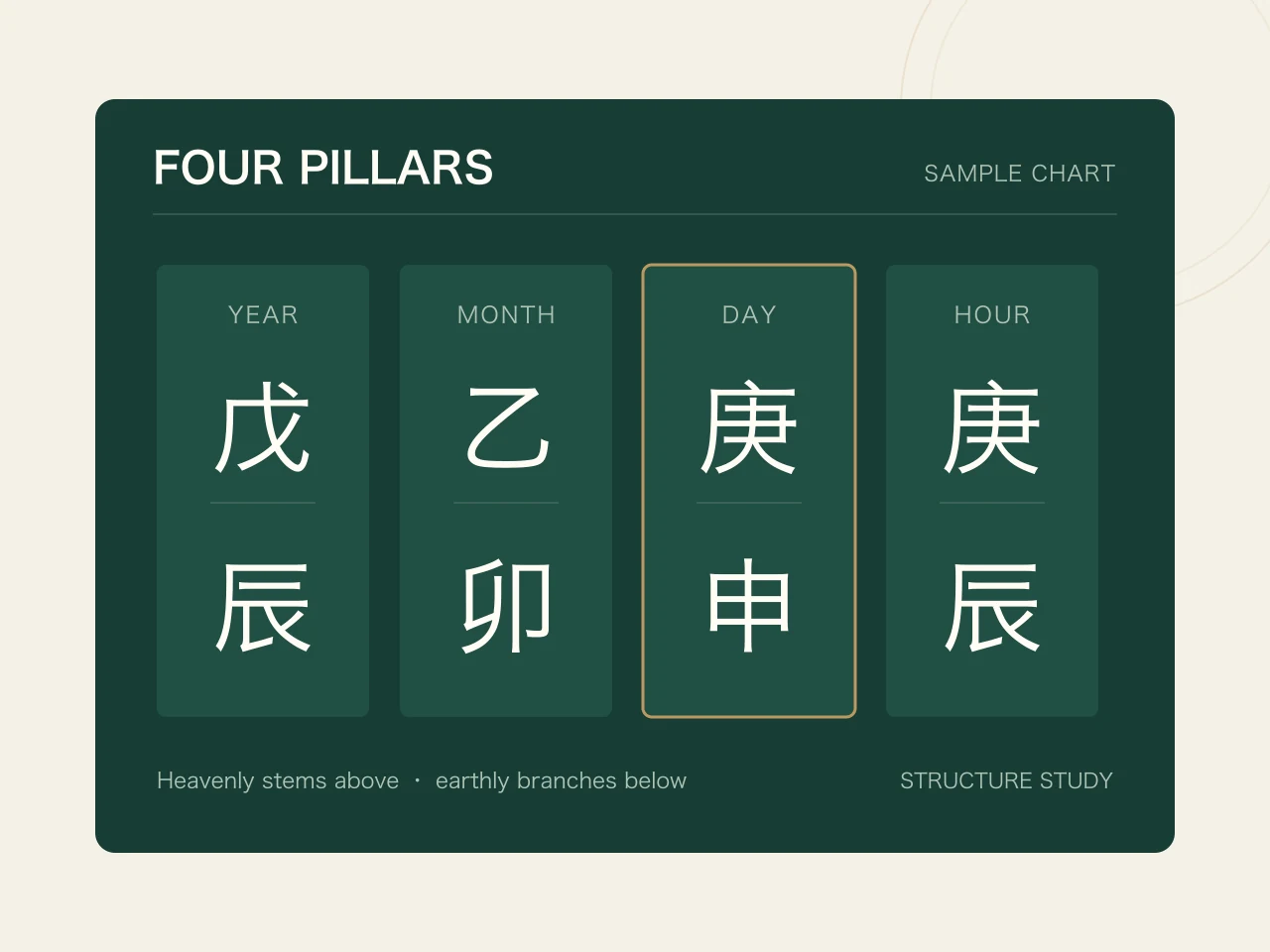
A second sample Four Pillars chart with its day pillar highlighted.

BaZi

Life Stage Reflection Chart

A visual guide to traditional BaZi age stages for recording yearly themes beside real calendar events, responsibilities, and observable changes.

Before you start

Prepare these details to see these results

Check which details are required before entering personal information. If something is missing, the page explains the effect instead of guessing for you.

What to prepare

  1. 1

    Name

    Labels the profile so the result remains understandable and distinguishable.

  2. 2

    Gender

    Applies method-specific rules and keeps the report wording appropriate.

  3. 3

    Birth date

    Establishes the calendar and timing data used by the calculation.

What you will see

  1. 1

    Birth profile input

  2. 2

    Age 1-100 K-line visualization

  3. 3

    Bull and bear period detection

What you need before you start

Before starting, confirm that dates, times, and other details are accurate, and note which items are required or optional. Do not replace missing required information with a guess.

Name

required

type in required

Labels the profile so the result remains understandable and distinguishable.

Example: Alex

What to enter: Remove accidental extra spaces and enter only the information requested.

If you leave it out: The tool cannot produce a reliable result without this required value.

Gender

choose optional

Applies method-specific rules and keeps the report wording appropriate.

Example: Female

What to enter: Choose one of the listed values; do not infer another person’s private information.

If you leave it out: The tool will continue with reduced detail and will not infer the missing value.

Birth date

required

date required

Establishes the calendar and timing data used by the calculation.

Example: 1990-06-15

What to enter: Use a valid calendar date that is not in the future.

If you leave it out: The tool cannot produce a reliable result without this required value.

Birth time

required

choose required

Adds the time pillar or time-dependent detail when the method supports it.

Example: Zi (23:00-01:00)

What to enter: Choose one of the listed values; do not infer another person’s private information.

If you leave it out: The tool cannot produce a reliable result without this required value.

How it works

This tool uses the details you enter on the page to produce a result. It is free to use, and your information is not sent to a third-party AI service.

Compare the curve with a real calendar

Mark actual deadlines, travel, health needs, family commitments, and recovery periods beside the symbolic curve. Use peaks and quieter segments only as prompts for preparation and review, not as forecasts. Revisit the chart monthly and record where reality disagreed; do not move a necessary medical, legal, financial, or work action solely because a line rises or falls.

How to read a rhythm chart

The age-stage chart is a visual arrangement of traditional timing labels, not a probability curve. Its axes are a reflective timeline, not financial market data or an actuarial estimate. Start with a real calendar: deadlines, travel, care duties, work cycles, recovery time, and commitments. Only then use a high or low segment as a prompt for preparation or reflection.

A monthly record

Before a month begins, save the chart version and write one observable question. For example, compare planned workload with completed work, or planned rest with actual recovery. Do not rewrite the question after seeing the result.

Example with conflicting evidence

A fictional chart may mark a month as active while the person has a fixed examination schedule and limited sleep. The practical record takes priority: reduce overload, ask for support, and review the plan. A symbolic segment cannot override health, employment, or family facts.

Checking hindsight

At review time, record what happened before reading a new interpretation. Keep mismatches and ordinary explanations such as workload, weather, illness, or schedule changes. A chart becomes useful only when it helps make uncertainty visible rather than explaining every event after the fact.

Boundary for planning

Do not postpone medical care, legal deadlines, financial obligations, travel safety, or necessary work because a line rises or falls. Treat the visualisation as a journaling aid and make decisions from current evidence and qualified advice.

Is the K-line chart deterministic?

Yes. The preview uses deterministic BaZi-derived factors to generate the same chart for the same input, then adds explanatory text for easier reading.

Is this financial advice?

No. The chart uses market-style visuals only to help you see life rhythm more clearly. It works best as a planning reference, not as investment advice.

What should I do when real events do not match the curve?

Trust the real evidence. Record the mismatch, update the plan, and use the curve only as a reflection prompt. The visualization is not a probability model and should not be fitted after the fact by changing the meaning of each segment.

How do I prevent hindsight from changing the meaning of the curve?

Before the month begins, save the chart version and write the specific planning prompt, expected observation, and review date. At review, record what happened before reading a new explanation. Keep mismatches instead of renaming every peak or dip after the event. Compare the symbolic curve with the actual calendar, workload, health needs, finances, and family commitments. The chart is not a probability or financial model, so it must not delay necessary action or justify an irreversible decision.

Try next

Related tools