Skip to content
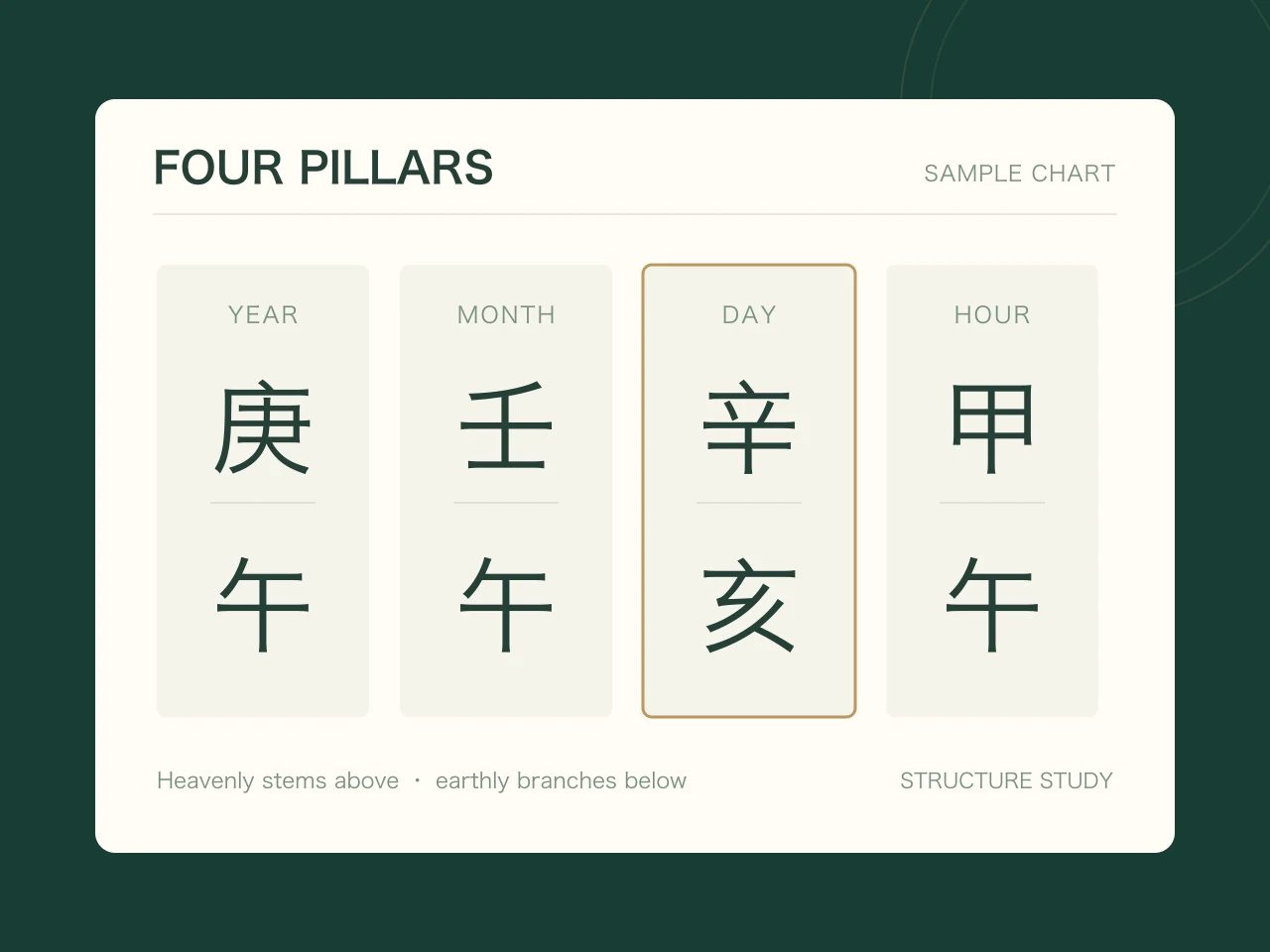
A sample Four Pillars chart with the year, month, day and hour stems above their branches.

BaZi

Four Pillars BaZi Calculator

Enter a Gregorian birth date and local time to see the four pillars, hidden stems, Ten Gods, Na Yin, branch relations, and element counts, with clear calendar and time-boundary limits.

Before you start

Prepare these details to see these results

Check which details are required before entering personal information. If something is missing, the page explains the effect instead of guessing for you.

What to prepare

  1. 1

    Birth date

    Calculates the year, month, and day pillars and lunar conversion.

  2. 2

    Birth time (local clock)

    Calculates the day-boundary case and hour pillar from local clock time.

What you will see

  1. 1

    Gregorian-to-lunar and GanZhi conversion

  2. 2

    Four pillars, hidden stems, Ten Gods, and Na Yin

  3. 3

    Eight-character element counts with no strength claim

What you need before you start

Before starting, confirm that dates, times, and other details are accurate, and note which items are required or optional. Do not replace missing required information with a guess.

Birth date

required

date required

Calculates the year, month, and day pillars and lunar conversion.

Example: 1990-06-15

What to enter: Must be a valid Gregorian date no later than the current moment.

If you leave it out: No pillar can be calculated.

Birth time (local clock)

required

time required

Calculates the day-boundary case and hour pillar from local clock time.

Example: 12:00

What to enter: Must be precise to the minute; boundary cases need comparison.

If you leave it out: A reviewable day and hour record cannot be produced.

How it works

This tool uses the details you enter on the page to produce a result. It is free to use, and your information is not sent to a third-party AI service.

This is a Four Pillars chart record

Four Pillars calculation converts a Gregorian birth date and local clock time into year, month, day, and hour stem-branch pairs. This page displays the birth details, conversion, and calendar rules so you can check the result again.

The chart shows which traditional details follow from this page's stated calendar method. It does not prove that a Day Master, Ten God, branch relation, or element count measures personality, ability, health, wealth, career, relationships, or future events.

What the chart includes

The main steps remain visible so you can locate a date, time, or calendar-method difference instead of accepting an unexplained summary.

  • Gregorian input, lunar conversion, year-branch zodiac label, and assigned double-hour branch.
  • The four pillars with each visible stem and branch element, yin-yang class, and Na Yin lookup.
  • Surface Ten Gods relative to the Day Stem, hidden stems, and hidden-stem Ten Gods.
  • Matched Six Harmony, Six Clash, Six Harm, Six Break, Three Harmony, Three Meeting, and self-punishment lookup conditions.
  • Visible counts for the four stems and four branches, without converting count into strength or a remedy.

Calendar and clock policy

Input is a Gregorian date and local clock time to the minute. Year and month pillars use solar-term boundaries, the day pillar changes at 23:00 local clock time, and the hour pillar follows twelve double-hour ranges.

The page does not collect birthplace or time zone, so it cannot correct historical daylight saving, longitude, or true solar time. Near 23:00, an odd-hour branch boundary, or a solar term, preserve candidate charts on both sides and mark every change.

How to read the visible element count

The page maps only the eight visible stem and branch characters to Wood, Fire, Earth, Metal, and Water. It does not add hidden-stem weights, season, roots, combinations, transformation, climate adjustment, or any school's strength method. The largest count is not automatically strongest, and zero does not prove a real-life deficiency.

Do not use the count to prescribe a colour, direction, occupation, food, accessory, or household object, and do not infer health, personality, income, or partner suitability. A report that adds strength, useful-element, or remedy claims must disclose the additional method and disagreement.

Verification and stop conditions

Keep the Gregorian date, local clock time, birthplace, historical time zone, daylight-saving status, and day-boundary rule with the result. When details are uncertain, compare only the parts that remain stable across the plausible range; never choose the chart that sounds more flattering.

Stop using the chart whenever a medical, investment, employment, legal, relationship, or safety decision depends on one chart detail. Use facts, records, consent, and qualified advice from the relevant domain instead. Getting the same chart again does not prove that a traditional interpretation is true.

What is the difference between this and the BaZi marriage tool?

It shows one chart's calendar conversion and traditional details. The marriage tool compares two charts with clearly explained traditional-rule reference scores. Neither page proves a relationship outcome, and birth details are not sent to a third-party AI service or placed behind a paid report.

Why does my chart look different from another website?

This page uses Gregorian input, solar-term month boundaries, and a 23:00 day change. It does not correct time zone, historical daylight saving, longitude, or true solar time. Another tool can differ when it uses another day-change school or applies location corrections, especially near a solar-term or double-hour boundary.

Does the largest or zero element count identify strength or a favourable element?

No. The count covers only the four visible stems and four visible branches. It omits hidden-stem weighting, season, roots, combinations, transformations, and school rules. The page therefore does not label strength, calculate a favourable element, or recommend colours, directions, industries, food, or objects.

Which calendar assumptions must a Four Pillars tool disclose?

It should state whether the entered date is Gregorian or lunar, the time zone, daylight-saving treatment, solar-term month boundary, day-change convention, and true-solar-time policy. It should preserve the converted date, four pillars, hidden stems, and any uncertainty around the hour. If a birth time or location is missing, the report must reduce time-dependent detail instead of filling a confident default. These assumptions are part of the result and should remain visible whenever the chart is saved or shared.

Keep reading

Related articles

Try next

Related tools