Skip to content
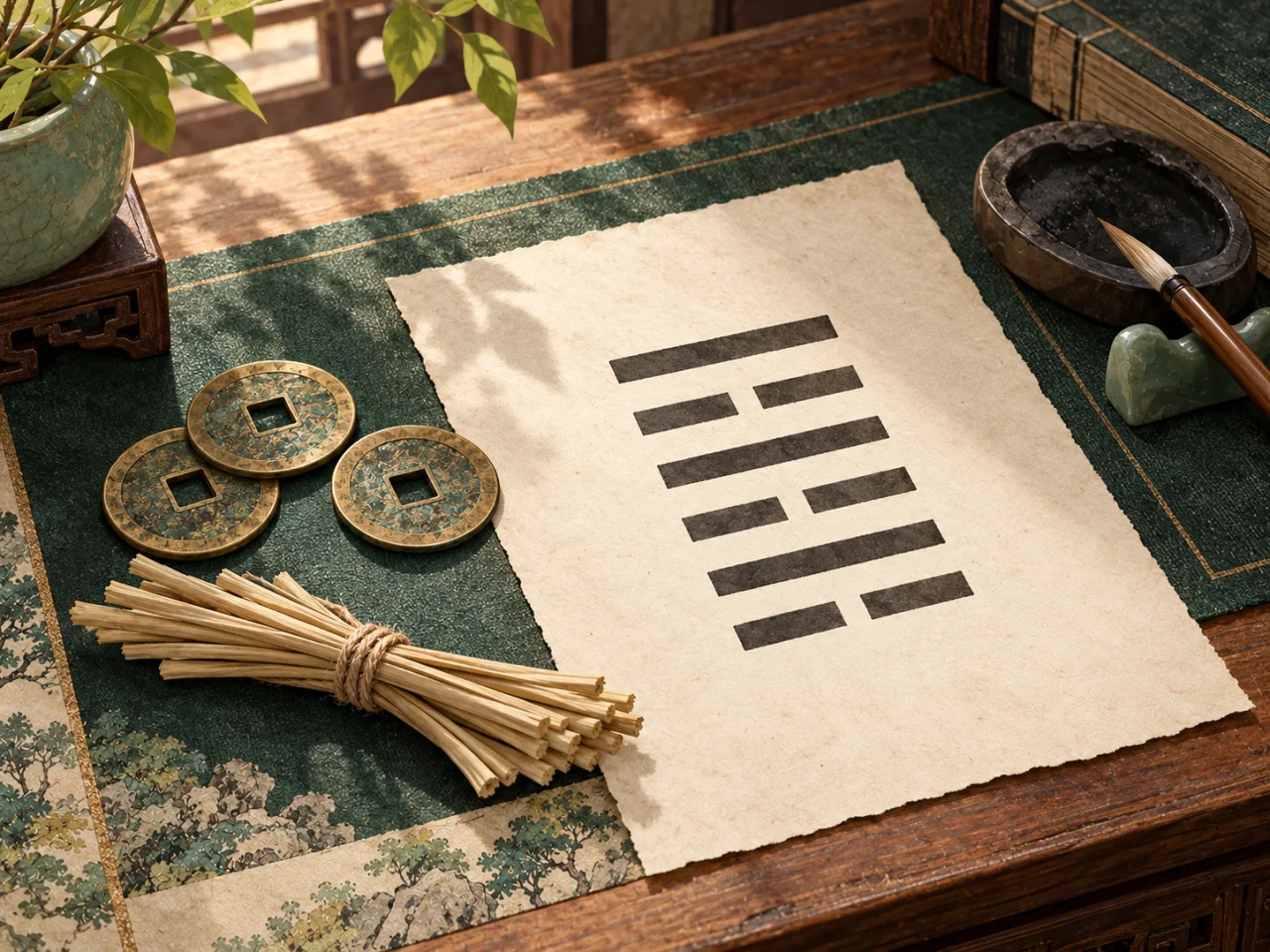
Yarrow stalks, bronze coins and a hand-drawn I Ching hexagram on parchment.

Numerology

He Luo Li Shu Numerology

Explore He Luo Li Shu number relationships as a documented cultural reflection sequence with declared inputs, sources, and review limits.

Before you start

Prepare these details to see these results

Check which details are required before entering personal information. If something is missing, the page explains the effect instead of guessing for you.

What to prepare

  1. 1

    Name

    Labels the profile so the result remains understandable and distinguishable.

  2. 2

    Birth date

    Establishes the calendar and timing data used by the calculation.

  3. 3

    Gender

    Applies method-specific rules and keeps the report wording appropriate.

What you will see

  1. 1

    Birth profile to four-pillar mapping

  2. 2

    He Tu and Luo Shu number derivation

  3. 3

    Innate and acquired hexagrams

What you need before you start

Before starting, confirm that dates, times, and other details are accurate, and note which items are required or optional. Do not replace missing required information with a guess.

Name

type in optional

Labels the profile so the result remains understandable and distinguishable.

Example: Alex

What to enter: Remove accidental extra spaces and enter only the information requested.

If you leave it out: The tool will continue with reduced detail and will not infer the missing value.

Birth date

required

date required

Establishes the calendar and timing data used by the calculation.

Example: 1990-06-15

What to enter: Use a valid calendar date that is not in the future.

If you leave it out: The tool cannot produce a reliable result without this required value.

Gender

choose optional

Applies method-specific rules and keeps the report wording appropriate.

Example: Female

What to enter: Choose one of the listed values; do not infer another person’s private information.

If you leave it out: The tool will continue with reduced detail and will not infer the missing value.

How it works

This tool uses the details you enter on the page to produce a result. It is free to use, and your information is not sent to a third-party AI service.

Record the number sequence

Save the birth inputs, sexagenary-calendar and lunar-month assumptions, He Tu and Luo Shu number derivation, earlier and later trigrams, changing-line rule, sequence version, and date accessed, sequence version, and date accessed. A later reader should be able to tell which step produced each number instead of receiving only a polished theme.

Use an annual theme carefully

Choose a theme before the year begins and connect it to two observable questions, such as whether a study routine was maintained or whether a project reached a stated milestone. The sequence is a journal structure, not a timetable of events.

A fictional annual review

A person might label a year as a period for consolidation, then record budget, workload, learning hours, and relationships in ordinary terms. If the year does not match the label, keep the mismatch. Do not redefine consolidation after the fact until every outcome appears to fit.

Compare sources and conventions

Different He Luo explanations may use different number maps, trigram language, or annual sequence rules. State the source and method, compare one difference at a time, and avoid averaging incompatible systems into a falsely precise answer.

Boundary for life decisions

The sequence cannot establish destiny, career direction, health, wealth, marriage, or an event date. Use current evidence, professional guidance, and the people affected by a decision rather than a distant symbolic period.

What does this He Luo tool calculate?

It maps birth year, month, day, and hour stems into He Tu and Luo Shu numbers, derives an innate hexagram, flips the changing line into an acquired hexagram, then rotates annual hexagrams from the 60-year cycle.

Is this deterministic?

Yes. The same birth profile always produces the same hexagrams and annual sequence. The longer report expands the same calculation into a fuller narrative.

How should I use a fifty-year sequence responsibly?

Treat it as a set of annual reflection headings, not a schedule of events. Plan with current finances, health, responsibilities, and evidence; review one year at a time. Do not postpone necessary action or make irreversible decisions because of a distant symbolic period.

How should an annual He Luo review be written?

Save the original birth input, time-zone and time assumptions, core numbers, earlier and later trigrams, sequence version, and the theme assigned before the year begins. Add real goals, constraints, and measurable review questions from work, relationships, health routines, or study. At year end, record matches and mismatches without rewriting the original theme. Use the sequence as a journaling framework, not an event schedule, and never postpone necessary professional, financial, legal, or medical action because of a symbolic year.

Try next

Related tools