A feng shui number you can check before you use it
Ming gua takes two inputs, the year a person was born and their sex, and returns one of eight values. That is unusual in this field: the step is fully specified, so the same year put through two published tables should give the same trigram. When two tables disagree, and they do, the disagreement is never mysterious. It comes from one of three conventions, and each of the three can be isolated and tested on its own.
That makes the calculation worth doing carefully even if you never use the answer. If the simplest step in Eight Mansions cannot be reproduced, the elaborate steps built on top of it inherit the problem.
The whole formula is one modular step
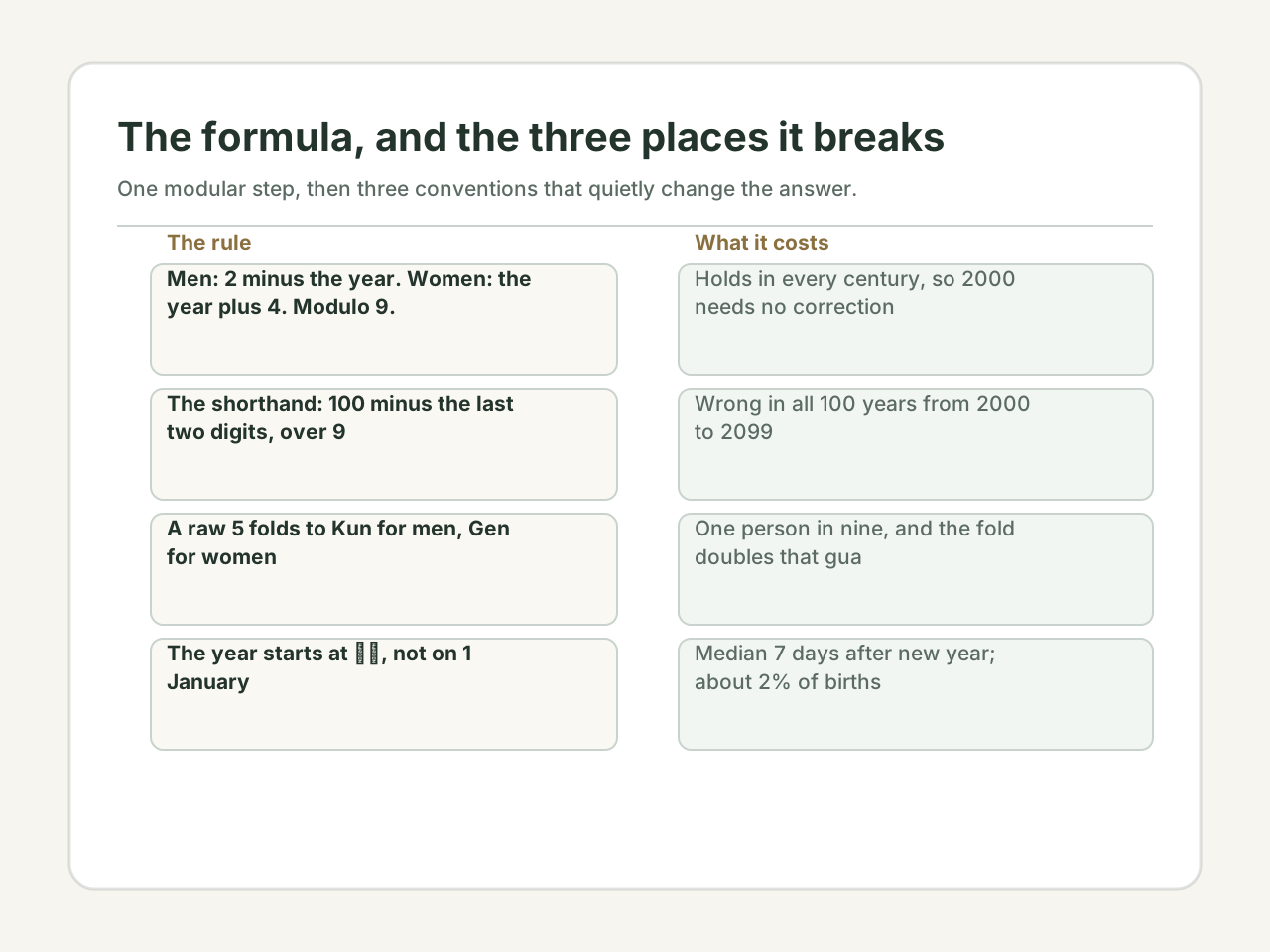
Reduce the birth year modulo 9, then apply a fixed offset: for a man, subtract the year from 2; for a woman, add 4. Read a remainder of 0 as 9. That is the entire rule, and it works across the century boundary without adjustment.
Most books state it as a digit sum instead, which is the same arithmetic in a different costume. A number and its digit sum have the same remainder modulo 9, so summing the digits of the year, reducing to a single digit d, then computing 11 minus d for a man and 4 plus d for a woman gives an identical result. If the answer exceeds 9, subtract 9 once more.
Seven years are enough to see that the two forms agree, and to see what the output looks like before the five is handled.
| Birth year | Digits, reduced | Man: 11 − d | Man's gua | Woman: d + 4 | Woman's gua |
|---|---|---|---|---|---|
| 1982 | 20 → 2 | 9 | 9 Li | 6 | 6 Qian |
| 1984 | 22 → 4 | 7 | 7 Dui | 8 | 8 Gen |
| 1985 | 23 → 5 | 6 | 6 Qian | 9 | 9 Li |
| 1999 | 28 → 1 | 1 | 1 Kan | 5 → 8 | 8 Gen |
| 2000 | 2 | 9 | 9 Li | 6 | 6 Qian |
| 2005 | 7 | 4 | 4 Xun | 2 | 2 Kun |
| 2025 | 9 | 2 | 2 Kun | 4 | 4 Xun |
The shorthand that stopped working in 2000
A shorter version circulates widely: take the last two digits of the year, subtract them from 100 for a man, subtract 4 from them for a woman, and divide by 9. It reproduces every result in the table above, because for years beginning 19 it is the same arithmetic. It also fails completely for years beginning 20, and it fails silently, returning a trigram that looks perfectly valid.
Take 2005. The shorthand gives 100 minus 5, which is 95, whose remainder modulo 9 is 5, which folds to 2 Kun. The digit method gives 4 Xun. Checked across 2000 to 2099, the shorthand disagrees with the digit method in all one hundred years, in the same direction, for both sexes.
The reason is that 100 leaves a remainder of 1 modulo 9, so each century shifts the constant by one. Dropping the century digits is only safe while the century you dropped happens to cancel. The repair is either to subtract from 99 instead of 100 for the 2000s, or to stop using the shorthand and sum the digits.
Five is not a trigram, and it is not rare
The eight palaces sit around a centre that has no direction, so the number 5 has no trigram to attach to. The classical convention folds it: a man reads 5 as 2 Kun, a woman reads 5 as 8 Gen. Over the two hundred years from 1900 to 2099 the raw result is 5 in 22 of the male years and 23 of the female years, which is one person in nine.
Folding doubles the weight of the trigram it lands on. Kun falls to 44 of those 200 male years, twice as often as any other gua, and Gen falls to 45 of the female years. A table that lists eight rows hides this: the rows are not equally likely.
There is a second convention, less common, that swaps the two folds, sending men to Gen and women to Kun. Both folds are West Group, so the group does not change and a careless reader will not notice. The directions do change. Kun's Sheng Qi is northeast, Gen's is southwest, so for the one person in nine who hits 5 the two conventions point them at opposite corners of the same group.
The year boundary is 立春, and it costs about two percent of birthdays
The year the formula wants is not the Gregorian year on a birth certificate and not the lunar year either. It is the solar year that begins at 立春, when the sun reaches 315 degrees of ecliptic longitude, which falls on 3 to 5 February.
The gap between 立春 and the first day of the lunar year is small but not zero. Between 1950 and 2050 the median gap is 7 days, the range is 0 to 16, and 立春 comes second in 46 of those 101 years. Anyone born inside that window gets a different gua depending on which boundary the table uses.
2026 is a wide year. 立春 falls on 4 February and the lunar new year on 17 February, thirteen days later. A boy born on 10 February 2026 is past 立春, so he belongs to 2026 and reads 1 Kan, East Group. A table that waits for the lunar new year puts him in 2025 and reads 2 Kun, West Group. Thirteen days of disagreement produce a different group and a different set of four directions.
The size of the exposure is easy to state. The ambiguous window averages 7.45 days, about two percent of a year, so roughly one birth in forty-nine sits inside it. Ignoring the boundary altogether is worse: 1 January to 立春 is 34 days, about nine percent of all birthdays, and every one of those is assigned to the wrong year.
What the eight outputs actually cover
Because the fold pushes every 5 into the West Group, the two groups are not the same size. Four trigrams are East Group and four are West Group, but the folded weight lands on the West side for both sexes, so West Group takes five ninths of all people, about 55.6 percent. Counted over 1900 to 2099 the measured share is 55 percent of male years and 56 percent of female years.
The sequence also repeats every nine years, which is why the same gua keeps appearing across unrelated generations. Nine consecutive male years cover eight distinct values with exactly one repeat and no 5 at all: 1984 through 1992 read 7, 6, 2, 4, 3, 2, 1, 9, 8. Two men born nine years apart therefore carry the same number, and the number says nothing about which decade they grew up in.
Checking your own number in a minute
The steps below reproduce the table, and the last step is a cross-check that catches an arithmetic slip:
- Write the four-digit birth year. If the birthday falls before 立春, which is 3 to 5 February, use the previous year.
- Sum the four digits, then sum again until one digit remains. Call it d.
- A man computes 11 minus d; a woman computes 4 plus d. If the result is above 9, subtract 9.
- If the result is 5, a man reads 2 Kun and a woman reads 8 Gen.
- Cross-check with the modular form: a man computes 2 minus the year, a woman computes the year plus 4, take the remainder after dividing by 9, and read a remainder of 0 as 9. Both routes must land on the same trigram.
What the number cannot do
Ming gua is one of two tables in Eight Mansions, not the whole system. The other table belongs to the building, generated from its facing direction, and the reading is a comparison between the two. A person's number on its own says which directions suit them; it does not say whether the house has any of them available.
It also does not rank people, predict income, or overlap with the favourable elements read from a full birth chart. Those are separate calculations with separate inputs, and a person can easily have a gua that points one way and a chart that favours another. When they conflict, the gua is the narrower claim: it concerns orientation, and orientation is usually the cheapest thing in a room to change.
The failure mode worth remembering is the quiet one. A wrong year boundary, a shorthand that expired in 1999, or a swapped fold each produce a valid-looking trigram with no error message. The only defence is to compute the number twice, by two routes, and see whether they agree.
Disclaimer: This content is for informational and cultural reference purposes only. It does not constitute professional medical, legal, financial, or psychological advice. Readers should exercise their own judgment and consult qualified professionals for specific concerns.
Sources and review basis
Traditional references explain historical vocabulary and context. Official practical sources support only the observable safety, comfort, or environmental points noted in the article; they do not validate metaphysical claims.
Traditional reference
Huangdi Zhaijing (黄帝宅经)Wikisource digital text · Accessed 2026-07-14
Historical context for traditional residential orientation and spatial vocabulary. Modern recommendations are judged against real conditions.
Practical source
NOAA Solar CalculatorNOAA Global Monitoring Laboratory · Accessed 2026-10-16
Used to check local solar noon and the equation of time, which is the part the true-solar-time correction adds to or subtracts from clock time.