Two decisions, and only one of them is about direction
Bed placement in Eight Mansions is usually described as a single question: which way should the head point. It is two questions. The first is where the bed can physically stand, which means a solid wall behind the headboard, no window above it, and a clear view of the door. The second is which of the four favourable directions that position happens to give you.
The order matters because the first question usually has one answer and the second has none. In most bedrooms only one wall can take a headboard, so the direction is settled before any table is opened. Starting from the direction and then looking for a wall is the mistake that produces beds under windows.
Which of the four to aim at, when there is a choice
The four favourable directions are not interchangeable. Each is read as supporting something different, so choosing between them is a statement about what the bed is for:
| Priority | Direction | Read as | Choose it when |
|---|---|---|---|
| Sleep and recovery | Tian Yi (天医) | The restorative one | You wake up tired, or sleep is the thing you most need to fix |
| Relationship | Yan Nian (延年) | The relational one | Two people share the bed, and the bed is also where you talk |
| Morning energy | Sheng Qi (生气) | The most active one | Mornings are the problem and you want to get up and go |
| Calm | Fu Wei (伏位) | The steadiest one | You are sensitive to stimulation, or the other three are not available |
The position rules come before the direction
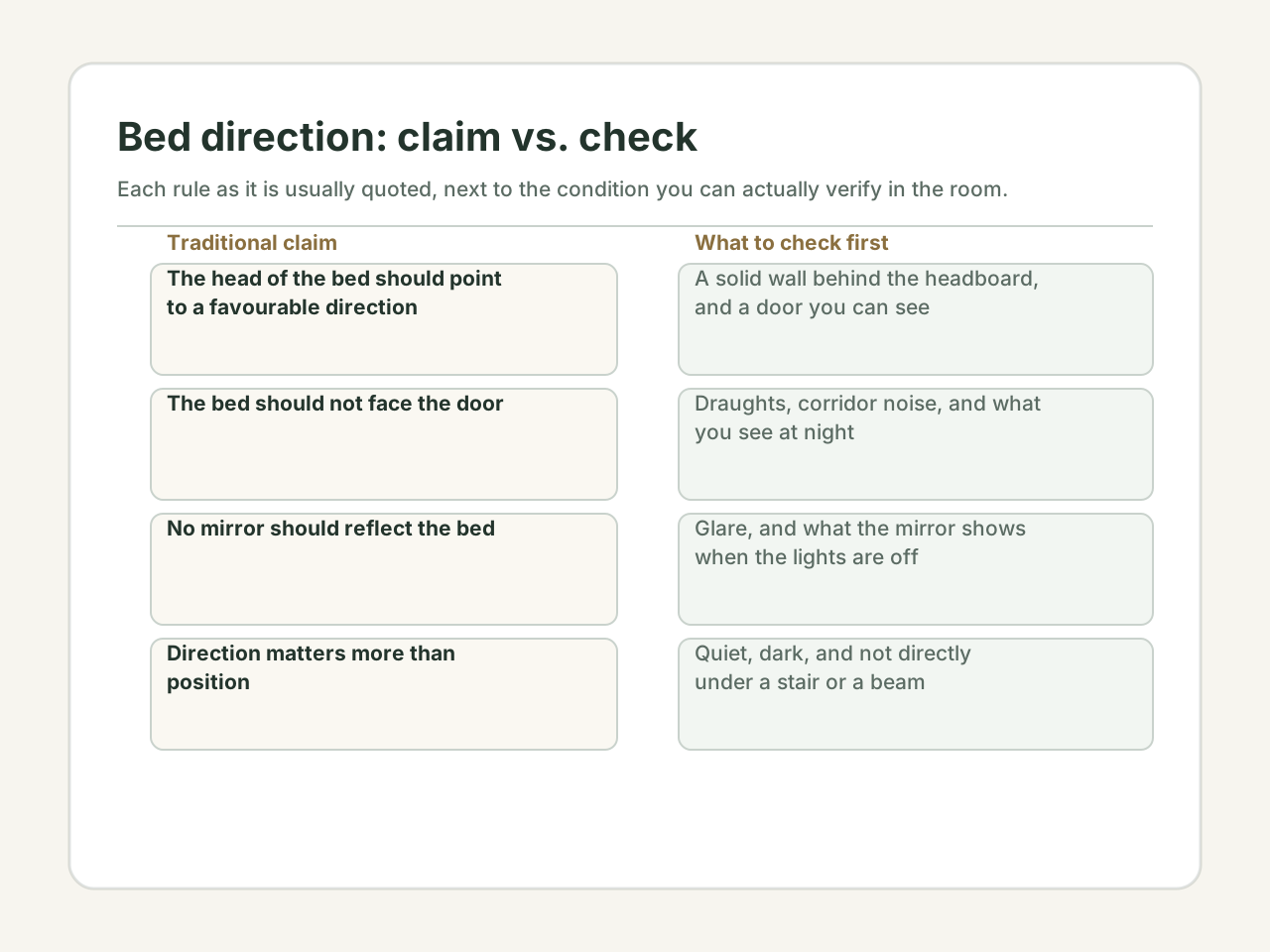
These four are settled first, because a bed that fails them will not be improved by any direction:
- A solid headboard against a solid wall. A headboard against a window is the same as no headboard: the wall behind it is the least solid one in the room, and the bed picks up every draught and every change of light.
- See the door, do not face it. The comfortable version is diagonal, so that you can see who enters without lying in the path of the door's noise and moving air.
- Not under a window. Light, noise and temperature all arrive through it. Blackout curtains and a sealed frame fix the first two and only soften the third.
- Keep the floor under the bed clear, with a caveat. This is a general recommendation rather than an Eight Mansions rule: the school assigns directions to sectors and stops there. What is actually measurable is dust and whether you can clean.
A worked example, with the numbers filled in
A couple, both born in years anyone can check. He was born in 1990, so his number is 1 Kan. She was born in 1984, so hers is 8 Gen. Both come from the same arithmetic: sum the digits of the year, then take 11 minus the sum for a man and 4 plus the sum for a woman.
Their tables cross. For him the west is Huo Hai, the mildest of his four unfavourable directions, and the east is Tian Yi, the second of his four good ones. For her the west is Yan Nian, the third of her good ones, and the east is Liu Sha, the second mildest of her four bad ones. Every wall that suits one of them takes something from the other.
The room settles most of it. The door is on the north wall. The south wall is mostly window. The east wall is solid and empty. The west wall is a built-in closet, which is solid but not empty.
Two placements survive the position rules, and they differ:
| Headboard on | Head points | For him (1 Kan) | For her (8 Gen) |
|---|---|---|---|
| East wall, solid and empty | West | Huo Hai, the mildest of his four bad | Yan Nian, the third of her four good |
| West wall, against the closet | East | Tian Yi, the second of his four good | Liu Sha, the second mildest of her four bad |
There is no exchange rate between two people
The table is as far as the method goes, and the last row of it is the honest limit of Eight Mansions:
- Eight Mansions ranks directions within one person and has nothing to say between two. There is no exchange rate that turns her Yan Nian into his Huo Hai, and no better table would supply one, because the method never compares people.
- So the tie is broken by what the system does not measure: who wakes at three in the morning, whether the closet doors open into the space the bed needs, and which option leaves a walkway at the foot of the bed.
- In this room that usually means the east wall. A closet behind a headboard is solid, but the doors open into exactly the space a bed wants, and the walkway at the foot of the bed is the thing you notice every night.
When no wall gives a favourable direction
Most bedrooms do not offer a favourable direction at all, and the useful moves are ordinary:
- Rotate the bed ninety degrees before moving it to another wall. The head direction follows the headboard, so one wall can produce two different answers.
- A partial view of the door is enough. You need the doorway in sight from where you lie, not the whole wall.
- If the only solid wall puts the head in an unfavourable direction, take the mildest of the four rather than the best of nothing. The order is fixed: Huo Hai is milder than Liu Sha, which is milder than Wu Gui, which is milder than Jue Ming.
- Do not angle the bed into the corner to split the difference. A diagonal headboard produces a direction no table can read, and it usually costs the walkway as well.
What the direction cannot promise
The direction is the smallest variable in the room. Mattress age, room temperature, light at the window and noise from the street all move sleep further than a 45-degree sector does, and each of those is easier to fix. Eight Mansions earns its place by forcing a decision most bedrooms never get: where the bed goes, and why. Once that is settled, everything left to improve is ordinary and measurable.
Disclaimer: This content is for informational and cultural reference purposes only. It does not constitute professional medical, legal, financial, or psychological advice. Readers should exercise their own judgment and consult qualified professionals for specific concerns.
Sources and review basis
Traditional references explain historical vocabulary and context. Official practical sources support only the observable safety, comfort, or environmental points noted in the article; they do not validate metaphysical claims.
Traditional reference
Huangdi Zhaijing (黄帝宅经)Wikisource digital text · Accessed 2026-07-14
Historical context for traditional residential orientation and spatial vocabulary. Modern recommendations are judged against real conditions.
Practical source
US NIH/NHLBI: Healthy Sleep HabitsNational Heart, Lung, and Blood Institute, NIH · Accessed 2026-07-14
Health background for sleep routines and bedroom conditions; it does not endorse directional feng shui claims.