Four names, one line of verse, and no judgement calls
Eight Mansions does not ask which direction feels good. It hands you a fixed vocabulary of eight names and a rule that assigns them to the eight compass directions. Four land on the favourable side — Sheng Qi (生气), Tian Yi (天医), Yan Nian (延年), Fu Wei (伏位). Four land on the other — Jue Ming (绝命), Wu Gui (五鬼), Liu Sha (六煞), Huo Hai (祸害). The assignment is generated by a mnemonic called the Da You Nian song (大游年歌), eight lines of verse, one for each trigram.
That has two consequences worth holding on to. The first is that the four auspicious directions are not four separate gifts you can shop from. They are four positions in one ordered list, and the list is produced by the verse rather than chosen by anyone. The second is that nothing in the process looks at your health, your marriage, your job, or your year beyond the number that gives you the gua. It is arithmetic on a birth year and a compass bearing, and it is repeatable — which is the only reason it is worth writing down.
Reading one verse into eight directions
The rule takes a sentence to state. Start at the trigram itself, which takes Fu Wei. Then walk the eight palaces in the fixed order of the Later Heaven arrangement — Kan north, Gen northeast, Zhen east, Xun southeast, Li south, Kun southwest, Dui west, Qian northwest — reading one character of the verse per palace as you go.
Take Qian. Its verse is 乾六天五祸绝延生. Walking from Qian the order is Kan, Gen, Zhen, Xun, Li, Kun, Dui, so Kan reads 六煞, Gen reads 天医, Zhen reads 五鬼, Xun reads 祸害, Li reads 绝命, Kun reads 延年, Dui reads 生气, and Qian itself is 伏位. A Qian person's four favourable directions are therefore Dui in the west (生气), Gen in the northeast (天医), Kun in the southwest (延年) and Qian in the northwest (伏位).
One property is worth checking, because it is the fastest way to catch a mistake. 生气 always lands on a trigram from the same group as the one you started from: east group with east group, west group with west group. Qian is west group, and Dui is too. Run the verse and get an east-group trigram as 生气 for a west-group gua, and the verse has been read from the wrong starting point or in the wrong direction around the ring.
The eight verses
Eight lines cover every case. There is no row for 5 because 5 has no trigram of its own: a result of 5 becomes Kun 2 for men and Gen 8 for women, so those two rows cover it.
Read a row across and you have that person's four favourable directions. Read the verse itself and you can reproduce the row: for Xun the verse is 巽天五六祸生绝延, so Li takes 天医 (south), Kun takes 五鬼, Dui takes 六煞, Qian takes 祸害, Kan takes 生气 (north), Gen takes 绝命, Zhen takes 延年 (east), and Xun keeps 伏位.
| Gua | Verse (大游年歌) | Sheng Qi 生气 | Tian Yi 天医 | Yan Nian 延年 | Fu Wei 伏位 |
|---|---|---|---|---|---|
| Qian 乾 6 | 乾六天五祸绝延生 | West, Dui | Northeast, Gen | Southwest, Kun | Northwest, Qian |
| Kan 坎 1 | 坎五天生延绝祸六 | Southeast, Xun | East, Zhen | South, Li | North, Kan |
| Gen 艮 8 | 艮六绝祸生延天五 | Southwest, Kun | Northwest, Qian | West, Dui | Northeast, Gen |
| Zhen 震 3 | 震延生祸绝五天六 | South, Li | North, Kan | Southeast, Xun | East, Zhen |
| Xun 巽 4 | 巽天五六祸生绝延 | North, Kan | South, Li | East, Zhen | Southeast, Xun |
| Li 离 9 | 离六五绝延祸生天 | East, Zhen | Southeast, Xun | North, Kan | South, Li |
| Kun 坤 2 | 坤天延绝生祸五六 | Northeast, Gen | West, Dui | Northwest, Qian | Southwest, Kun |
| Dui 兑 7 | 兑生祸延绝六五天 | Northwest, Qian | Southwest, Kun | Northeast, Gen | West, Dui |
A ranking, not four equal gifts
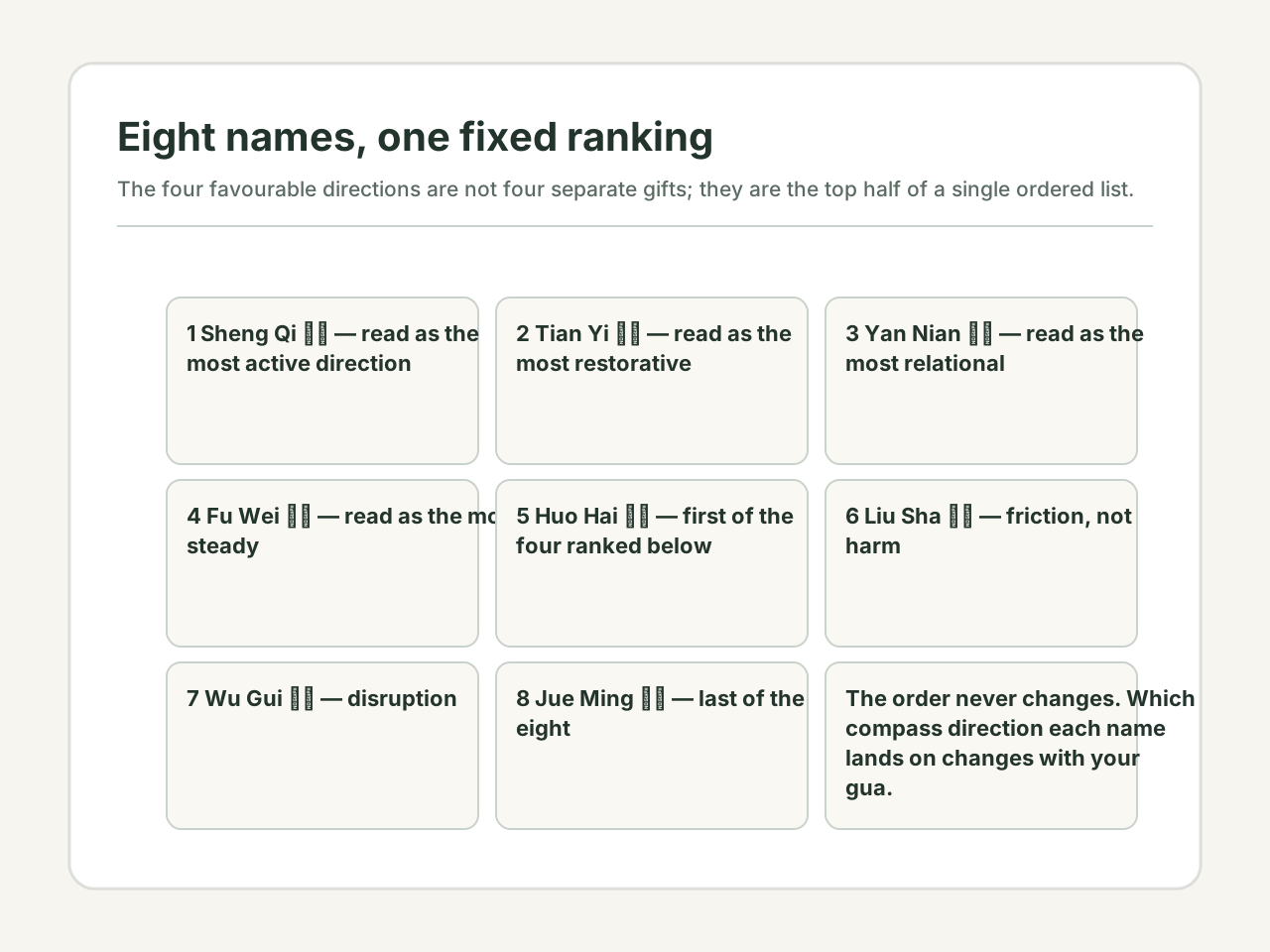
The eight names form one ordered list, and the four favourable ones are simply the top of it: Sheng Qi, then Tian Yi, then Yan Nian, then Fu Wei, then Huo Hai, Liu Sha, Wu Gui, Jue Ming. The star names carry the same order — Tan Lang (贪狼) for Sheng Qi, Ju Men (巨门) for Tian Yi, Wu Qu (武曲) for Yan Nian, Zuo Fu (左辅) for Fu Wei. Nothing in the tradition treats the four as interchangeable.
The ranking is useful for exactly one thing: it tells you what to drop first. A room usually offers one or two usable orientations, not four. If only one is available, take Sheng Qi; if two, Sheng Qi and Tian Yi; Fu Wei is what you accept when nothing better fits, not a prize you were hoping for. The ordering itself is doctrine rather than measurement — it is consistent across the classical texts, which is the most that can honestly be said for it.
What the ranking cannot do is schedule anything. Eight Mansions has no time dimension: it does not shift with the year or the period, so it cannot tell you when a direction is worth using, only which ones sit on the favourable side of the list.
When the person's table and the house's table disagree
There are two tables in Eight Mansions, and they are generated by the same eight verses. One is yours, from the ming gua. The other belongs to the building, from its measured sitting direction — the house gua. A direction can be Sheng Qi for you and Jue Ming for the house, and this happens constantly in flats nobody chose the orientation of.
The tradition does not settle the conflict. Some readings put the house first and treat the person as secondary; others reverse it. What the classical practice actually does is narrower than either: it reads three points — the door, the main bedroom and the stove — against the house table, and uses the person's table for the orientation of the body, which means the head of the bed and the direction a chair faces. That division is the one used here, because it keeps each table doing the job it is good at.
The compass is the weak link in both. Five degrees of error moves a reading across a sector boundary and renames every entry in the table, and a phone compass held near a steel door frame, a radiator or a fuse box can be off by more than that. Take the sitting direction from outside the building, away from metal, and take it three times before trusting it.
A worked example you can redo on paper
A woman has a ming gua of 4, Xun. The verse is 巽天五六祸生绝延, and walking from Xun the order is Li, Kun, Dui, Qian, Kan, Gen, Zhen: Li takes 天医, Kun 五鬼, Dui 六煞, Qian 祸害, Kan 生气, Gen 绝命, Zhen 延年, and Xun keeps 伏位. Her four favourable directions are north (生气), south (天医), east (延年) and southeast (伏位). The whole calculation is four steps — gua, verse, walk, read — and it takes about a minute.
Her bedroom has one window, on the south wall. A headboard against the south wall means facing north, which is her Sheng Qi. A headboard against the north wall means facing south, which is her Tian Yi. Both are on the favourable side, so the choice is between first and second rank rather than between good and bad, and the room itself does not force either one.
She takes south for the bed, on the Tian Yi reading, because she wakes tired and the restorative label is the one she wants attached to sleep. Her desk goes in the living room facing north, on Sheng Qi, because work is the activity that needs the active one. Yan Nian and Fu Wei go unused — not because they are weak, but because a small flat gave her two usable orientations and she spent both. Nothing in that decision required a consultant, and nothing in it can be checked against an outcome, which is the honest limit of the table.
Three ways the table gets misread
These three come up often enough to be worth naming:
- Treating all four as things you must use. Most rooms allow one or two orientations. The ranking exists so that dropping three of them is a decision rather than a failure.
- Using the person's table to judge a room. The table ranks directions, not rooms. A Sheng Qi direction in a dark, damp, noisy bedroom is still a dark, damp, noisy bedroom, and the verse has nothing to say about that.
- Ignoring compass error. The eight sectors are 45 degrees wide, so a reading within about 5 degrees of a boundary is uncertain, and the table will flip if it crosses. Near a boundary, treat the answer as a coin toss and let the room decide.
What the table can and cannot do
What it can do is rank eight directions deterministically from a birth year, and rank the house's eight from a compass bearing, in a way anyone can redo with the verse and a protractor. That is more than most feng shui advice offers, and it is why the table has survived. What it cannot do is tell you whether the room is any good. That question is answered by light, noise, damp, draught, and whether the door opens onto the bed — all measurable, none of them in the verse. Use the ranking to choose between layouts that already work, and never to justify one that does not.
Disclaimer: This content is for informational and cultural reference purposes only. It does not constitute professional medical, legal, financial, or psychological advice. Readers should exercise their own judgment and consult qualified professionals for specific concerns.
Sources and review basis
Traditional references explain historical vocabulary and context. Official practical sources support only the observable safety, comfort, or environmental points noted in the article; they do not validate metaphysical claims.
Traditional reference
Huangdi Zhaijing (黄帝宅经)Wikisource digital text · Accessed 2026-07-14
Historical context for traditional residential orientation and spatial vocabulary. Modern recommendations are judged against real conditions.
Traditional reference
Book of Changes (周易)Wikisource digital text · Accessed 2026-10-14
The classical text that writes yang lines as 九 and yin lines as 六, which is where calling the ninth day double yang comes from. Cited for terminology, not for any claim about the date.
Practical source
APA Dictionary of Psychology: Barnum effectAmerican Psychological Association · Accessed 2026-07-14
A psychology reference for why broad, favourable personality descriptions can feel personally accurate. It does not evaluate BaZi calculations themselves.