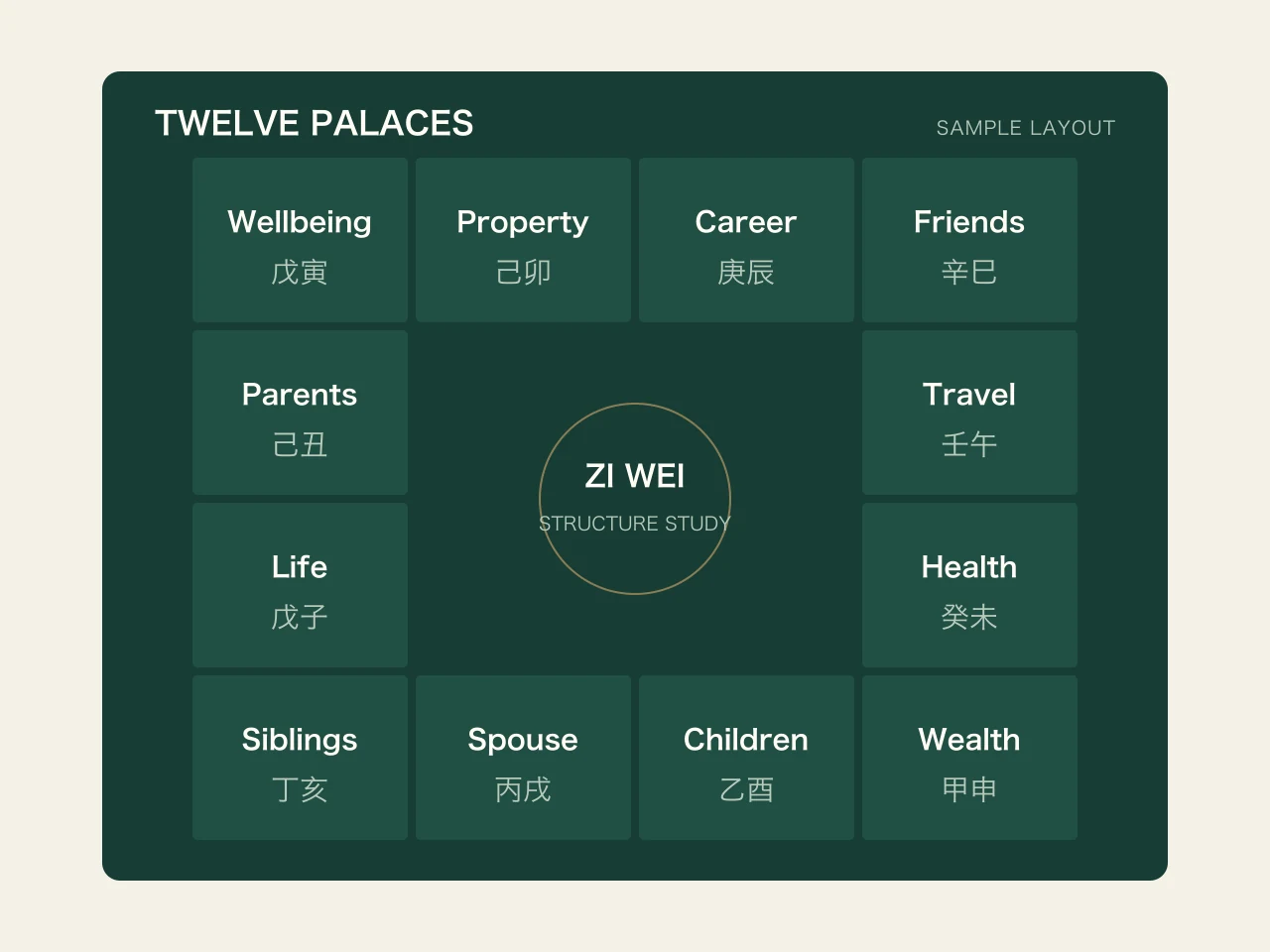
The wealth palace sits in a fixed geometry
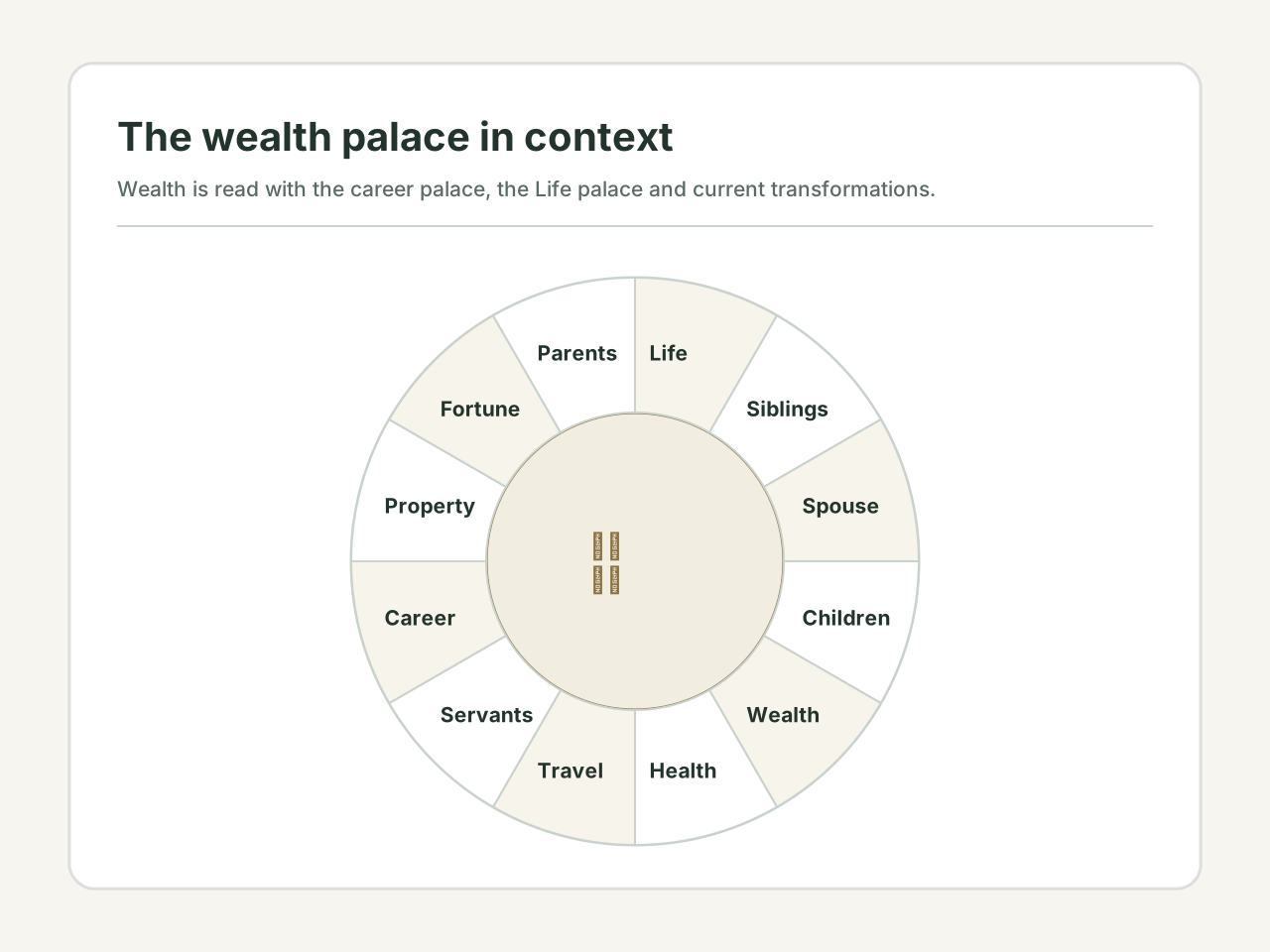
The wealth palace (财帛宫) is four palaces from 命宫, which places it in the self palace's trine alongside the career palace (官禄宫). The travel palace (迁移宫) sits directly opposite the self palace. Those four — 命, 财帛, 官禄, 迁移 — are the 三方四正, the minimum set any single palace has to be read inside.
Two further relationships matter and are usually skipped. The wealth palace faces the 福德宫, the palace of enjoyment and inner state, directly opposite. And the 田宅宫 sits five positions away: it is the store, the part that stays after the money has moved.
The geometry is the argument. If the wealth palace faced nothing in particular, reading it alone would be defensible. Because it faces the palace that governs how a person spends and enjoys, and shares a trine with the palace that governs what they do, the wealth palace cannot be read as an isolated number. It is one vertex of a triangle whose other vertices describe the channel and the state of mind.
What the stars say about the channel
Read as a channel rather than an amount, the main stars in the wealth palace become specific. The table is the working version. Grade modifies every entry, and any of them at 陷 reads as the same channel with more resistance.
| Star in 财帛 | Channel | Where it fails |
|---|---|---|
| 武曲 | Direct exchange: skill and execution converted into income | Tunnel vision; the ledger becomes the only measure |
| 天府 | Management and storage: money held and administered | Slow; the container grows and nothing is enjoyed |
| 太阴 | Recurring and quiet: salary, rent, royalties, property | Hesitation; gains that need a decision get postponed |
| 太阳 | Public labour: reputation, visibility, giving out | Overgiving; output exceeds what is billed |
| 天同 | Settled comfort: a stable position with low volatility | Drift; comfort removes the pressure to improve terms |
| 紫微 | Position: income tied to authority and being the reference point | Delegation failure; nothing moves without you |
| 天机 | Circulation: brokerage, information, turnover, timing | Too many switches; no position is held long enough |
| 廉贞 | Competition: contested fields, edge under pressure | Risk appetite outruns the buffer |
| 贪狼 | Multiple channels: several income streams at once | Spending scales with income; appetite outruns receipts |
| 巨门 | Specialist voice: argument, analysis, disputed expertise | Dispute costs; the fee is consumed by the argument |
| 天相 | Service and agency: acting for someone else's authority | Dependence; the channel closes when the principal changes |
| 天梁 | Seniority: credentials, protection, long tenure | Price resistance; being right is not being paid |
| 七杀 | Campaigns: concentrated pushes with clear end points | Feast and famine; nothing accrues between campaigns |
| 破军 | Replacement: buying, clearing, turning over | Churn; turnover costs what it earns |
Two structural notes before the star names
If the wealth palace has no main star, it borrows from the palace opposite — which is 福德宫. The borrowing is not a technicality. It means the income structure is read off the person's disposition toward money, and the disposition itself becomes the channel.
禄存 in the wealth palace holds a resource in place, but by the placement rule it is flanked by 擎羊 and 陀罗, so the same palace carries both the reserve and the cost of defending it. A wealth palace with 禄存 and a poor 田宅宫 describes a reserve that is guarded and never banked.
What to settle before naming a star
Four questions decide most of the reading, and they are ordered by how much they change the answer.
First, where is the 命宫 and what does it say about capacity? A wealth palace full of 武曲 reads one way for a self palace built for sustained execution and another way for a self palace built for variety. The channel is the same; the ability to use it is not.
Second, what is in the career palace? Income channel and work channel are read together, and when they disagree the disagreement is the finding — a 财帛 palace pointing at multiple streams, sharing a trine with a 官禄 palace pointing at a single long tenure, describes someone trying to do two incompatible things.
Third, what is in 福德宫, directly opposite? 化忌 there, facing a wealth palace with 化禄, is a specific and common configuration: the money arrives, and the capacity to enjoy or hold it is where the friction sits.
Fourth, what is in 田宅宫, the store? A strong wealth palace with an empty 田宅宫 describes high throughput and low retention — income that is real and does not stay. This is one of the few places where a chart says something operationally actionable, because retention is a design problem rather than a character problem.
What transformations do to the reading
化禄 in the wealth palace enlarges the channel; it does not enlarge the amount. 化权 in the wealth palace puts the person in control of the channel, which is a different thing from having more of it — a 化权 wealth palace with modest stars often describes someone who sets the terms of a small trade rather than someone who earns a lot.
化忌 in the wealth palace is the most misread placement in the system. It does not mean poverty. It marks where effort is required and where the obvious shortcut fails: money that has to be chased, terms that have to be renegotiated, a channel that works but never becomes effortless. The practical response is administrative — invoices, contracts, collection — not resignation.
One more layer changes the picture and is often left out. If the wealth palace's own stem transforms a star sitting inside it, the palace activates itself (自化). 财帛自化禄 reads as money that arrives and leaves within the same structure, which is a different pattern from 化禄 arriving from outside.
A chart that says throughput, and a practice built for lump sums
A designer's wealth palace has no main star. Opposite it, in 福德宫, sits 太阴. By the borrowing rule the income structure reads off 太阴: quiet, recurring, accumulating — retainers, licensing, rent, anything that pays on a schedule. Her 田宅宫 carries 禄存, so the store is intact.
Her actual work is project-based. Each engagement is a lump sum and between engagements there is nothing. On the chart's terms the channel and the practice are mismatched: the structure is built for recurrence and the work is built for events. The visible symptom is not low income — she earns well — but a continuous low-grade anxiety between projects, which sits exactly where the chart puts it, in the palace opposite the wealth palace.
The response that follows from the reading is not a career change. It is to convert part of the lump-sum practice into recurrence: two retained clients on monthly terms, a licence on a template, a maintenance agreement attached to each build. The chart does not say she will succeed at this. It says that if the structure is recurrence and the practice is events, the gap will keep generating the same anxiety regardless of how much comes in.
Where the wealth palace stops
The wealth palace describes a channel and a disposition. It does not describe an amount, and no reading of it produces a number. Two people with identical wealth palaces and different educations, markets, and decades will hold very different balances.
It also does not survive being read alone. Every claim above depends on the trine and the opposite palace; take those away and the same star can be made to say almost anything. That is not a limitation of the method. It is the method.
The usable output is narrow and worth having: which channel fits the structure, where retention leaks, and whether the disposition and the work point the same way. Those three can be checked against a bank statement and a calendar. Anything beyond them is being supplied by the reader rather than by the chart.
Disclaimer: This content is for informational and cultural reference purposes only. It does not constitute professional medical, legal, financial, or psychological advice. Readers should exercise their own judgment and consult qualified professionals for specific concerns.
Sources and review basis
Traditional references explain historical vocabulary and context. Official practical sources support only the observable safety, comfort, or environmental points noted in the article; they do not validate metaphysical claims.
Traditional reference
Zi Wei Dou Shu Quanshu (紫微斗數全書)Wikisource digital text · Accessed 2026-10-14
A classical source for the twelve palaces, the main stars, and the four transformations that Zi Wei Dou Shu terminology is built on.
Practical source
APA Dictionary of Psychology: Barnum effectAmerican Psychological Association · Accessed 2026-07-14
A psychology reference for why broad, favourable personality descriptions can feel personally accurate. It does not evaluate BaZi calculations themselves.