The flying-star and trine schools split over where transformations start
Zi Wei Dou Shu contains two visibly different lines of practice. The trine school (三合) reads star combinations, palace positions, and how palaces meet each other. The flying-star school (飞星) puts its weight on the Four Transformations, and not as a single set cast from the birth year but as one set cast from each palace's own stem.
The split begins there. The same star may carry no transformation in the birth-year set and yet become Hua Ji under some palace stem. Flying-star practitioners hold that changes in relationships and events live in exactly these palace-stem activations; trine practitioners hold that the star combination already describes the structure. Both are internally consistent, and the conclusions frequently disagree — not because anyone miscalculated, but because the two are different languages.
| Point of comparison | Trine (三合) | Flying star (飞星) |
|---|---|---|
| What it reads | Star combinations, palace positions, how palaces meet | Palace-stem transformations, flight paths, self-transformation |
| Where transformations start | Mainly birth-year and decade transformations | One set of four from each palace's stem |
| What question it answers | Is the structure of this palace tight or open? | Where does pressure travel from, and to which palace? |
| Where arguments start | Whether a combination counts as auspicious or not | Which transformation table, and how self-transformation is defined |
How palace-stem transformations are cast
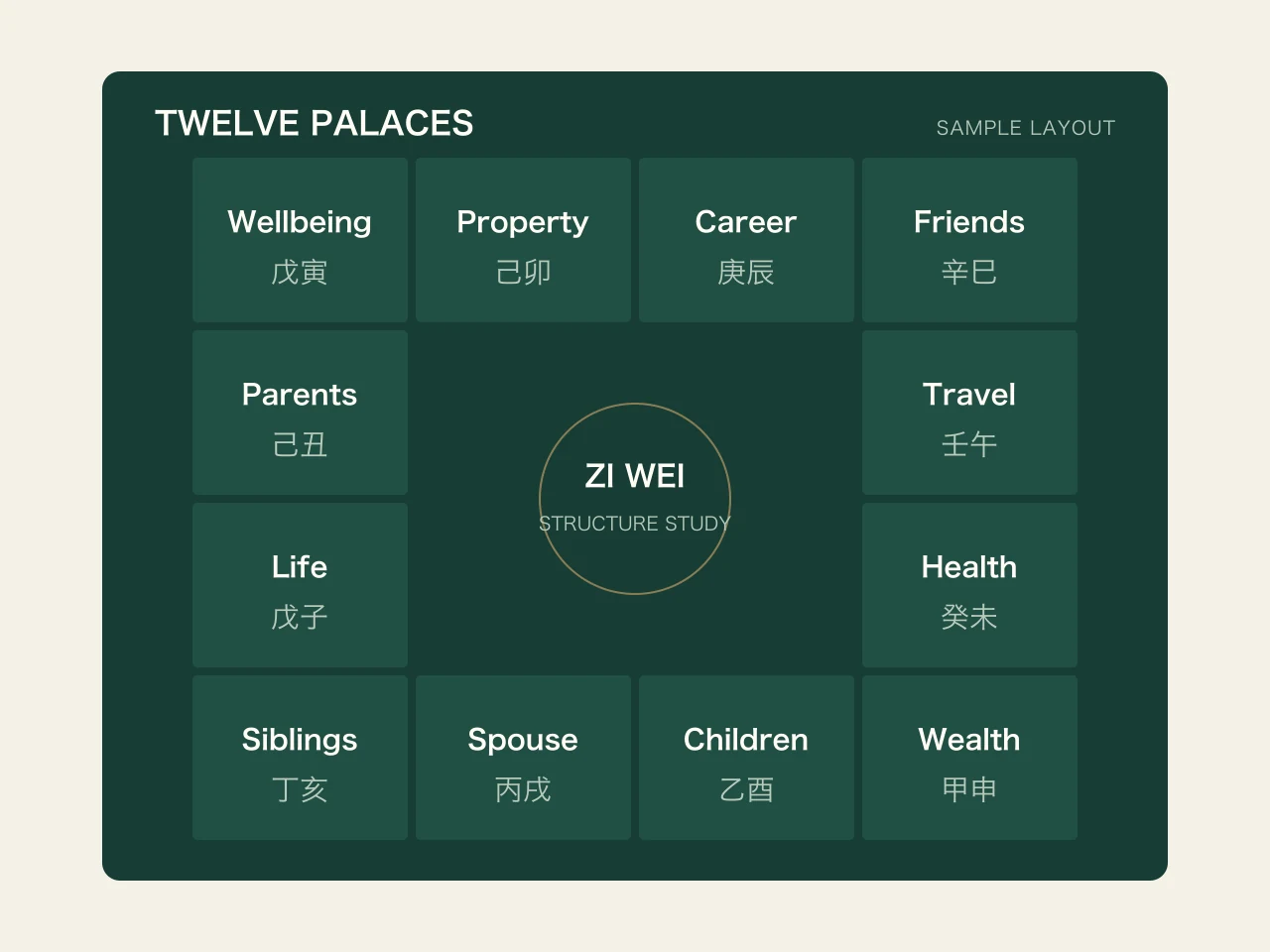
Step one: assign stems to the twelve palaces using the Five Tigers method (五虎遁). The birth-year stem decides which stem starts at the Yin palace, and the rest follow in order. In a Jia year the Yin palace starts with Bing, Mao with Ding, Chen with Wu, and so on.
Step two: look up which four stars that palace stem turns into Lu, Quan, Ke, and Ji. The table is fixed except for Geng, which splits as described in the four-transformations article. Decide which version you are using before you start; mixing them makes the rest of the chart impossible to follow.
Step three: see which palace the activated star sits in. What flying star actually cares about is the path from palace A to palace B, not the isolated nature of the star.
An example: the decade palace's stem flies Hua Ji into the spouse palace. The reading is not 'the spouse palace has Hua Ji' but 'for these ten years there is a line of pressure running from the decade into the relationship'. The path matters more than the endpoint, and that is the most fundamental difference between flying star and trine.
Self-transformation and the origin palace are two different things
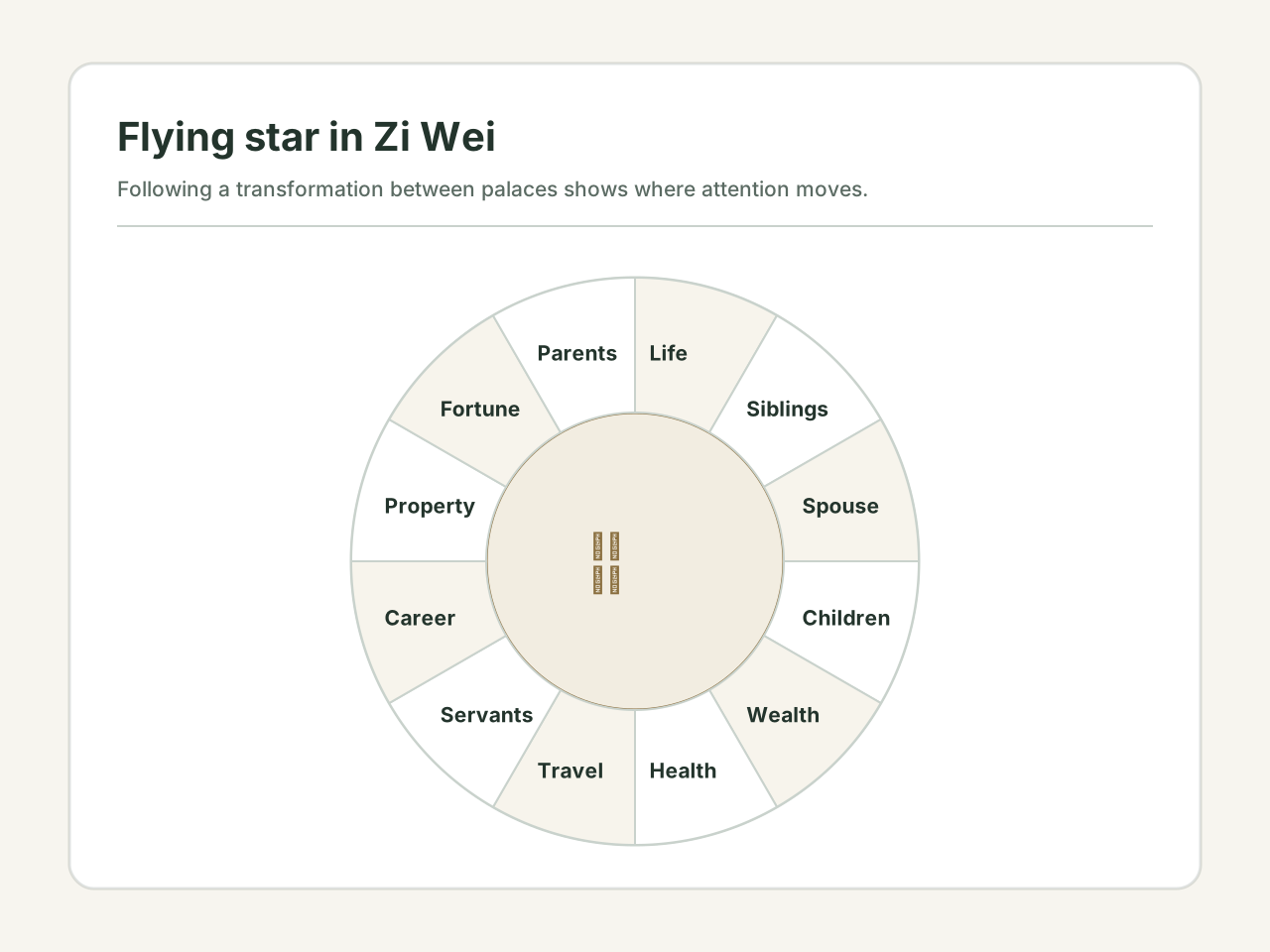
Self-transformation (自化) is a palace's own stem transforming a star that sits inside that same palace — the palace activating itself. Traditionally it is read as energy leaking outward: a wealth palace that self-transforms into Hua Ji is often described as earning money that will not stay.
The origin palace (来因宫) is a different starting point. You take the birth-year stem and find the palace whose stem matches it; that palace is treated as the source of every activation. How much weight this carries varies enormously between schools — some barely use it, others build the whole reading around it.
A worked example: one path, two readings
Suppose a decade lands in the career palace, and the career palace's stem makes a main star in the spouse palace turn Hua Ji. The flying-star reading is that work will pull on the relationship for these ten years, with pressure running from career into the marriage. The trine reading would instead look directly at the star combination in the decade spouse palace and conclude that the relationship structure is tight in this period.
The two statements sound close and are used differently. Flying star gives a conduction path, which is useful for asking where pressure comes from. Trine gives a structural state, which is useful for judging which link is tight. Mixing the two on the same question readily produces two contradictory answers.
Where each method is actually useful
If the question is where pressure in a period comes from and where it goes, flying star supplies a path. If the question is whether a palace's structure is tight or open, trine supplies a state. These are different questions and neither answer substitutes for the other.
Chart tools generally output the trine structure: twelve palaces, stars, brightness, birth-year transformations, decade ranges — all fields you can check directly. Palace-stem transformations are usually not built in, because once you introduce them you must also fix a transformation-table version, a self-transformation convention, and a weight for the origin palace, and those choices change the answer.
If you want to cast flying star yourself, work through the three steps above: assign the palace stems, look up the table, follow the landing palace. When you are done, write down which school you used. Flying star is an analytical language, not a prediction machine.
Disclaimer: This content is for informational and cultural reference purposes only. It does not constitute professional medical, legal, financial, or psychological advice. Readers should exercise their own judgment and consult qualified professionals for specific concerns.
Sources and review basis
Traditional references explain historical vocabulary and context. Official practical sources support only the observable safety, comfort, or environmental points noted in the article; they do not validate metaphysical claims.
Traditional reference
Zi Wei Dou Shu Quanshu (紫微斗數全書)Wikisource digital text · Accessed 2026-10-14
A classical source for the twelve palaces, the main stars, and the four transformations that Zi Wei Dou Shu terminology is built on.
Practical source
APA Dictionary of Psychology: Barnum effectAmerican Psychological Association · Accessed 2026-07-14
A psychology reference for why broad, favourable personality descriptions can feel personally accurate. It does not evaluate BaZi calculations themselves.