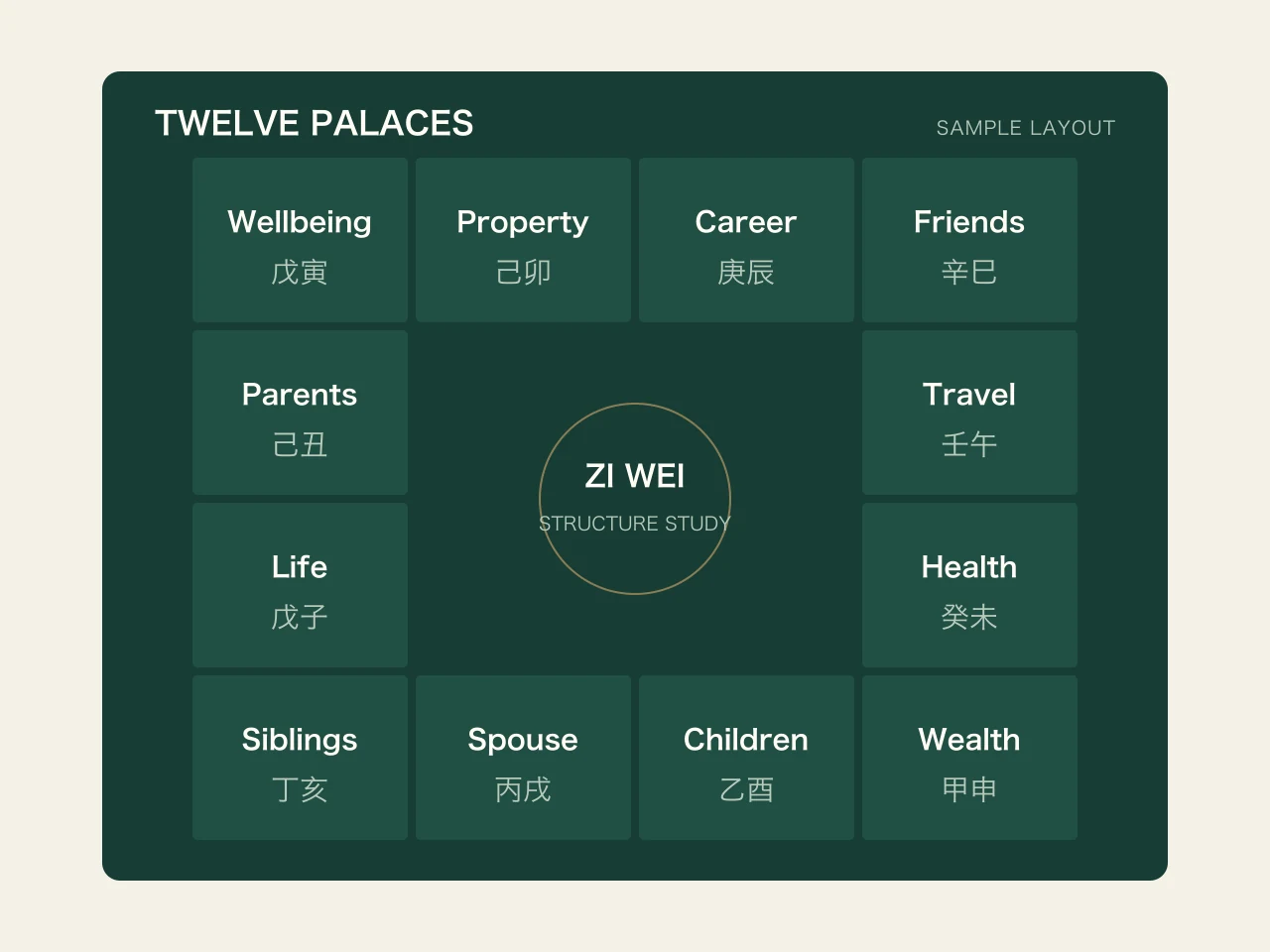
The decade chart is the natal chart under new management
The decade chart (大限) is not a second chart drawn over the first. It is the same twelve palaces with one of them promoted to ruling palace for a ten-year stretch, and the other eleven read against that new vantage point. Nothing in the natal chart moves. What changes is which palace is speaking.
That sounds like a small distinction and is not. A decade reading is not a forecast bolted onto a personality profile — it is a change of position. The natal chart describes the material; the decade says which part of the material is under load. The annual layer (流年) repeats the same operation at a finer grain, which is why a decade and a year can disagree without either one being wrong.
Where the sequence starts
The sequence does not begin at a fixed age. It begins at the number carried by the 五行局 (Five Element Bureau), which is the 纳音 element of the 命宫 stem-branch pair.
| Bureau | First decade starts at | Span |
|---|---|---|
| 水二局 | 虚岁 2 | 2–11 |
| 木三局 | 虚岁 3 | 3–12 |
| 金四局 | 虚岁 4 | 4–13 |
| 土五局 | 虚岁 5 | 5–14 |
| 火六局 | 虚岁 6 | 6–15 |
Two consequences of that table
The first is that the starting age is not the same for everyone. Because the bureau follows the 命宫, and the 命宫 follows the birth month and hour, two people born on the same day can enter their first decade years apart.
The second is that the first decade always sits on 命宫, regardless of gender or polarity. Gender and polarity do not move the starting point. They set the direction of everything after it.
Forward or backward, and who decides
Direction comes from two things only: the polarity of the birth year stem and the person's gender. 甲丙戊庚壬 are yang years; 乙丁己辛癸 are yin.
阳男 and 阴女 run forward: 命宫, then 父母, 福德, 田宅, 官禄, 交友, 迁移, 疾厄, 财帛, 子女, 夫妻, 兄弟. 阴男 and 阳女 run backward: 命宫, then 兄弟, 夫妻, 子女, 财帛, 疾厄, 迁移, 交友, 官禄, 田宅, 福德, 父母. The two lists hold the same twelve palaces in reverse order, which is the point — the sequence is not arbitrary, it is the palace order read from one end or the other.
The consequence is easy to state and easy to forget. A 丙-year man and a 丙-year woman with birth data identical down to the minute walk the palaces in opposite directions. At no age are they in the same decade palace. Any reading that hands both of them the same decade has skipped the step that decides it.
What the overlay adds
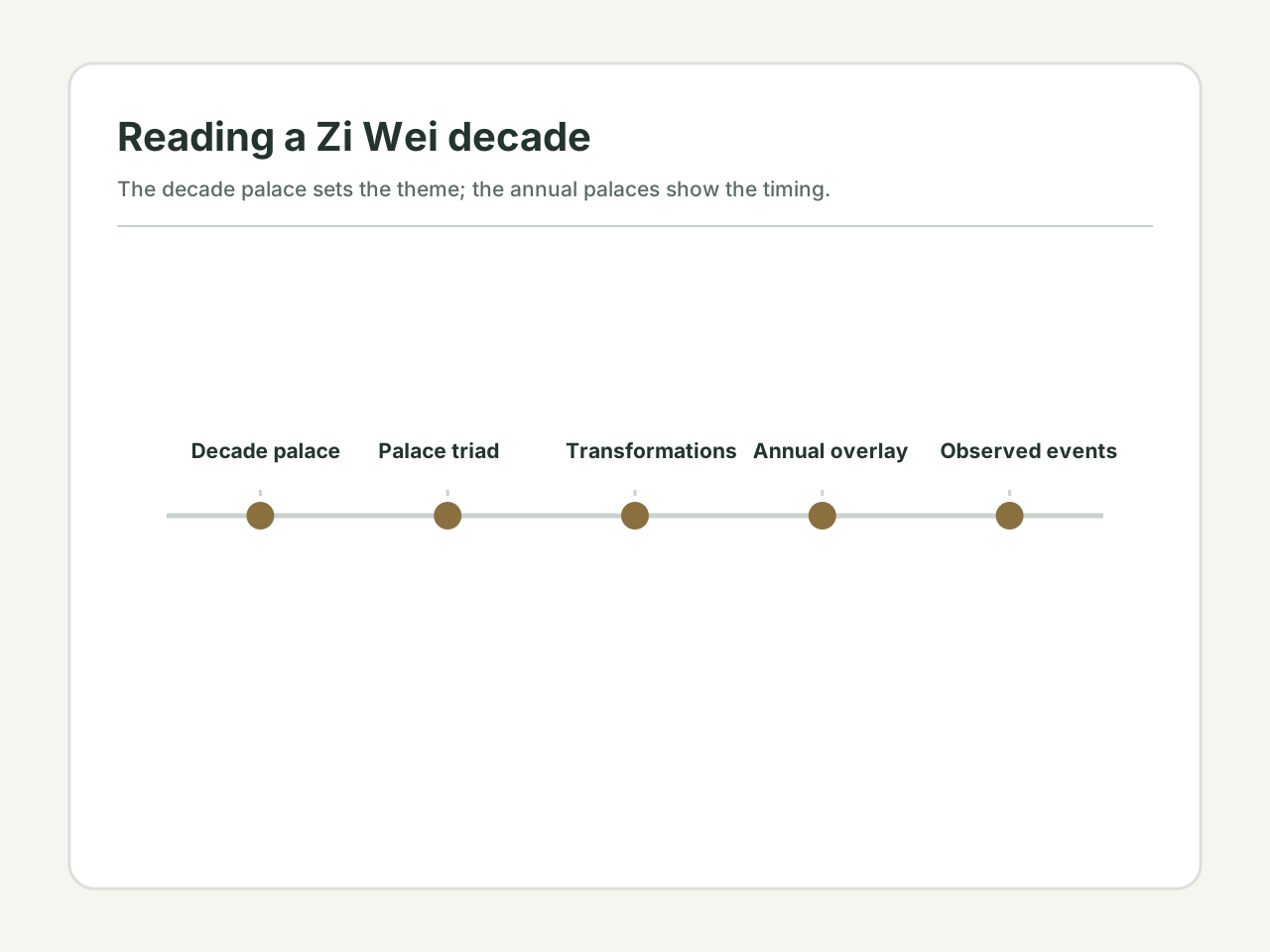
Each palace carries a stem, and when a palace becomes the decade palace its stem generates a fresh set of 四化 from the same table used for the birth year. The mechanism belongs to the Four Transformations article. What matters here is the arithmetic of overlap.
When decade transformations land on stars that already carry birth-year transformations, the layers stack. 生年化禄 plus 大限化禄 on one star is 双禄; 生年化忌 plus 大限化忌 is 双忌. These doublings are the most concrete thing a decade chart produces, because they do not depend on interpretive taste — the same star is pushed twice in the same direction, and the schools agree on where it sits.
The mixed case carries the most information. A star with 生年化忌 that then receives 大限化禄 is being pushed two ways at once. The usual reading is not that the problem is cancelled, but that the decade supplies the means to work on a long-standing difficulty. That is a different instruction from either layer alone.
Where the decade reading runs out
A decade is a ten-year window, not a schedule. Inside it the annual chart rotates and generates its own transformations, so a difficult decade can hold a good year and a strong decade can hold a bad one. Reading a decade as a single verdict skips the layer where most of the variation lives.
化忌 marks where effort is required and shortcuts fail. It does not mark where things break. The difference is not politeness; it changes behaviour. 'This area needs work' produces preparation. 'This area is doomed' produces avoidance, and avoidance is the one response that reliably makes a 化忌 reading come true.
Finally, the reading is only as good as the input. 紫微 depends on the hour, the 命宫 moves with the hour, and the entire sequence is anchored to the 命宫. An approximate birth time produces an approximate sequence. No amount of interpretive skill recovers from that, and the honest move is to say so and read the natal chart's robust features instead of a rotation built on a guessed hour.
Disclaimer: This content is for informational and cultural reference purposes only. It does not constitute professional medical, legal, financial, or psychological advice. Readers should exercise their own judgment and consult qualified professionals for specific concerns.
Sources and review basis
Traditional references explain historical vocabulary and context. Official practical sources support only the observable safety, comfort, or environmental points noted in the article; they do not validate metaphysical claims.
Traditional reference
Zi Wei Dou Shu Quanshu (紫微斗數全書)Wikisource digital text · Accessed 2026-10-14
A classical source for the twelve palaces, the main stars, and the four transformations that Zi Wei Dou Shu terminology is built on.
Practical source
APA Dictionary of Psychology: Barnum effectAmerican Psychological Association · Accessed 2026-07-14
A psychology reference for why broad, favourable personality descriptions can feel personally accurate. It does not evaluate BaZi calculations themselves.