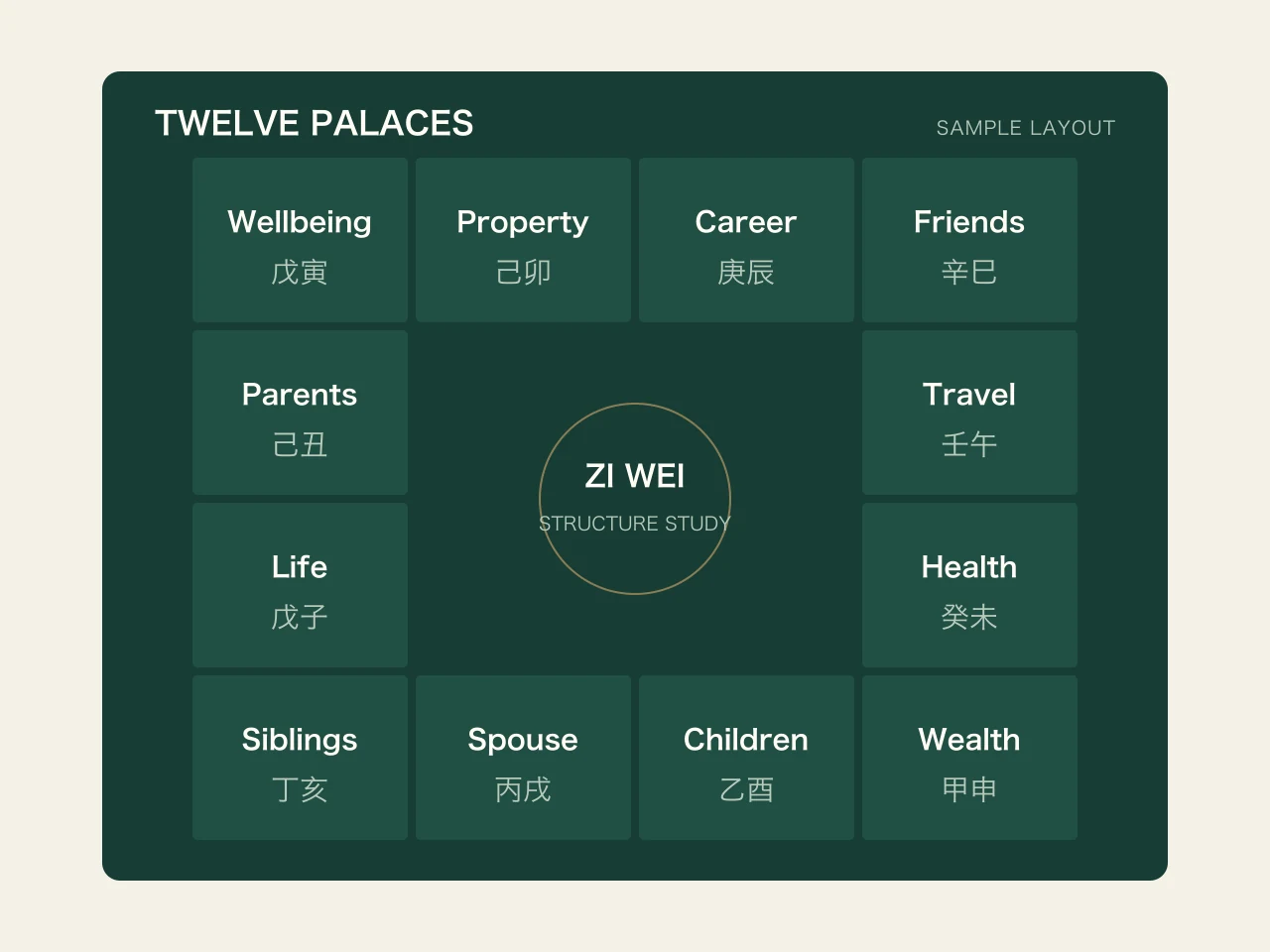
The career palace is trine to the self palace and opposite the spouse palace
The twelve palaces hold fixed positions relative to one another, and the career palace (官禄宫) occupies two that carry most of its meaning. It sits in the trine of the self palace (命宫) — four palaces away, with the wealth palace and the travel palace completing the set. And it sits directly opposite the spouse palace (夫妻宫).
Both relationships do explanatory work. Because career shares a trine with the self palace, the career palace is read as the outward face of identity: what a person does in the world, as distinct from what they are. Because it faces the spouse palace, career and marriage are structurally opposed, which is why the same period so often reads as either a career push or a relationship squeeze. Anyone who has watched a promotion put pressure on a household has seen this geometry described in advance.
What the palace cannot do is name a job. A star describes a quality of work — how decisions get made, whether the output is visible, whether the environment is structured or fluid — and a quality can be satisfied by dozens of occupations and by none of the ones a popular book lists. Reading the quality is the whole method; reading it as a job title is where the method gets abandoned.
What the main stars suggest, read as qualities rather than professions
Each of these is a way of working, not a sector. The third column is where the same quality is most easily expressed; the fourth is what the quality costs when it is not managed.
| Star in the career palace | Quality of work | Where it is easily expressed | What it costs when unmanaged |
|---|---|---|---|
| Zi Wei (紫微) | Authority and visibility | Roles where the person sets direction and is seen doing it — senior technical, editorial, executive, public office | Being read as remote or unapproachable. Authority without contact stops generating information |
| Tian Ji (天机) | Analysis and adaptation | Research, consulting, systems design, strategy, teaching — work that rewards re-framing the problem | Re-deciding what has already been decided. The analysis becomes a substitute for committing |
| Tai Yang (太阳) | Public work and service | Teaching, media, healthcare, public service — anything where the work is addressed to people rather than to objects | Depletion through over-commitment. The visibility is real and the recovery time is not scheduled |
| Wu Qu (武曲) | Discipline and precision | Finance, accounting, engineering, operations, anything where a small error is expensive | Rigidity at the moment flexibility is required. The same precision that built the position refuses to give it up |
| Tian Tong (天同) | Cooperation and harmony | Supportive teams, counselling, hospitality, client-facing work, creative collaboration | Avoiding conflict past the point where the avoidance itself becomes the problem |
| Po Jun (破军) | Disruption and rebuild | Turnarounds, startups, restructuring, creative industries — roles whose brief is to break a pattern | Leaving before consolidation. The disruption is genuinely the skill; finishing is the part that gets skipped |
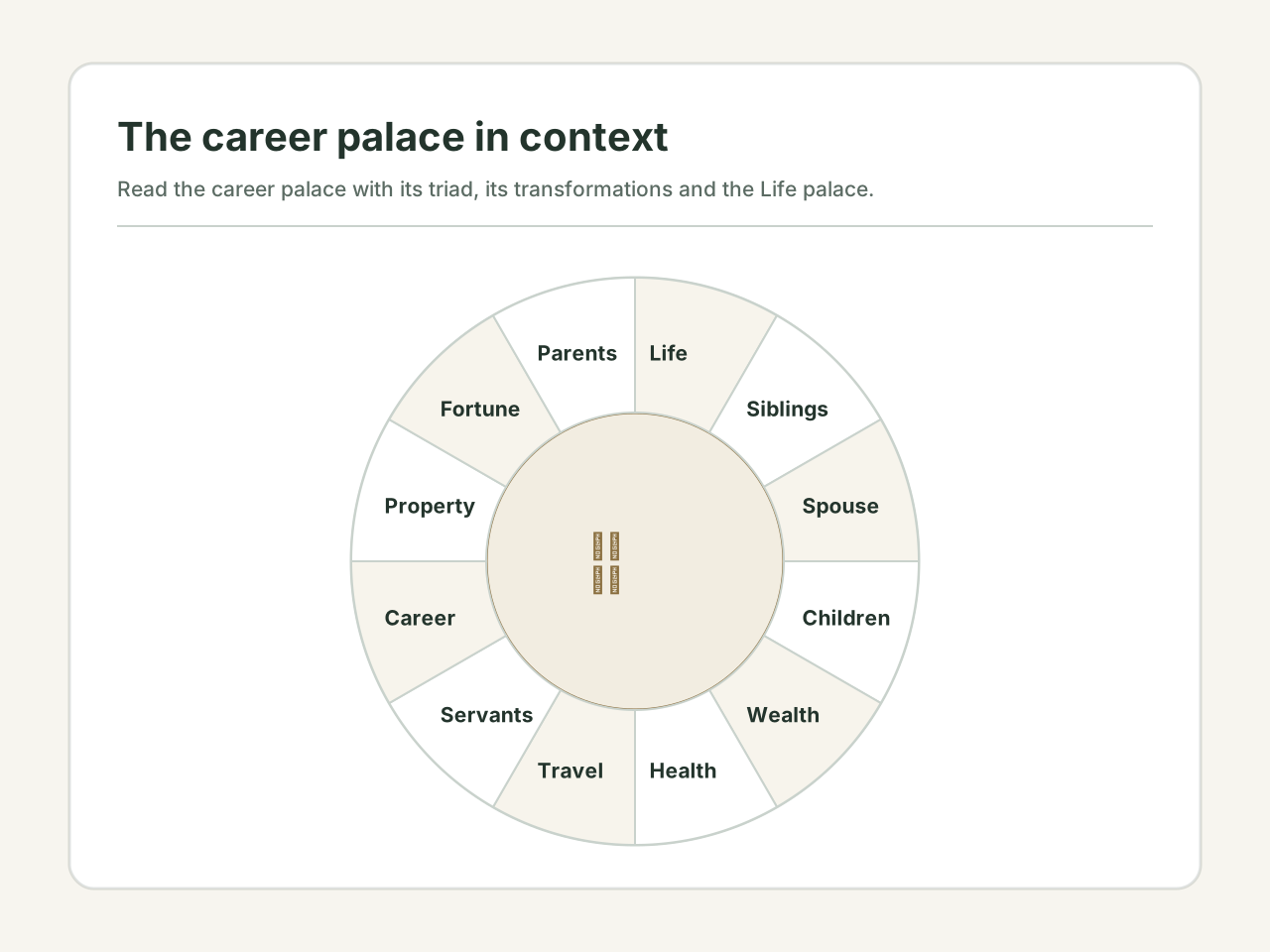
Four readings that come before the star names
The star list is the last thing to read, not the first. These four change the conclusion more than swapping one main star for another.
| Reading | What to check | How it changes the conclusion |
|---|---|---|
| Palace-stem transformations (宫干四化) | Which star does the career palace's own stem transform, and into what? | A self-transformation in the career palace is read as the domain spending its energy outward — effort that does not accumulate. Hua Lu there reads as opportunity arriving without being asked for; Hua Ji there reads as friction that keeps recurring in the same place |
| Brightness (庙旺利陷) | Is the main star bright, neutral, or dim in this branch? | The same star expresses differently by brightness. A dim Zi Wei is read as responsibility without standing — the authority is assigned and not recognised |
| Assistant and malefic stars | Which of 左辅, 右弼, 文昌, 文曲 are present, and which of 擎羊, 陀罗, 火星, 铃星? | Assistants stabilise the main star; the four malefics complicate it. Two malefics in the career palace changes the reading more than replacing the main star entirely |
| Decade and annual overlay | Where is the decade palace, and what does it transform? | The natal palace gives the baseline; the decade palace gives the phase. A decade-level tension read as a lifelong verdict is the most common error in the whole system |
Timing: what the decade palace actually adds
A decade landing on the career palace puts work in the foreground for ten years, and the practical consequence is that career decisions taken in that window have more leverage than the same decisions taken outside it. A decade landing on the spouse palace — the palace facing the career palace — reads differently: the relationship is the decade's theme, and career is what gets negotiated against it.
Hua Lu and Hua Quan are not interchangeable. Hua Lu in the career palace reads as receiving: offers, resources, and visibility that arrive without being asked for. Hua Quan reads as control: the ability to set direction and hold it. A decade with Lu and no Quan often produces opportunities the person cannot direct, which is a specific and recognisable frustration.
Hua Ji in the career palace is not a stop sign. It marks where friction concentrates, which usually means the same problem recurring in the same place for the length of the decade — a reporting line, a role definition, a founder. Naming it precisely is more useful than waiting for the decade to end, because the decade will end either way and the pattern will have repeated.
A worked example: the chart says leader, the person does not want to lead
A software engineer has Zi Wei in her career palace. Two readings she was given told her she was 'destined for leadership' and should move into management. She likes writing code and has no interest in managing people, and she began to read her own preference as a failure to live up to the chart.
The readings had translated Zi Wei into 'boss'. What the star describes is authority and visibility, and neither requires a reporting line. A principal engineer who makes the technical calls, whose judgement others wait on, and who is consulted precisely because she is visible in her field has both. What she does not have is direct reports, which is a different thing.
She stayed on the individual contributor track and went after technical leadership instead: principal engineer, the person others bring hard decisions to, mentoring without managing, speaking publicly on her specialism. The Zi Wei quality is expressed. The traditional reading had assumed one particular container for it.
The general lesson is not 'follow your preference'. It is that a star names a quality and the chart never names the container. Zi Wei means authority, not management. Wu Qu means precision, not accounting. Tian Ji means analysis, not consulting. Match the quality to work that exists and that you will actually do.
Where this stops
The career palace describes the shape of work that suits a person: how much structure, how much visibility, whether decisions are made alone or negotiated. It also shows when that shape is under pressure. Both are usable, and both are descriptions of conditions rather than outcomes.
It cannot tell anyone which job to take. That depends on skills, credentials, network, geography, health, and what happens to be hiring — none of which is in the chart. A palace that reads 'authority' is satisfied equally by a department head, a lead engineer, a shop owner, and a senior nurse, and the chart has no opinion on which.
The workable use is to read the quality, read the decade, and then ask a question about the actual situation: does my current role exercise the quality this palace describes, and is this the decade to push or to consolidate? The chart supplies the vocabulary. The decision is made with information the chart does not have.
Disclaimer: This content is for informational and cultural reference purposes only. It does not constitute professional medical, legal, financial, or psychological advice. Readers should exercise their own judgment and consult qualified professionals for specific concerns.
Sources and review basis
Traditional references explain historical vocabulary and context. Official practical sources support only the observable safety, comfort, or environmental points noted in the article; they do not validate metaphysical claims.
Traditional reference
Zi Wei Dou Shu Quanshu (紫微斗數全書)Wikisource digital text · Accessed 2026-10-14
A classical source for the twelve palaces, the main stars, and the four transformations that Zi Wei Dou Shu terminology is built on.
Practical source
APA Dictionary of Psychology: Barnum effectAmerican Psychological Association · Accessed 2026-07-14
A psychology reference for why broad, favourable personality descriptions can feel personally accurate. It does not evaluate BaZi calculations themselves.