What a journal actually measures
A dream journal is usually sold as an instrument for reading dreams. What it measures is recall. The record you produce is the set of dreams you remembered well enough to write down, and that set is smaller and stranger than the set of dreams you had. Most dreams are gone by the time you are properly awake, and the ones that survive are the vivid, the frightening, the novel and the ones you woke up inside.
That is not a reason to skip the practice; it is a reason to know what the practice produces. A journal gives you a dated record of recalled dreams, written before the day they might have predicted has happened. Nothing else in dream work has that property, and the property is the whole value. A memory consulted after the fact can be quietly edited to fit what occurred. A page written at 6:40 in the morning cannot.
Why the record has to be immediate
Dream memory decays faster than almost any other kind, and the decay is not gradual in a useful way — a dream that felt completely present on waking can be unrecoverable within a few minutes of sitting up. Three practical consequences follow. Write before you are fully awake, which means paper rather than a screen, because a phone's light and its notifications end the state you are trying to record from. Write in the present tense and in fragments, because you are transcribing rather than composing, and a page of nouns and verbs written at speed beats a polished paragraph written an hour later. And accept that some mornings will produce nothing, because the gaps are data too: they tell you where the floor of your recall sits, which is exactly the quantity a journal is measuring.
| Habit | Why it matters for the record | What it costs if you skip it |
|---|---|---|
| Paper and pen within reach | No light, no notifications, no wake-up cost | The dream is gone before the screen is unlocked |
| Write in the present tense | Keeps you transcribing instead of interpreting | You start editing the dream into a story |
| Fragments are acceptable | Speed beats completeness at the moment of waking | The most vivid image is the first thing lost |
| Record the nights you recall nothing | The gaps are the recall floor | The journal looks like a complete record and is not |
The one effect a diary reliably produces
Write a dream down before the day happens, and the dream stops looking like a prediction. This is the single most reliable result of keeping a journal, and it is not because dreams are meaningless. It is because of how the matching is done. Without a record, the dreams you remember are the ones that matched something, and the ones that matched nothing are not retrieved at all. The American Psychological Association defines confirmation bias as the tendency to gather evidence that confirms preexisting expectations, typically by emphasising or pursuing supporting evidence while dismissing or failing to seek contradictory evidence. An unrecorded dream is a perfect instrument for that tendency: the misses are invisible by default. Once the page is dated and written in advance, the misses become visible too, and the hit rate falls to whatever it actually is. The related effect is the Barnum effect, the reason a broad and flattering reading feels personally exact — a description general enough to fit anyone will feel like it was written for you, and dream readings are usually general enough to fit anyone.
A method built around that effect
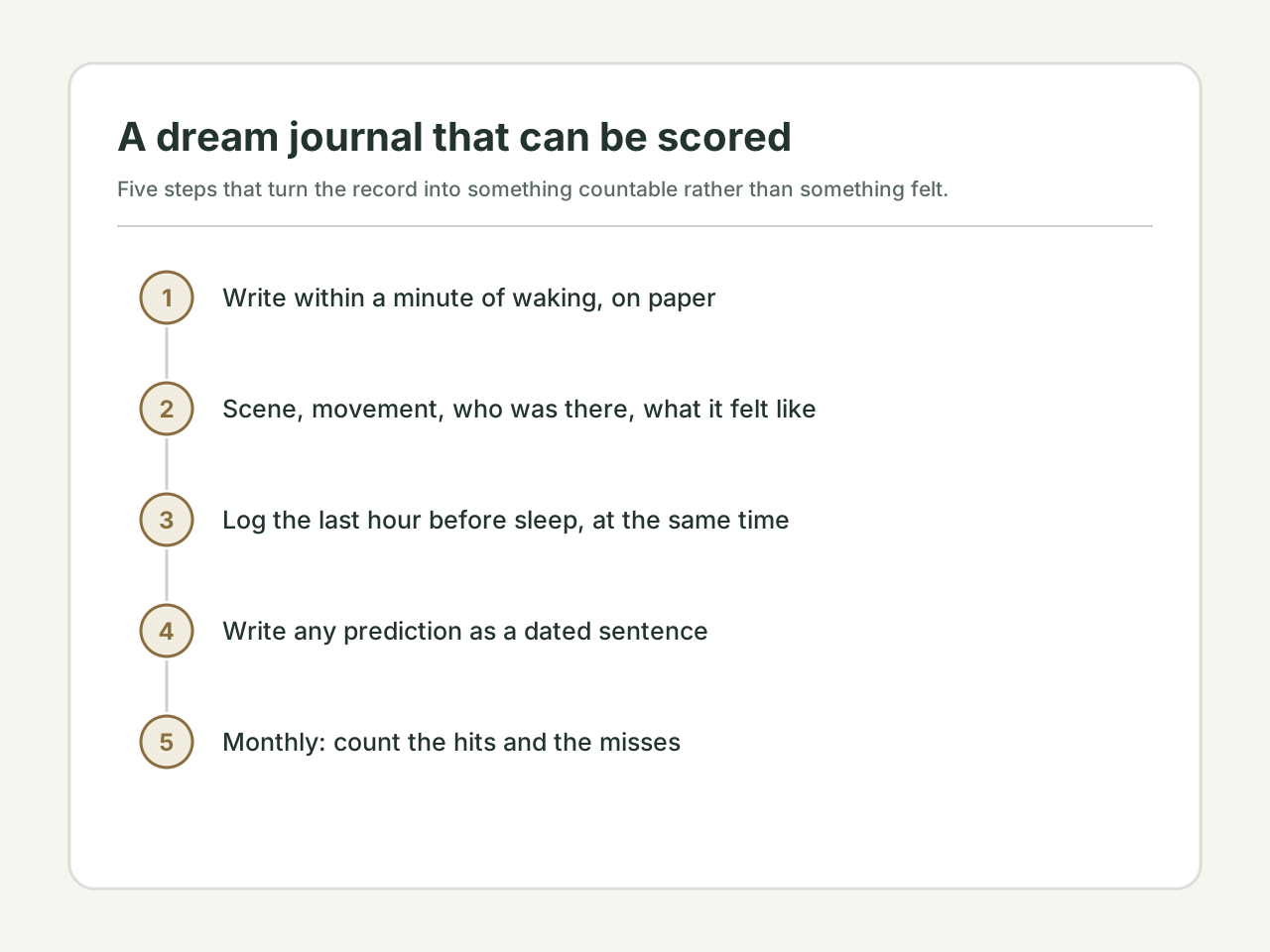
The method below is designed so that the record can be scored rather than merely felt. It is the same journaling habit, arranged so the scoring is possible.
| Step | What to do | What it makes possible later |
|---|---|---|
| 1. Set up the night before | Paper and pen on the bedside surface, and one line of intent before sleep: I will write down whatever I remember. | A record that exists at all, which is the only hard part |
| 2. Capture immediately | Within a minute of waking, in the present tense, in fragments. Scene, movement, who was there, what it felt like. | A dated record written before the day's events |
| 3. Log the context at the same time | Two lines: the last hour before sleep, and the first thought on waking. Written now, not reconstructed at review. | A way to test causes rather than meanings |
| 4. Write predictions as predictions | If the dream seems to point at something, write it as a dated sentence in a separate column. | A countable hit rate instead of an impression |
| 5. Review on a fixed date | Once a month, count the predictions that hit and the ones that missed, and list the themes that recurred. | The measurement the journal exists to make |
What to look for, and what the numbers cannot carry
At review, the productive questions are about recurrence and tone rather than about decoding:
- Which scenes came back, and what did they have in common? Recurrence is the one pattern a journal can establish that a single dream cannot, and a recurring scene is worth a second look for the practical reasons on the health page — the evening, the room, the breathing.
- What was the dominant feeling, and did it change? Tone is more stable than plot and easier to compare across weeks.
- What did the prediction column actually score? A hit rate is only interesting if the misses were recorded with the same care. A theme that appears in most people's dreams cannot distinguish you from anyone, so a match on it carries no information.
- What was happening in the logged context? The two lines written at 6:40 in the morning are the most useful part of the entry, because they are the only part written before interpretation had a chance to start.
- What did you not record? A month of near-empty pages is a finding about recall, not about your dreams, and it tells you not to draw conclusions from the few nights you did remember.
What the practice is for
Kept this way, a dream journal is a self-observation instrument with a narrow and honest output: a dated record of what you recalled, a log of the evenings that preceded it, and a scored prediction column. It will not tell you what a symbol means, and it will not tell you what will happen. What it can do is show you what your mind returns to when nothing is directing it, and it can do that because the record is made before the day rather than after it. The value is in the discipline of writing first and reading second, which is the opposite of the order in which dream interpretation is usually presented.
Disclaimer: This content is for informational and cultural reference purposes only. It does not constitute professional medical, legal, financial, or psychological advice. Readers should exercise their own judgment and consult qualified professionals for specific concerns.
Sources and review basis
Traditional references explain historical vocabulary and context. Official practical sources support only the observable safety, comfort, or environmental points noted in the article; they do not validate metaphysical claims.
Practical source
APA Dictionary of Psychology: Confirmation biasAmerican Psychological Association · Accessed 2026-10-26
A psychology reference for why evidence that fits an existing expectation is kept and evidence that does not is not retrieved. Used to explain what a dated dream record changes; it does not evaluate dream interpretation itself.
Practical source
APA Dictionary of Psychology: Barnum effectAmerican Psychological Association · Accessed 2026-07-14
A psychology reference for why broad, favourable personality descriptions can feel personally accurate. It does not evaluate BaZi calculations themselves.
Practical source
US NIH/NHLBI: Healthy Sleep HabitsNational Heart, Lung, and Blood Institute, NIH · Accessed 2026-07-14
Health background for sleep routines and bedroom conditions; it does not endorse directional feng shui claims.