Two genres share one shelf
Chinese writing about dreams splits into two bodies of text that are almost never shelved together. One of them has a mechanism and ends in clinical instructions. The other has no mechanism and ends in verdicts. The first is a single chapter: 淫邪發夢, chapter 43 of the 靈樞, the acupuncture half of the 黃帝內經. The second is the popular dictionary genre, of which 周公解夢 is the best-known surviving example. Both are quoted today as traditional Chinese dream interpretation, and they do not agree on what a dream is.
The chapter with a mechanism opens by saying why dreams happen at all. 正邪從外襲內,而未有定舍,反淫於藏,不得定處,與營衛俱行,而與魂魄飛揚,使人臥不得安而喜夢 — a pathogenic factor comes in from outside, finds no fixed lodging, floods back into the organs, cannot settle, travels with the nutritive and defensive qi, and the hun and po drift, so the sleeper cannot lie still and dreams. That is a theory with a cause, a pathway and a consequence. The dictionary genre offers nothing comparable. It offers a list.
What the chapter with a mechanism contains
The chapter then works through its cases. Twelve of them describe an excess, and each opens with the word 盛. Fifteen describe a deficiency, and each opens with 客, a visiting pathogen that has lodged where it should not be. Every row names a dream image, states the pattern, and ends with an instruction: 寫之, drain, for the twelve excesses, and 補之, supplement, for the fifteen deficiencies. Twenty-seven rows in total, and not one of them is a symbol carrying a fixed meaning.
| Dream image, as the chapter writes it | The pattern it names | What the chapter says to do |
|---|---|---|
| 陰氣盛,則夢涉大水而恐懼 | Excess of yin | 寫之 — drain |
| 陽氣盛,則夢大火而燔倦 | Excess of yang | 寫之 |
| 上盛則夢飛 | Excess above | 寫之 |
| 下盛則夢墮 | Excess below | 寫之 |
| 肝氣盛,則夢怒 | Excess in the liver | 寫之 |
| 肺氣盛,則夢恐懼,哭泣,飛揚 | Excess in the lung | 寫之 |
| 客於腎,則夢臨淵,沒居水中 | Deficiency in the kidney | 補之 — supplement |
| 客於心,則夢見邱山煙火 | Deficiency in the heart | 補之 |
| 客於肺,則夢飛揚,見金鐵之奇物 | Deficiency in the lung | 補之 |
| 客於膽,則夢箆訟自刳 | Deficiency in the gall bladder | 補之 |
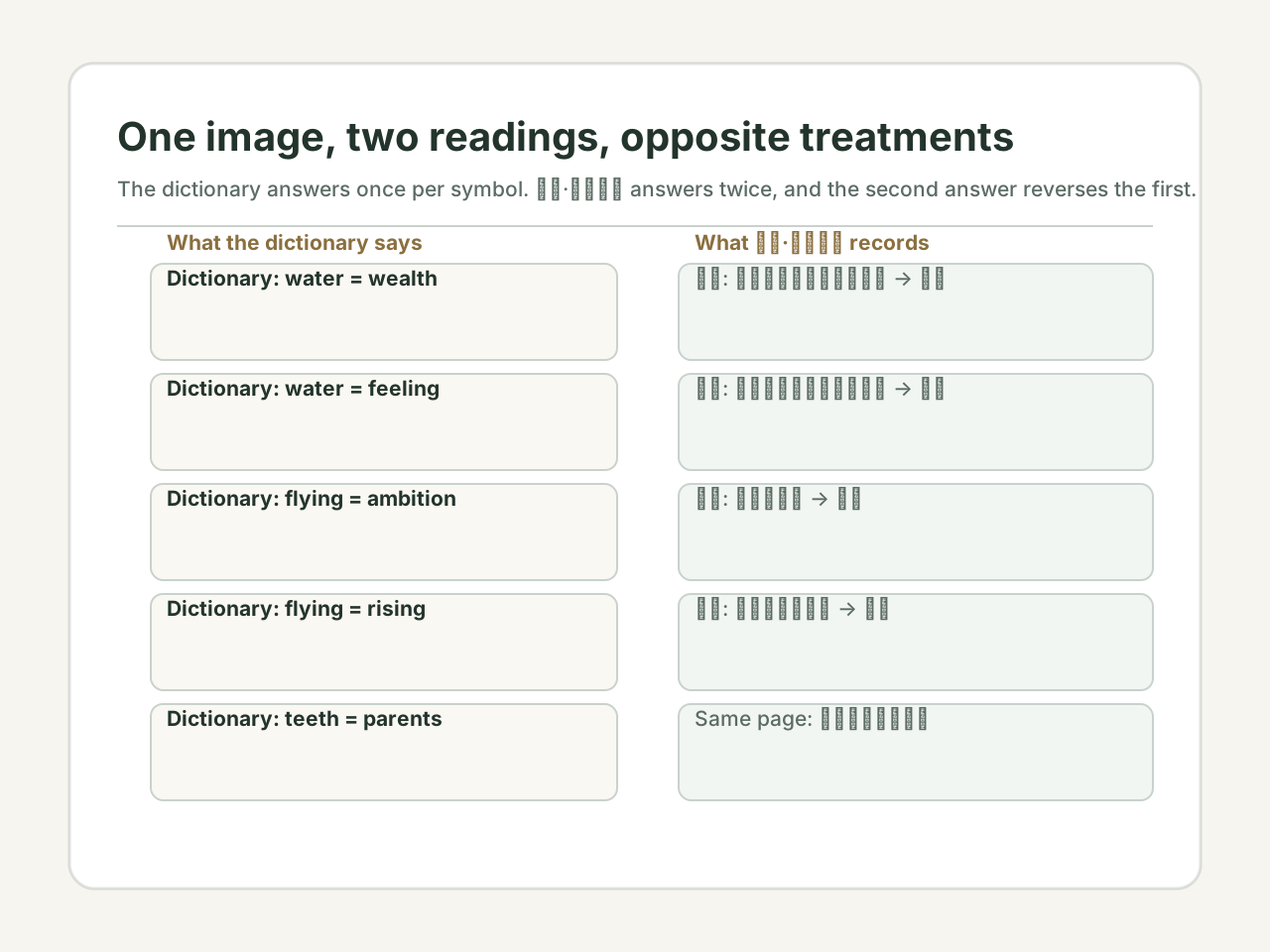
Three images the chapter reads twice, in opposite directions
The dictionary genre has one row per image. The chapter has two rows for several images, and the second row reverses the first. Water appears as 陰氣盛,則夢涉大水而恐懼, an excess of yin to be drained, and again as 客於腎,則夢臨淵,沒居水中, a deficiency in the kidney to be supplemented. Flying appears as 上盛則夢飛, an excess above to be drained, and again inside the lung row of the deficiency list. Fire appears as 陽氣盛,則夢大火而燔倦 and again as 客於心,則夢見邱山煙火.
The lung pair is the clearest, because it holds the organ constant as well as the image. 肺氣盛,則夢恐懼,哭泣,飛揚 sends you to the needle to drain. 客於肺,則夢飛揚,見金鐵之奇物 sends you to the needle to supplement. Same organ, same image, opposite polarity, opposite treatment. A table with one row per symbol cannot express that, which is why the two genres are not two versions of the same system.
| Dream image | Reading one, and its treatment | Reading two, and its treatment |
|---|---|---|
| Water | 陰氣盛,則夢涉大水而恐懼 — excess of yin, drain | 客於腎,則夢臨淵,沒居水中 — deficiency in the kidney, supplement |
| Flying | 上盛則夢飛 — excess above, drain | 客於肺,則夢飛揚 — deficiency in the lung, supplement |
| Fire and smoke | 陽氣盛,則夢大火而燔倦 — excess of yang, drain | 客於心,則夢見邱山煙火 — deficiency in the heart, supplement |
| Fear, weeping and flying | 肺氣盛,則夢恐懼,哭泣,飛揚 — excess in the lung, drain | 客於肺,則夢飛揚,見金鐵之奇物 — deficiency in the lung, supplement |
The dictionary genre, read as written
The surviving dictionary is organised by category rather than by theory. 周公解夢 runs through 27 sections, from 天地日月星辰 at the top to 龜鱉魚蝦昆蟲 at the bottom, and each entry is a four-character dream scene followed by a two- to four-character verdict. There is no preface explaining why any of it works. The page is signed to 周公旦, but the opening verse that follows the signature cites 江淹, who lived in the Southern Dynasties, and the 黃粱 and 巫峽 stories, which are Tang. The attribution is a convention of the genre, not a date.
Read closely, the entries do not behave like a code either. In the water section the verdicts split in every direction: 水上行者主大吉, 自在水中大吉利 and 飲水不休得大財 sit alongside 自跌水中不出凶, 流水遶身有獄訟 and 人家有水兒子亡. Teeth falling out is entered twice with opposite verdicts — 齒自落者父母凶 and 齒落更生子孫興. The snake entries make the dependency explicit: 蛇赤黑口舌青吉 reads the colour of the snake rather than the snake, which means the entry is not about snakes at all. The dictionary is a catalogue of scenes with attached verdicts, assembled from more than one source, and it does not claim to be a system.
Three rules that survive reading both
What is left once the two genres are set beside each other is narrower than either, and more usable:
- Read the scene, not the noun. Both bodies of text are scene-level when you read them closely. The chapter's rows are full sentences with a state of the body in them, and the dictionary's entries are four-character scenes. Water is not a row in either. Wading across great water in fear, and falling into water and not coming back out, are rows — and they carry different verdicts in both texts.
- Ask which way the reading runs before accepting it. The chapter's rows divide into excess and deficiency, and the treatment inverts with the division. A modern reading that cannot say which side it is on has not finished. Being chased is the most frequently reported recurring dream theme in the survey literature, and a theme that common carries very little information about any one person; the useful question is what the chase was doing in your dream and how it ended.
- Count the entries before you accept the verdict. If a symbol appears more than once in the dictionary with more than one verdict, the verdict is attached to the scene and not to the symbol. Checking takes a minute and it stops the most common error in symbol reading, which is quoting the entry that agrees with you.
What a symbol is actually good for
A symbol list earns its place as a checklist for describing a dream accurately rather than as a decoder for it. The dictionary's 27 categories are a reasonable prompt sheet: was there water, a house, a road, an animal, a relative, a fight, a journey, food? Working through them after a vivid dream surfaces details that would otherwise be dropped in the first retelling, and the details are where both classical genres put their content. The chapter never reads a noun; it reads a situation with a bodily state attached. The dictionary never reads a noun either, once you notice that its entries are scenes. Neither tradition supports the idea that a single object in a dream stands for a single thing in a life, and the two genres disagree with each other too often to be merged into one answer.
Disclaimer: This content is for informational and cultural reference purposes only. It does not constitute professional medical, legal, financial, or psychological advice. Readers should exercise their own judgment and consult qualified professionals for specific concerns.
Sources and review basis
Traditional references explain historical vocabulary and context. Official practical sources support only the observable safety, comfort, or environmental points noted in the article; they do not validate metaphysical claims.
Traditional reference
Huangdi Neijing, Lingshu 43: Yinxie Fameng (靈樞·淫邪發夢)Wikisource digital text · Accessed 2026-10-26
The only classical chapter that explains why dreams occur and then lists twenty-seven dream scenes with their patterns and treatments. Quoted for the text itself; it is a clinical chapter, not a symbol dictionary.
Traditional reference
Zhougong Jiemeng (周公解夢)Wikisource digital text · Accessed 2026-10-26
The best-known surviving dream dictionary: twenty-seven categories, each entry a four-character dream scene followed by a verdict. Quoted for the structure and for the entries that contradict each other.