Skip to content
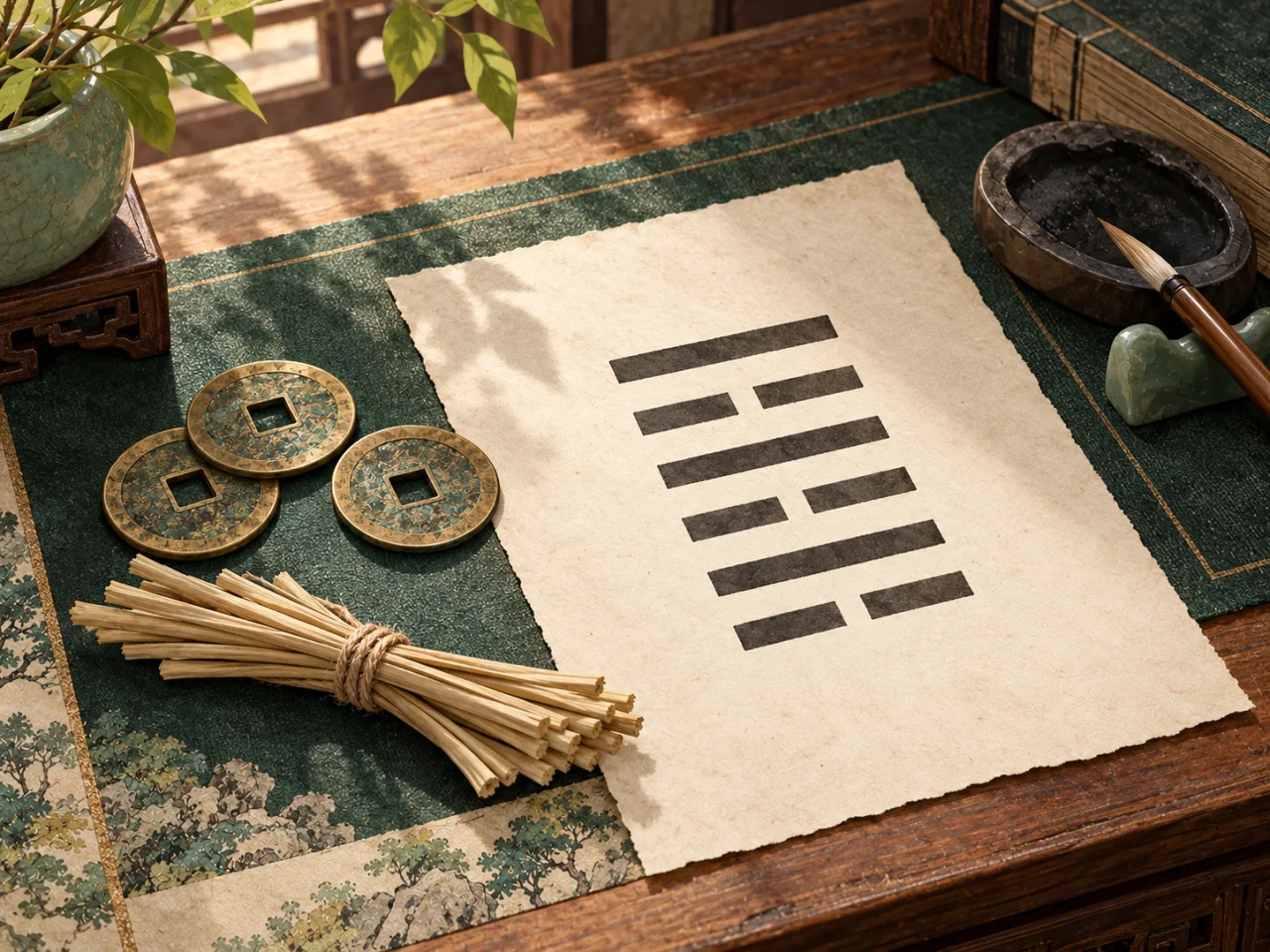
Yarrow stalks, bronze coins and a hand-drawn I Ching hexagram on parchment.

Divination

Qi Men Dun Jia Planning Board

Use a simplified Qi Men Dun Jia board to document a question, compare options, and keep practical evidence separate from symbolic planning prompts.

Before you start

Prepare these details to see these results

Check which details are required before entering personal information. If something is missing, the page explains the effect instead of guessing for you.

What to prepare

  1. 1

    Question or situation

    Defines the decision or situation that the result should address.

  2. 2

    Reading date

    Sets the date used to construct this event-specific reading.

  3. 3

    Reading time

    Sets the time used to construct this event-specific reading.

What you will see

  1. 1

    Question context

  2. 2

    Reading time

  3. 3

    Nine-palace board

What you need before you start

Before starting, confirm that dates, times, and other details are accurate, and note which items are required or optional. Do not replace missing required information with a guess.

Question or situation

required

type in required

Defines the decision or situation that the result should address.

Example: Describe the decision or situation

What to enter: Remove accidental extra spaces and enter only the information requested.

If you leave it out: The tool cannot produce a reliable result without this required value.

Reading date

date optional

Sets the date used to construct this event-specific reading.

Example: Optional

What to enter: Use a valid calendar date that is not in the future.

If you leave it out: The tool will continue with reduced detail and will not infer the missing value.


Reading time

time optional

Sets the time used to construct this event-specific reading.

Example: Optional

What to enter: Use a valid local time; leave it blank only when this item is optional.

If you leave it out: The tool will continue with reduced detail and will not infer the missing value.

How it works

This tool uses the details you enter on the page to produce a result. It is free to use, and your information is not sent to a third-party AI service.

Use the board as a decision record

Save the exact question, local date and time, time zone, available options, constraints, stakeholders, facts still needing verification, and fallback plan. Compare the board with these real conditions instead of selecting a direction in isolation. At the next milestone, record what occurred and whether the chosen action worked. This simplified board is educational and must not direct investment, gambling, medical, legal, or safety decisions.

Define the decision before the board

Write one operational question, the available options, the time-zone and location convention, the people affected, and the facts still needing verification. Qi Men palace, door, star, deity, and nine-palace terms are labels in a declared school; do not blend them with route facts., the people affected, and the facts still needing verification. A direction without a question is only a label. A clear record prevents the board from becoming a substitute for ordinary planning.

Separate board output from route facts

For each option, compare access, cost, permission, weather, timing, safety, and a fallback plan. Then record the board’s direction or palace association separately. If the practical route fails, reject it regardless of a favourable symbolic label.

A reversible planning case

Suppose a fictional team must choose where to hold a short meeting. The board may provide a secondary prompt, but noise, accessibility, privacy, internet access, and participant consent decide whether the room works. Record the chosen option and why the alternatives were rejected.

Review the milestone

At the agreed milestone, write the outcome before reopening the interpretation. Record what was expected, what was observed, and what ordinary factor mattered. Keep the original board version so a later review cannot quietly change the input.

Safety boundary

This simplified educational board cannot direct investment, gambling, medicine, law, emergency response, travel safety, or structural work. Use qualified advice and direct evidence whenever the decision has material consequences.

Is this a complete Qi Men Dun Jia lineage chart?

No. It is a simplified cultural planning board that turns a question and time into a deterministic nine-palace direction map. It is useful for reflection, not for deterministic prediction.

How should I use the directions?

Translate directions into practical choices: who to contact, where to sit or meet, which option to prioritize, and which path needs more verification.

Can a favourable direction replace checking the practical route?

No. Travel time, access, weather, safety, permission, cost, and the needs of other people come first. A direction can be a secondary planning prompt only when the practical options are already acceptable.

What makes a Qi Men decision record reviewable?

Save the exact question, local date and time, time zone, board version, available options, known constraints, stakeholders, source facts, chosen action, fallback, and review milestone. Separate facts from symbolic interpretation and list what still needs direct verification. At the milestone, record the outcome before changing the original reading. A reviewable record shows whether the board organized the decision; it does not turn the board into evidence for investing, gambling, medicine, law, travel safety, or another high-stakes choice.

Keep reading

Related articles

Try next

Related tools