The zodiac is one branch out of four
Your zodiac animal is the branch of your birth year. A full chart has four branches and four stems — eight characters — so the zodiac is one of eight, and it belongs to the palace that describes family background and early environment rather than the person's own working life.
That does not make it useless. It makes it a small input, and it explains why zodiac-based advice sounds specific while covering very little: a recommendation derived from one branch can be stated with total confidence and still miss the three branches where a person's actual pressures sit.
Where the year branch sits
The four pillars are not interchangeable. Each is read as a palace with its own subject and, in the common assignment, its own stretch of life: the year for family background and early environment, the month for upbringing and social position, the day for the person and the partner, the hour for children and later life. The zodiac occupies the first of these.
So 属兔 is a statement about the palace that describes where a person came from, and almost nothing about the day branch — the palace most readings use for partnership — or the month branch, which carries work and standing. A zodiac object bought with a career in mind is aimed at the wrong pillar before the question of whether objects work at all has been raised.
| Pillar | Palace | Main subject | Common age band |
|---|---|---|---|
| Year 年 | ancestry and early home | family background, childhood environment | 1–16 |
| Month 月 | parents and social position | upbringing, work, standing | 17–32 |
| Day 日 | self and spouse | the person (stem) and the partner (branch) | 33–48 |
| Hour 时 | children and later life | children, outcomes, old age | 49+ |
Two element assignments that do not agree
There are two different ways an animal gets an element, and they answer different questions.
The branch has a fixed element: 子 is water, 丑 earth, 寅 wood, 卯 wood, 辰 earth, 巳 fire, 午 fire, 未 earth, 申 metal, 酉 metal, 戌 earth, 亥 water. This never changes and it is what a chart uses.
The year pair also has a 納音 element, assigned in pairs across the sixty-year cycle: 2023 癸卯 is 金箔金, 2024 甲辰 and 2025 乙巳 are both 覆燈火, 2026 丙午 is 天河水. So someone born in 2023 is wood by branch and metal by 納音. A product that says the rabbit is wood and a product that says this rabbit is metal can both be quoting a real system, and neither is talking about the same thing.
The pairing table, which is the part that is checkable
The 合 and 沖 relations are fixed and finite. They apply to branches, which means they apply to the year branch when the zodiac is being used, and to any other branch when a full chart is being read.
| Animal | Branch | Element | 六合 with | 三合 with | 沖 with |
|---|---|---|---|---|---|
| Rat | 子 | water | Ox 丑 | Dragon 辰, Monkey 申 | Horse 午 |
| Ox | 丑 | earth | Rat 子 | Snake 巳, Rooster 酉 | Goat 未 |
| Tiger | 寅 | wood | Pig 亥 | Horse 午, Dog 戌 | Monkey 申 |
| Rabbit | 卯 | wood | Dog 戌 | Pig 亥, Goat 未 | Rooster 酉 |
| Dragon | 辰 | earth | Rooster 酉 | Rat 子, Monkey 申 | Dog 戌 |
| Snake | 巳 | fire | Monkey 申 | Rooster 酉, Ox 丑 | Pig 亥 |
| Horse | 午 | fire | Goat 未 | Tiger 寅, Dog 戌 | Rat 子 |
| Goat | 未 | earth | Horse 午 | Pig 亥, Rabbit 卯 | Ox 丑 |
| Monkey | 申 | metal | Snake 巳 | Rat 子, Dragon 辰 | Tiger 寅 |
| Rooster | 酉 | metal | Dragon 辰 | Snake 巳, Ox 丑 | Rabbit 卯 |
| Dog | 戌 | earth | Rabbit 卯 | Tiger 寅, Horse 午 | Dragon 辰 |
| Pig | 亥 | water | Tiger 寅 | Rabbit 卯, Goat 未 | Snake 巳 |
What the pairings actually constrain
The relations are branch-to-branch, and that has a consequence most zodiac advice skips. A rabbit's clash is with the rooster, which means the year branch 卯 is opposed by 酉. If 酉 appears nowhere in the chart, the clash has nothing to act on at the level of the birth chart, and 属兔 avoid roosters reduces to a statement about one branch out of eight.
The reverse case is more interesting. A chart can hold 卯 in the year and 酉 in the month. Then the clash is inside the natal chart and has nothing to do with zodiac compatibility — it was there before any object was bought.
So the checkable version of zodiac advice is narrow: locate the year branch, list its 合 and 沖 partners, then look at whether those branches appear elsewhere in the chart. Anything beyond that is no longer using the table.
本命佛 and the modern mappings
The eight-patron-buddha scheme, which assigns each zodiac animal a bodhisattva or buddha, circulates widely in Chinese and Japanese devotional retail. It is a modern mapping: the classical canon does not pair the twelve branches with eight patrons, and the scheme's popularity tracks the souvenir trade rather than any liturgical calendar.
That does not make a pendant meaningless to the person wearing it. It makes the claim to antiquity false, and the two should be kept apart — a devotional object can be genuinely meaningful and still be a recent invention.
Choosing an object without pretending it acts
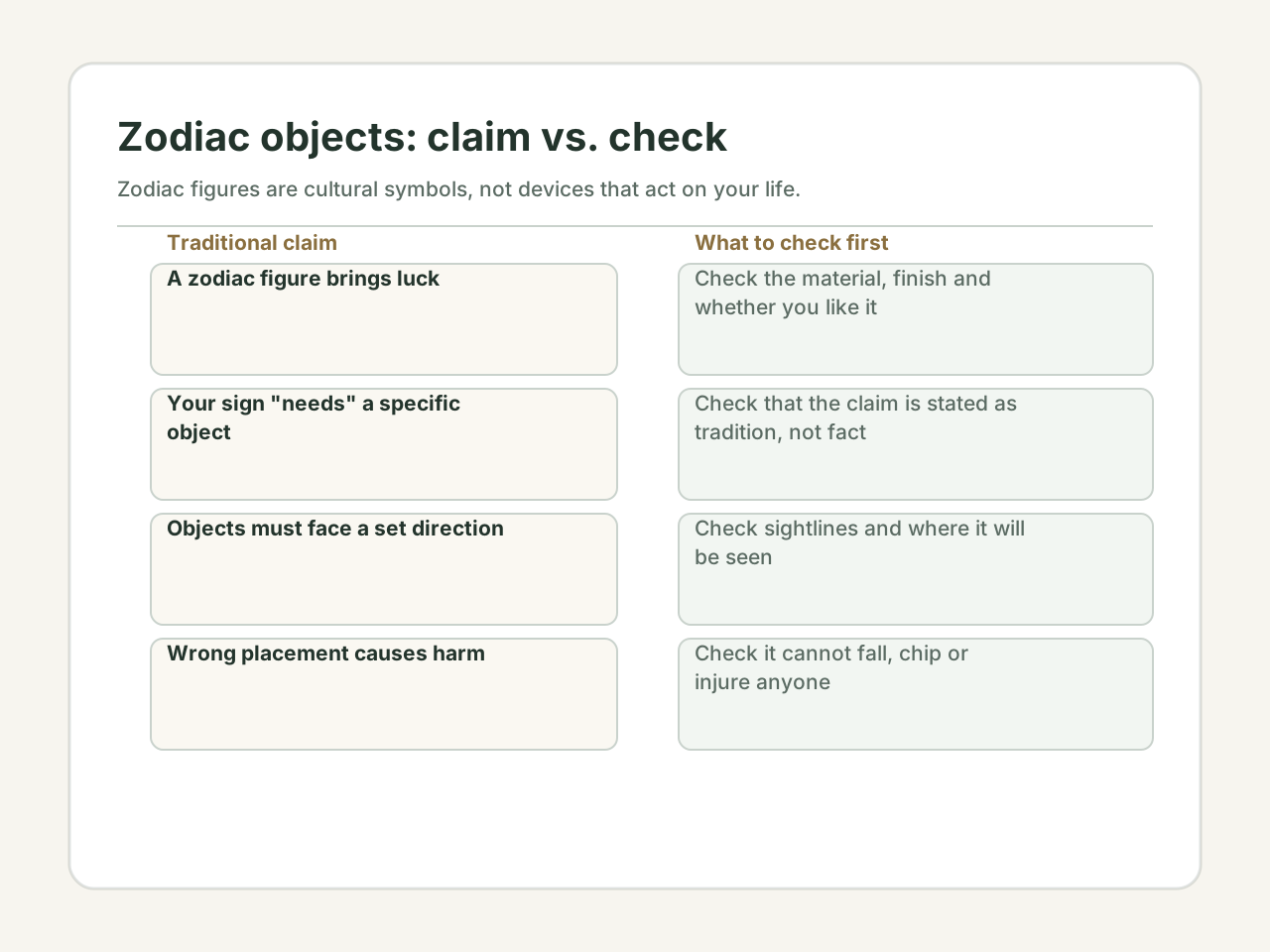
The tradition can do one thing here, and it is modest: it can tell you which animals are paired, opposed, or grouped with your year branch. That is a ranking of motifs, not a mechanism.
What it cannot do is establish that a figurine changes finances, health, or a relationship. An object you like, placed where you will see it, in a room that works, is a good outcome on its own terms. Buying it because a listing said it would fix your luck is a purchase made on a claim nobody has tested.
Disclaimer: This content is for informational and cultural reference purposes only. It does not constitute professional medical, legal, financial, or psychological advice. Readers should exercise their own judgment and consult qualified professionals for specific concerns.
Sources and review basis
Traditional references explain historical vocabulary and context. Official practical sources support only the observable safety, comfort, or environmental points noted in the article; they do not validate metaphysical claims.
Traditional reference
Huangdi Zhaijing (黄帝宅经)Wikisource digital text · Accessed 2026-07-14
Historical context for traditional residential orientation and spatial vocabulary. Modern recommendations are judged against real conditions.
Practical source
APA Dictionary of Psychology: Barnum effectAmerican Psychological Association · Accessed 2026-07-14
A psychology reference for why broad, favourable personality descriptions can feel personally accurate. It does not evaluate BaZi calculations themselves.