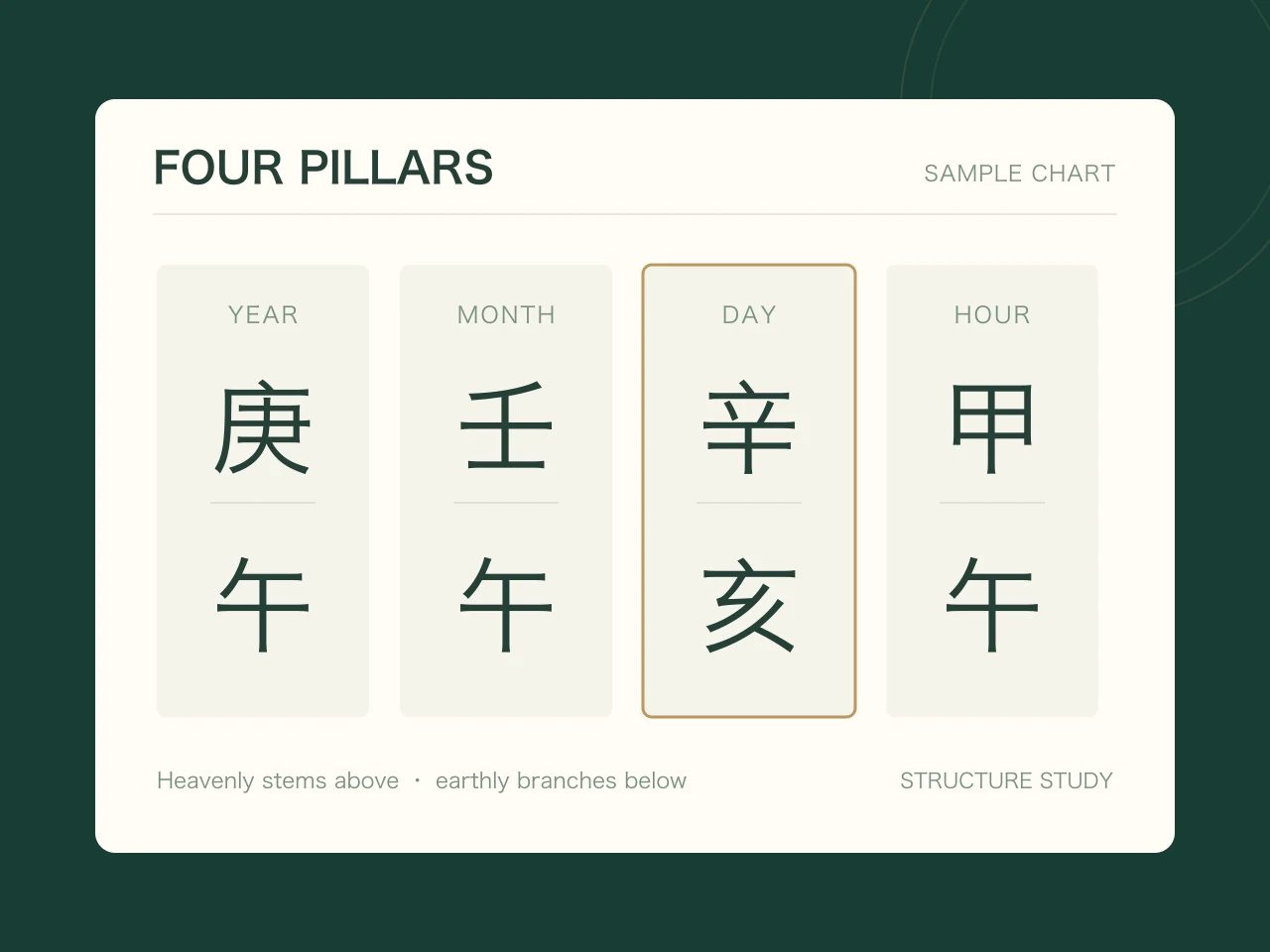
Winter Begins in 2026, and why the date is not really fixed
Winter Begins (立冬, Lìdōng) is the nineteenth of the twenty-four solar terms and the first of winter. In 2026 the sun reaches 225° of apparent longitude at 17:52 on Saturday 7 November, China Standard Time.
The date looks welded to 7 November, and mostly it is. Across 2015 to 2040 it lands on 7 November in twenty-three of twenty-six years, and on 8 November in three — 2015, 2019 and 2023. The arithmetic is ordinary: a tropical year runs 365.2422 days, so the extra 0.2422 accumulates to roughly a day every four years, and the leap day pulls it back again.
The name is the part that misleads. 立冬 marks a position, not a temperature. On the same date Harbin may have been heating for two weeks while Guangzhou is still in short sleeves, and neither changes the date or the month. For whether it is cold where you live, read a local forecast; for whether the month turned, read 17:52.
立冬 is a 节, and that is the whole difference
The twenty-four terms alternate between twelve 节 (jié, nodes) and twelve 中气 (zhōngqì, middle qi). The twelve 节 — 立春, 惊蛰, 清明, 立夏, 芒种, 小暑, 立秋, 白露, 寒露, 立冬, 大雪, 小寒 — each open a solar month, and the BaZi month pillar is set by the solar month. The twelve 中气 fall in the middle of a solar month and move nothing.
Winter Begins is a 节. It opens the solar month that BaZi calls 亥月, and the month pillar moves from 戊戌 to 己亥. Frost's Descent three weeks earlier was a 中气, which is why the pillar did not move then. The two terms sit on a calendar as equally significant dates and behave completely differently inside a chart.
Winter is not one month either. It holds three solar months and therefore three different month pillars. A chart described as "born in winter" can sit in any of three seasonal settings, and the gap between them is the gap between a day master that is 旺 and one that is 死.
| Solar term | Kind | Date in 2026 | Month pillar from that date |
|---|---|---|---|
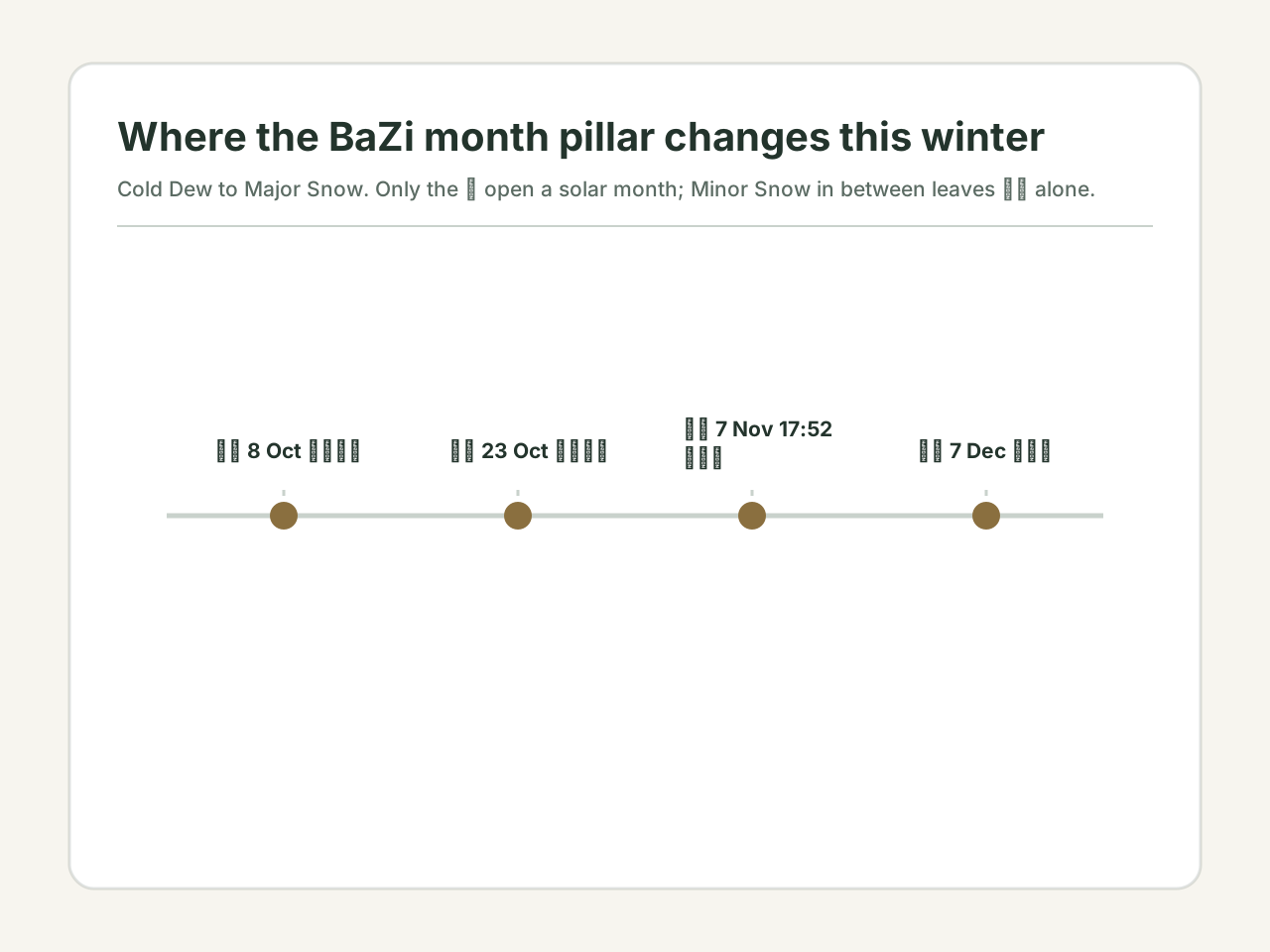
| Cold Dew (寒露) | 节 — opens a solar month | 8 October | Changes here: 丁酉 becomes 戊戌 |
| Frost's Descent (霜降) | 中气 — sits mid-month | 23 October | Unchanged: still 戊戌 |
| Winter Begins (立冬) | 节 — opens a solar month | 7 November, 17:52 | Changes here: 戊戌 becomes 己亥 |
| Minor Snow (小雪) | 中气 — sits mid-month | 22 November | Unchanged: still 己亥 |
| Major Snow (大雪) | 节 — opens a solar month | 7 December | Changes here: 己亥 becomes 庚子 |
| Minor Cold (小寒) | 节 — opens a solar month | 5 January 2027 | Changes here: 庚子 becomes 辛丑 |
The boundary is an instant: 17:52 on 7 November 2026
This is the part most software gets wrong in a way you can check. The BaZi month does not change at midnight on the date printed in the calendar. It changes at the exact moment the sun reaches 225°, and in 2026 that moment is 17:52 Beijing time on 7 November.
So 7 November 2026 is a split day. Two births one hour apart fall in different solar months, and the four-pillar chart changes in exactly one position:
| Birth moment | Year | Month | Day | Hour | Element counts across four pillars |
|---|---|---|---|---|---|
| 7 November 2026, 17:00 | 丙午 | 戊戌 | 乙酉 | 乙酉 | 木 2 · 火 2 · 土 2 · 金 2 · 水 0 |
| 7 November 2026, 18:00 | 丙午 | 己亥 | 乙酉 | 乙酉 | 木 2 · 火 2 · 土 1 · 金 2 · 水 1 |
A one-minute test, and a convention you can see
The test takes one minute. Enter 7 November 2026 at 17:00 and again at 18:00 into any four-pillars calculator. If the month pillar is identical in both results, the tool is applying the calendar-day convention rather than the solar-term instant, and it will disagree with a traditional almanac for the eighteen hours before 17:52. Neither convention is a bug: the question "which month is 7 November in?" has two defensible answers. What is not defensible is switching between them inside one reading.
The library this site builds on contains both conventions side by side. The four-pillars calculator reads the month pillar from the birth instant, so it switches at 17:52. The daily-almanac engine reads the month from the calendar day, so its element counts for 7 November include the water inside 亥 for the whole day. On the table above, those two readings differ by one count of earth and one count of water, for exactly eighteen hours in the year.
The same split explains a second common surprise. Someone born on the morning of 7 November 2026 has a 戊戌 month pillar, and any reading that starts from 己亥 has already moved them into a different season before it has looked at anything else.
Where the month stem 己 comes from
Nobody chose 己 because of anything about you. The stem of a month pillar is fixed by the stem of the year, through a rule called 五虎遁 ("five tigers"), which reads: 甲己之年丙作首,乙庚之岁戊为头,丙辛之岁寻庚起,丁壬壬位顺行流,戊癸之年何方发,甲寅之上好追求.
2026 is a 丙 year, so the first solar month — 寅月, which opens at 立春 — is 庚寅. Counting forward through the ten solar months: 寅庚, 卯辛, 辰壬, 巳癸, 午甲, 未乙, 申丙, 酉丁, 戌戊, 亥己. The tenth solar month is therefore 己亥. The branch 亥 comes from the position of the term; the stem 己 comes from the year. Two inputs, both of them calendar-level, and neither of them about a person.
The consequence is that 己亥 is not a 2026 event. Every 丙 or 辛 year produces the same month pillar in the same solar month, and after 2026 the next ones are 2031 and 2036. Whatever the month is said to mean, it means the same thing for everyone born inside it, this year and in 2031 alike.
What 己亥 says, and what it cannot say
Two classical tables describe what a month does to a stem, and they are not the same table. 旺相休囚死 reads the season: in winter water is 旺, wood is 相, metal is 休, earth is 囚, fire is 死. The month stem 己 is earth, so by that table the month's own stem is 囚 — confined, not flourishing. 十二长生 reads the branch instead, and puts 己 at 胎 inside 亥.
For eight of the ten stems the two tables agree on which month is the stem's peak. They disagree outright for the two earth stems: 旺相休囚死 puts earth's peak in the four earth months 辰戌丑未, while 十二长生 puts 戊's 帝旺 in 午 and 己's in 巳. Quoting whichever table supports a conclusion is a choice, not a reading.
亥 also carries the 纳音 label 平地木 and hides two stems of its own, 壬 and 甲.
The limit matters more than either table. The month pillar is identical for every person born between 17:52 on 7 November and 大雪 on 7 December. It cannot separate you from anyone else in that window. What it does is set the season that the other six characters are read against, which is a real job and a different one.
| Stem | 十二长生 position in 亥 | 旺相休囚死 reading in 亥月 |
|---|---|---|
| 甲 | 长生 | 相 |
| 乙 | 死 | 相 |
| 丙 | 绝 | 死 |
| 丁 | 胎 | 死 |
| 戊 | 绝 | 囚 |
| 己 | 胎 | 囚 |
| 庚 | 病 | 休 |
| 辛 | 沐浴 | 休 |
| 壬 | 临官 | 旺 |
| 癸 | 帝旺 | 旺 |
What changes for a chart when the month turns
Three things move on 7 November, and each is checkable.
First, 得令 flips. In the 戌月 that ends at 17:52, water is 相. In the 亥月 that begins there, water is 旺. A 壬 or 癸 day master gains the season on that minute, and a 丙 or 丁 day master moves from 囚 to 死. Nothing about the person changed; the calendar did.
Second, 巳 is clashed. 亥 opposes 巳, so the new month pillar clashes any 巳 in the chart. Inside this particular window the year branch is 午 and the month branch is 亥 for everyone, which means 巳 can only appear in the day or hour pillar. Enumerating every two-hour chart across the thirty days of 亥月 2026 gives 351 charts, and 51 of them — about one in seven — carry a 巳 in the day or hour branch. The intuition that this should be about one in twelve fails because two of the four branches are fixed by the calendar rather than by the birth.
Third, the ten-god label of the month stem changes with your day stem, and it changes to ten different things:
| Day master | Month stem 己 reads as | Example chart from a past 己亥 month (丙申年, 2016) |
|---|---|---|
| 甲 | 正财 | 丙申 己亥 甲午 庚午 |
| 乙 | 偏财 | 丙申 己亥 乙未 壬午 |
| 丙 | 伤官 | 丙申 己亥 丙申 甲午 |
| 丁 | 食神 | 丙申 己亥 丁酉 丙午 |
| 戊 | 劫财 | 丙申 己亥 戊戌 戊午 |
| 己 | 比肩 | 丙申 己亥 己亥 庚午 |
| 庚 | 正印 | 丙申 己亥 庚子 壬午 |
| 辛 | 偏印 | 丙申 己亥 辛丑 甲午 |
| 壬 | 正官 | 丙申 己亥 壬寅 丙午 |
| 癸 | 七杀 | 丙申 己亥 癸卯 戊午 |
What does not change at 立冬
The year pillar does not move. It is still 丙午, and it stays 丙午 until 立春 on 4 February 2027. Winter is not the new year, and a chart that switches its year pillar on 7 November has moved the boundary by three months.
The day pillar does not care. It rolls on its own sixty-day cycle regardless of the terms: 7 November is 乙酉, 8 November is 丙戌. The solar term and the day pillar are two unrelated cycles that happen to be printed on the same line.
The lunar month does not move either. 7 November 2026 is the twenty-ninth day of the ninth lunar month. The tenth lunar month begins on 9 November, two days after the solar term. Two different definitions of a month, two different change dates, and neither is a correction of the other.
The hour pillar is untouched by all of this. It is derived from the day pillar and the clock, so a birth at 17:00 and a birth at 18:00 share it — which is exactly what makes the two-chart example above isolate the month pillar.
The almanac entry for 7 November 2026
Read as an almanac prints it, 7 November 2026 is year 丙午, month 己亥, day 乙酉, the first day of Winter Begins. The day clashes with 卯 (Rabbit) and places its sha to the east. The twelve duties give 开, the yellow-and-black path gives 朱雀, the twenty-eight mansion is 柳, and the 彭祖百忌 lines read 乙不栽植千株不长 and 酉不会客醉坐颠狂.
The 宜 list reads 解除 and 馀事勿取. The 忌 list reads 百无禁忌. In other words, the day that opens the winter month carries an almost empty recommendation list and no prohibitions at all. Whatever the 宜忌 system is doing, it is not marking the start of winter as a day for much of anything.
The 七十二候 layer sits behind all of it. Each solar term is divided into three five-day pentads, and Winter Begins is given 水始冰 (water begins to freeze), 地始冻 (the ground begins to harden), and 雉入大水为蜃 (the pheasant enters the great water and becomes the clam). Those are seasonal descriptions written for one region, then pinned to fixed five-day slots; move north, south or uphill and the observation separates from the slot.
Those entries belong to three different categories, and keeping them apart is the whole discipline. The term itself is an astronomical position. The day pillar, the duty, the path, the mansion and the clash are values computed from fixed cycles. The 宜 and 忌 lists are traditional recommendations attached to the date. Only the first two can be reproduced; the third is inherited.
Six checks on 7 November you can run yourself
Every item below can be verified in an almanac or a calculator, so none of it asks for trust:
- Separate the calendar question from the weather question. Which solar month a moment belongs to has one correct answer; whether 7 November feels like winter where you live has none.
- Test your software on the boundary itself: 7 November 2026 at 17:00 against 18:00. If the month pillar does not move, the tool is using the calendar-day convention and will be roughly eighteen hours out of step with a traditional almanac every year.
- Check the month stem against the day stem before reading anything into the month. 己 is 正官 to a 壬 day master and 七杀 to a 癸 day master — one stem of polarity apart, opposite labels, same month.
- Do not read the year pillar from the season. The year changes at 立春 on 4 February 2027, not at 立冬.
- Treat the 宜 and 忌 lists as the tradition's own annotations. Use them, if at all, for a small reversible activity you already intended.
- If the real question is when winter starts where you live, use three dates you can look up: your city's usual heating start, the median first-frost date for the last decade, and the week the trees on your route go bare. What you actually feel as winter usually sits between them, and none of the three is 7 November.
Disclaimer: This content is for informational and cultural reference purposes only. It does not constitute professional medical, legal, financial, or psychological advice. Readers should exercise their own judgment and consult qualified professionals for specific concerns.
Sources and review basis
Traditional references explain historical vocabulary and context. Official practical sources support only the observable safety, comfort, or environmental points noted in the article; they do not validate metaphysical claims.
Traditional reference
Yuanhai Ziping (渊海子平)Wikisource digital text · Accessed 2026-07-14
A classical source for Four Pillars terminology, element relationships, and the Day Master framework.
Practical source
NOAA Solar CalculatorNOAA Global Monitoring Laboratory · Accessed 2026-10-16
Used to check local solar noon and the equation of time, which is the part the true-solar-time correction adds to or subtracts from clock time.
Practical source
APA Dictionary of Psychology: Barnum effectAmerican Psychological Association · Accessed 2026-07-14
A psychology reference for why broad, favourable personality descriptions can feel personally accurate. It does not evaluate BaZi calculations themselves.