Twelve palaces, and the three names that differ from 紫微斗数
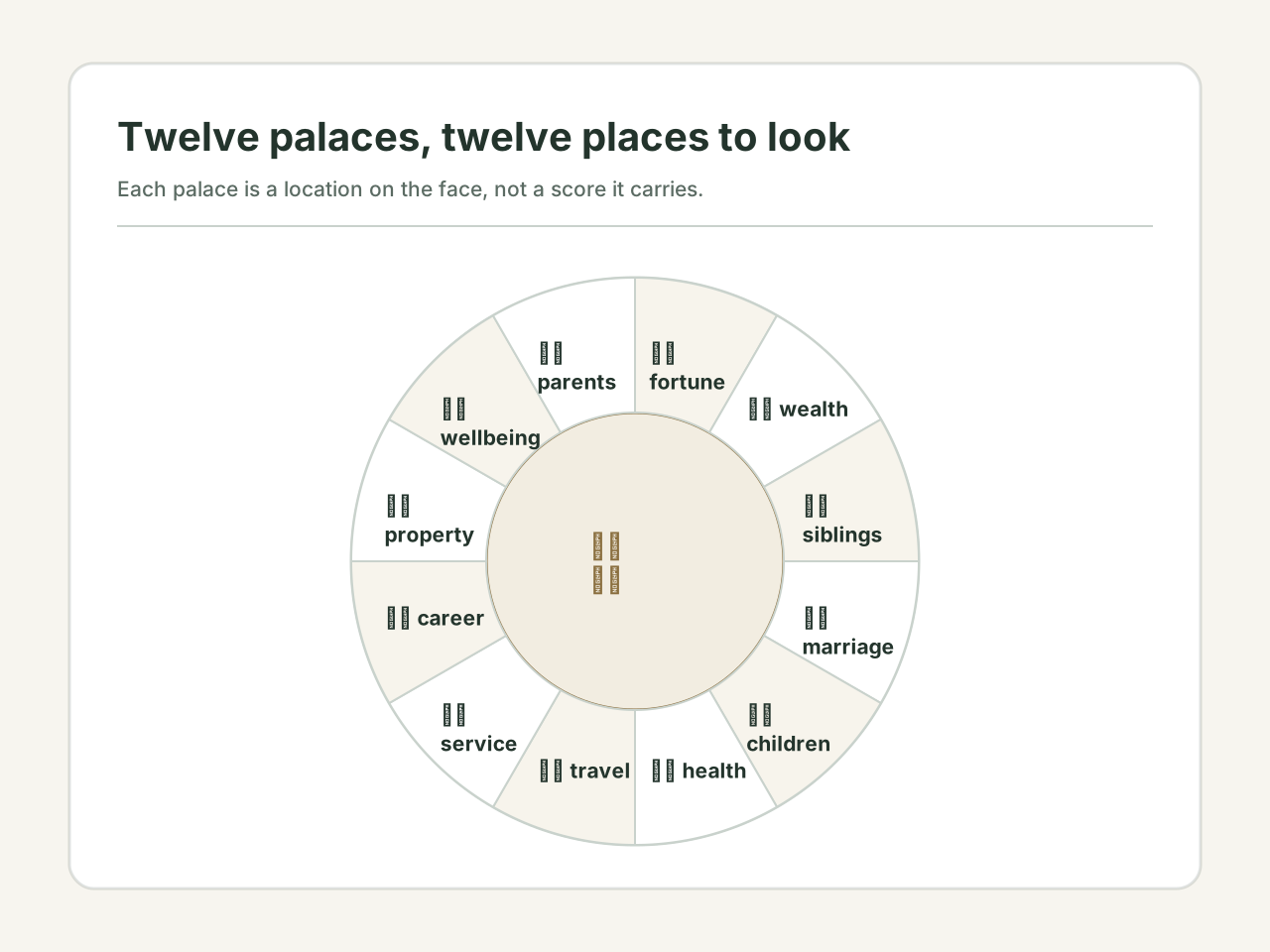
面相十二宫 lays twelve life domains over twelve regions of the face. Nine of the twelve names are the same as the palaces of 紫微斗数: 命宫, 财帛宫, 兄弟宫, 田宅宫, 奴仆宫, 疾厄宫, 迁移宫, 官禄宫 and 福德宫. Three are not. 相术 has 男女宫 where 紫微 has 子女宫, 妻妾宫 where 紫微 has 夫妻宫, and 相貌宫, which has no counterpart at all — it is not a region but the whole face, read as a summary.
The overlap is why the two systems get used together, and why they get confused. They share a vocabulary, not a method. 紫微斗数 assigns the palaces to the twelve branches of a chart cast from a birth time; 面相 assigns them to positions on a head. A strong 财帛宫 in one says nothing about the other, and no classical text claims that it does.
The three differing names are the tell. Anyone who lists 夫妻宫, 子女宫 and 父母宫 as the palaces of 面相 is using the 紫微 list on a face — which is common, and which quietly imports a system that was never about faces.
The twelve regions, under the 相术 names
The regions can be located. The domains cannot, and the difference matters:
| Palace | Region | Read for | 紫微 name, where it differs |
|---|---|---|---|
| 命宫 | Between the brows (印堂) | The anchor of the reading — everything else is read against it | Same |
| 财帛宫 | The nose | Earning and handling money | Same |
| 兄弟宫 | The brows | Siblings, and peers generally | Same |
| 田宅宫 | The upper eyelids | Household and property | Same |
| 男女宫 | Below the eyes (泪堂) | Children, and what one produces | 子女宫 |
| 奴仆宫 | Below the corners of the mouth | Subordinates, staff and dependants | 交友宫 in some lineages |
| 妻妾宫 | The outer eye corners (鱼尾) | Marriage and partnership | 夫妻宫 |
| 疾厄宫 | The bridge between the eyes (山根) | Health and resilience | Same |
| 迁移宫 | The outer forehead (天仓) | Travel, relocation, change of circumstance | Same |
| 官禄宫 | The centre of the forehead (中正) | Work and public standing | Same |
| 福德宫 | Above the brows, toward the temples | Contentment, and what one enjoys | Same |
| 相貌宫 | The whole face | A summary judgement, not a region | None — 紫微 has 父母宫 here |
Shape or colour
The palaces are read two ways, and the texts are not always clear about which is in play. Shape — the fullness, evenness and proportion of a region — is treated as long-term. Colour and lustre, 气色, are treated as current. The tradition reads a dull 印堂 as a present state and a hollow one as a structural one, and the two are supposed to be reported separately.
This matters because it is the one place in 面相 where the framework makes a claim that could in principle be checked. If 印堂 colour tracks something real about a person's state, it should track it consistently. The tradition asserts that it does. It does not offer a way to tell whether a dull 印堂 caused a bad month, reflected it, or neither.
Practically, the distinction is what keeps a reading from becoming a permanent verdict. A structural observation should hold across visits; a colour observation should not. A reader who reports the same colour finding twice, months apart, is either looking at structure and calling it colour, or not looking.
Two palaces that disagree
Take a face with a broad, even forehead and a small nose on a low bridge. Under the twelve palaces that is a strong 官禄宫 and a modest 财帛宫, and the usual gloss is someone who does the work well and does not convert it into money.
Read the other way, the same pair is a caution about the reading rather than about the person. 官禄宫 and 财帛宫 are not two independent measurements; they are two regions of one face, and a face that is broad above and narrow in the middle will produce this pair of findings almost regardless of who is being read. The disagreement between the palaces is a fact about the geometry.
That is the trap in the system. Twelve palaces produce twelve findings, and any two of them can be combined into a story, so the framework can generate a coherent narrative about anyone. The check is to ask whether the finding would have been different on a different face. If the answer is no, the finding is about the grid.
What the twelve palaces cannot do
Twelve domains across any number of faces is a system that can describe anyone, and a system that can describe anyone cannot tell them apart. That is a structural problem, and no amount of care in the reading fixes it: the flexibility is the defect, not a mark of skilled practice.
What it can still do is organise a conversation. If someone wants to think about why work and money have gone differently for them, having twelve named domains is a better prompt than having none, and a reader who uses the palaces as questions rather than as findings is using the system at its strongest.
The line to hold is the one between a region and a life. 官禄宫 is a place on a forehead. Whether the work went well is not written there, and the tradition's claim that it is has never been given a mechanism, a measurement, or a way of being wrong.
Disclaimer: This content is for informational and cultural reference purposes only. It does not constitute professional medical, legal, financial, or psychological advice. Readers should exercise their own judgment and consult qualified professionals for specific concerns.
Sources and review basis
Traditional references explain historical vocabulary and context. Official practical sources support only the observable safety, comfort, or environmental points noted in the article; they do not validate metaphysical claims.
Traditional reference
Huangdi Zhaijing (黄帝宅经)Wikisource digital text · Accessed 2026-07-14
Historical context for traditional residential orientation and spatial vocabulary. Modern recommendations are judged against real conditions.
Practical source
APA Dictionary of Psychology: Barnum effectAmerican Psychological Association · Accessed 2026-07-14
A psychology reference for why broad, favourable personality descriptions can feel personally accurate. It does not evaluate BaZi calculations themselves.