What a travel-day check compares
Travel dates are checked the same way as any other: the candidate day's branch against the traveller's year branch. For a single traveller that is about one day in twelve. Two further markers sometimes enter. 驿马 — the travelling horse — is the branch opposite the 三合 frame of the traveller's year branch: 申 for anyone born in a 寅, 午 or 戌 year; 寅 for 子, 辰 or 申; 亥 for 巳, 酉 or 丑; and 巳 for 亥, 卯 or 未. A day carrying the traveller's own 驿马 is read as suited to movement. Directional rules add a third layer, assigning each day a favourable heading.
Of these, only the first is a hard rule. 驿马 and the directional tables are softer, and they contradict each other often enough that practitioners disagree about which to apply.
None of them touch what actually determines a journey: the weather at the destination, the length of the connection, the validity of the passport, and whether the airline's schedule survives the season. A day can be flagged as ideal for travel and still put you in a two-hour delay, because the flag was never about the aeroplane.
Three layers, in descending order of hardness
The layers are usually listed together as if they carried equal weight. They do not:
| Layer | How it is determined | How to treat it |
|---|---|---|
| Day branch against year branch (冲) | One branch opposes one branch: 子-午, 丑-未, 寅-申, 卯-酉, 辰-戌, 巳-亥. About one day in twelve. | The only unambiguous check. Worth avoiding when the date is still free |
| 驿马 (travelling horse) | 申 for 寅/午/戌 years, 寅 for 子/辰/申, 亥 for 巳/酉/丑, 巳 for 亥/卯/未 | A positive marker, not a requirement. Useful mainly as a tie-break |
| Direction of travel | Each day is assigned favourable and unfavourable headings | The softest layer, and the one most likely to contradict the other two. Skip it unless you already use it |
| Documents, weather, connections | Not traditional at all: passport validity, the forecast at the destination, the length of the layover | This is the layer that decides how the trip goes. It outranks the three above |
Two consecutive days, one of them clashing
A man is flying to Japan in April 2027. He was born in 1990 — 庚午, year branch 午 — so his 驿马 is 申. Two departures suit his leave: Friday 2 April and Saturday 3 April.
2 April 2027 is 辛亥. Its branch is 亥: no clash with his 午, and no particular relation either. Its stem is 辛, Metal. 3 April 2027 is 壬子, and its branch 子 is the branch that opposes 午 — a direct clash with his year branch. Neither date carries 申, so his 驿马 is not in play.
The practical difference between the two is one day of annual leave. Saturday costs him nothing; Friday costs a day he would rather keep for later in the year. That is the whole trade-off, and it is exactly the kind of trade-off the traditional layer is supposed to arbitrate.
He flies on the Saturday. The clash rule is real but narrow — it compares one branch to one branch, and it says nothing about the aeroplane, the weather over the Sea of Japan, or the queue at immigration. The leave day is a real cost. When a soft rule and a hard cost disagree, the hard cost wins, and pretending otherwise is how people end up paying for a date.
His flight is delayed by two hours. The clash did not cause it, and taking the Friday would not have prevented it. What made the delay survivable was a connection he could afford to miss.
What actually decides whether a journey goes well
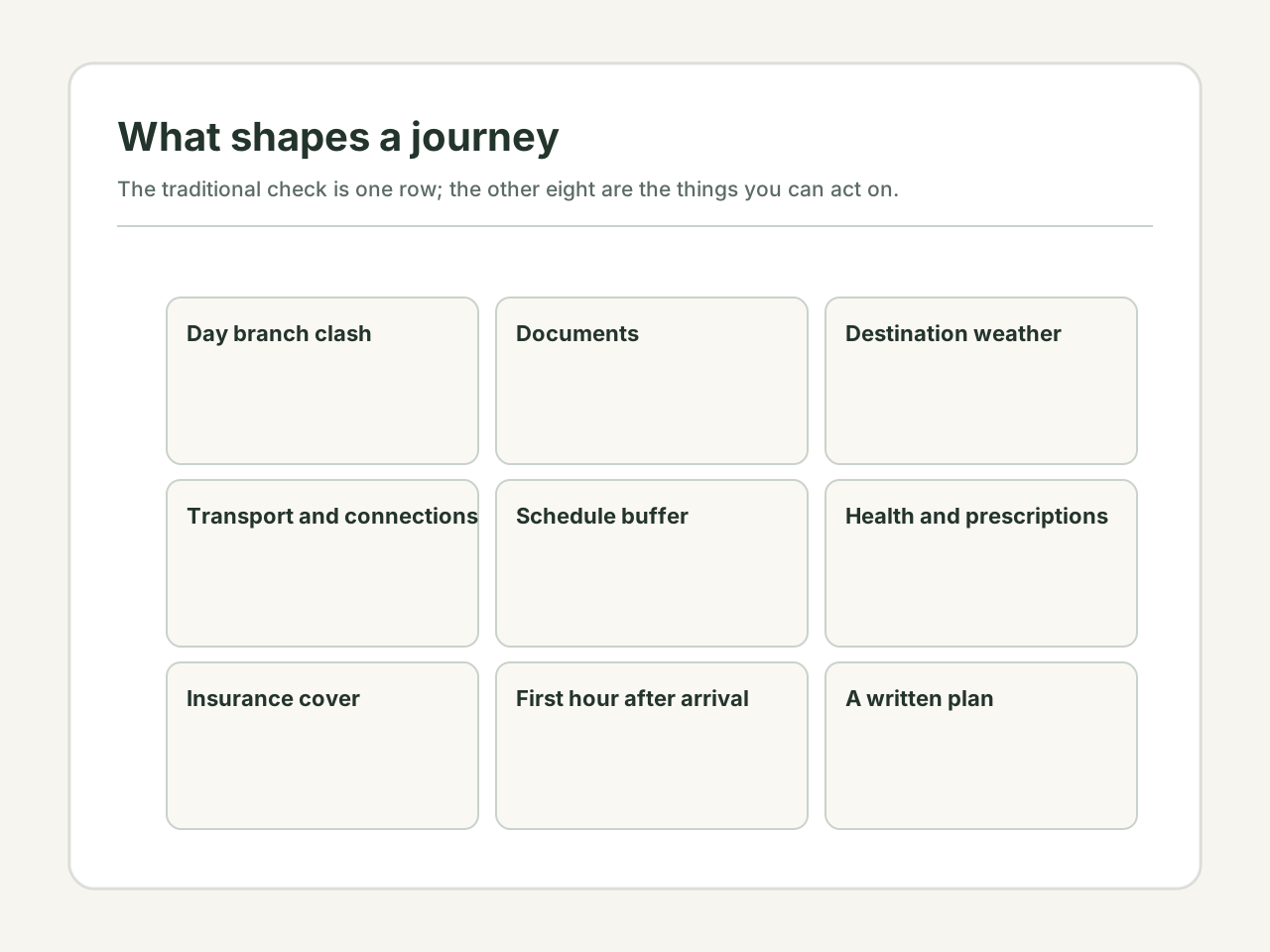
Once the traditional check is done, the things that shape a trip are ordinary and unglamorous. They are also the only ones you can act on, which is why a short list is worth keeping next to the almanac.
- Documents first: passport validity, visas, transit rules, and a copy of each kept separately from the originals
- Weather and season at the destination rather than at home, checked close enough to departure that the forecast still means something
- A buffer in the schedule — a connection you can afford to miss, a day you can afford to lose, an arrival that does not have to be on time
- Health basics: prescriptions, vaccinations where required, and travel insurance that genuinely covers what you are going to do
- A written plan for the first hour after arrival: how you leave the airport, where the keys are, and who to call if the plan breaks
The return leg gets checked less, and fails more
Almost all date selection is applied to the outbound flight. The return is booked later, checked less, and is where the practical problems concentrate — a red-eye that lands the morning you are due back at work, a connection that is tight in the wrong airport, a Sunday flight that turns into a Monday.
If you are going to apply one traditional check to a trip, apply it to the leg you cannot afford to lose. For most people that is the return: a delayed outbound costs a day of holiday, a delayed return costs a day of work, a meeting, or a handover.
The other thing worth checking is the buffer, measured in hours rather than branches. A connection under ninety minutes at an airport you have not used before is a risk whatever the day's stem and branch; three hours at the same airport absorbs most of what goes wrong.
Disclaimer: This content is for informational and cultural reference purposes only. It does not constitute professional medical, legal, financial, or psychological advice. Readers should exercise their own judgment and consult qualified professionals for specific concerns.
Sources and review basis
Traditional references explain historical vocabulary and context. Official practical sources support only the observable safety, comfort, or environmental points noted in the article; they do not validate metaphysical claims.
Traditional reference
Yuxia Ji (玉匣記)Wikisource digital text · Accessed 2026-10-15
A household almanac whose 入宅 and 移徙 sections show how traditional date selection for moving house was organised. It documents a convention, not evidence that a date changes an outcome.
Practical source
APA Dictionary of Psychology: Barnum effectAmerican Psychological Association · Accessed 2026-07-14
A psychology reference for why broad, favourable personality descriptions can feel personally accurate. It does not evaluate BaZi calculations themselves.