Three bands, and the proportion rule that comes with them
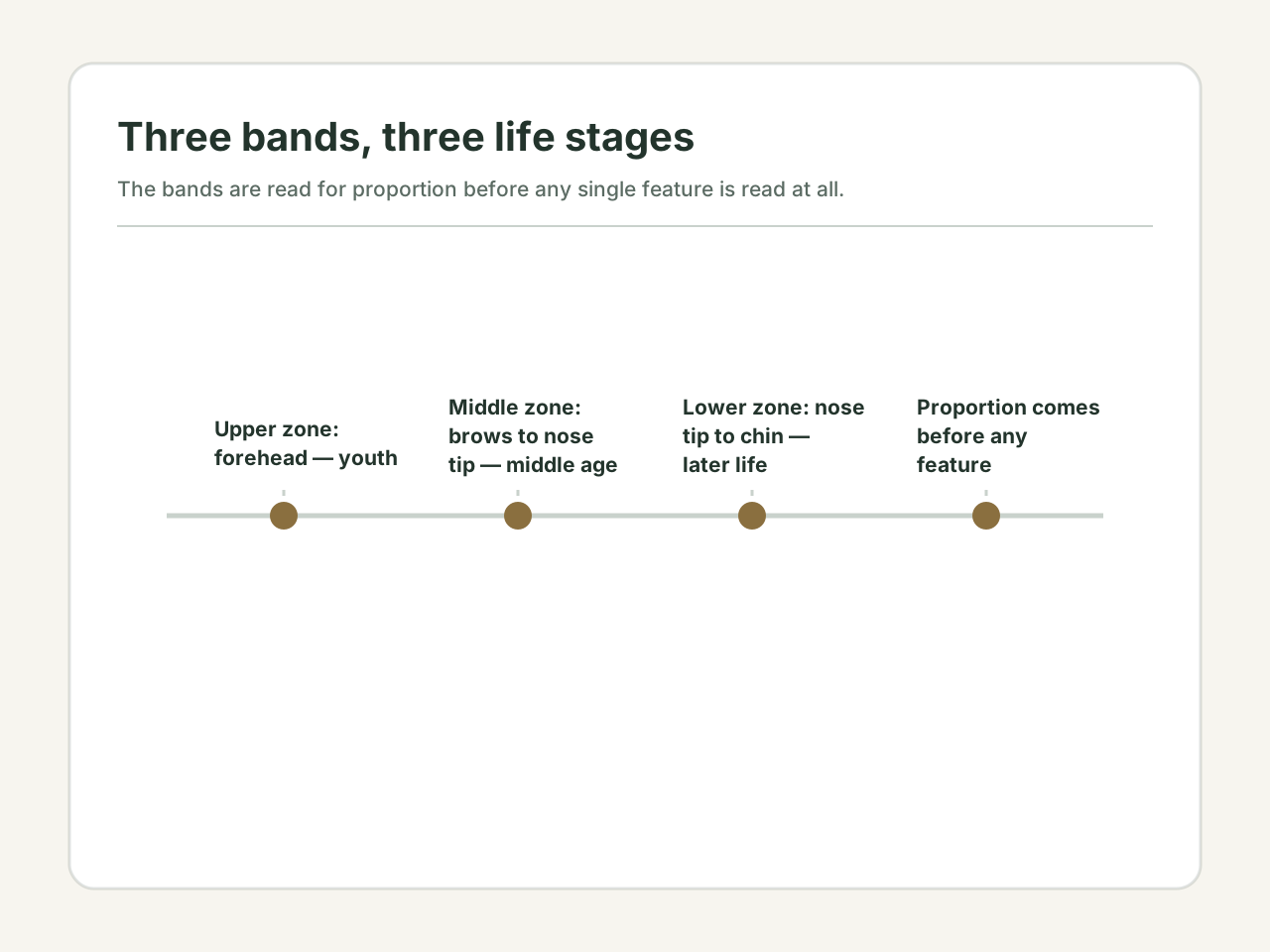
三停 divides the face horizontally into three bands: 上停 from the hairline to the brow, 中停 from the brow to the tip of the nose, 下停 from the nose tip to the chin. Each band is assigned a period of life — youth, middle age, later life — along with the domains that go with that period.
The framework has a second half that is usually left out: the bands are supposed to be equal. 三停平等 is the ideal, and a face in which one band runs markedly longer or shorter than the others is read as an emphasis or a deficit in that period rather than as a set of separate features. That is what makes 三停 a structural reading — it is about proportion before it is about shape.
There is a vertical complement. 五岳 marks five peaks: the forehead as 南岳, the nose as 中岳, the chin as 北岳, and the two cheekbones as 东岳 and 西岳. 三停 reads the face in horizontal thirds; 五岳 reads it in peaks. A full structural reading uses both, and a reader using one is describing half the geometry.
The three bands, with the boundaries that can be checked
The boundaries are the useful part — they are the only thing in the framework that can be located without interpretation:
| Band | Boundaries | Life period | Domains assigned to it | What a deviation is read as |
|---|---|---|---|---|
| 上停 | Hairline to the brow line | Roughly the first thirty years | Early family circumstances, schooling, and what the tradition calls 天 — inherited position | A short 上停 reads as a compressed early period, not as a bad one |
| 中停 | Brow line to the tip of the nose | Roughly thirty to fifty | Work, marriage, and the middle of adult life | A long 中停 against short outer bands reads as a life weighted toward the middle years |
| 下停 | Nose tip to the chin | Roughly the last third | Household, later family, and what is left behind | A full 下停 reads as a settled later period; a narrow one as a quieter one |
What the proportion rule actually claims
三停平等 sounds like a measurement and is not one. No classical text gives a ratio in units; the comparison is made by eye, against the reader's sense of a balanced face. That is worth saying plainly, because it decides what the framework can be used for: it can describe a face consistently, and it cannot settle a disagreement about one.
The rule does have a real use, which is that it forces the reader to look at the whole face before naming a feature. Anyone starting from 三停 has to decide where the bands fall, and that decision makes later observations comparable from one visit to the next. It is a discipline of looking rather than a measurement.
The vertical counterpart works the same way. 五岳 compares height and fullness across five points, and the ideal is that they stand in proportion rather than that any one is large. A high 南岳 with a low 中岳 is an imbalance; the same forehead with a proportionate nose is not. Read the pair, not the peak.
Two faces, read structurally
First face: a short 上停, a long 中停, and a 下停 of ordinary length. Structurally that is a face weighted toward the middle, and the usual gloss is that the person built in the middle years what was not given at the start.
Second face: a long 上停, a short 中停, and a full 下停. That is the reverse weighting and the reverse story — advantages early, a middle period that did not extend them, a later period that settles.
Both glosses are stories, and the framework is built so that either can be told about almost any face. Notice what the reading never does: it never says how much shorter the 上停 has to be, or what would count as evidence against the story. That is the honest limit of 三停, and it is the same limit that applies to 五岳 and to every other proportional rule in 相术.
What survives the limit is the discipline. Deciding where the bands fall, and comparing them before naming any feature, is a way of looking at a face carefully and consistently. That is a real skill. It is not a forecast, and the tradition's error is to have treated one as the other.
Where the three bands stop being useful
三停 is at its most defensible when it describes a face, and at its weakest when it explains a life. The step from 'this band is short' to 'this period was hard' has no mechanism behind it, and the tradition never supplies one — the correspondence is asserted and then elaborated.
It also has a practical problem the texts do not address: the landmarks move. Hairlines recede, brows are plucked or tattooed, and the nose tip is not a fixed point on a face that has gained weight. A reader comparing two visits is comparing two different sets of landmarks unless they are careful.
The reasonable use is as a prompt for a life review rather than as a finding about one. 'The middle band is long' is a sentence about a face. 'So the middle years matter most' is a sentence about a life, and that one belongs to the subject, not to the reader.
Disclaimer: This content is for informational and cultural reference purposes only. It does not constitute professional medical, legal, financial, or psychological advice. Readers should exercise their own judgment and consult qualified professionals for specific concerns.
Sources and review basis
Traditional references explain historical vocabulary and context. Official practical sources support only the observable safety, comfort, or environmental points noted in the article; they do not validate metaphysical claims.
Traditional reference
Huangdi Zhaijing (黄帝宅经)Wikisource digital text · Accessed 2026-07-14
Historical context for traditional residential orientation and spatial vocabulary. Modern recommendations are judged against real conditions.
Practical source
APA Dictionary of Psychology: Barnum effectAmerican Psychological Association · Accessed 2026-07-14
A psychology reference for why broad, favourable personality descriptions can feel personally accurate. It does not evaluate BaZi calculations themselves.