What the stone actually is
Amethyst is quartz — silicon dioxide, SiO₂ — with traces of iron that create colour centres when exposed to natural radiation in the ground. It is hardness 7 on the Mohs scale, which is why it survives as a polished point or a geode without scratching easily.
The colour is not permanent under heat. Above roughly 400 to 500 °C the colour centres break down and the stone turns yellow, which is why most commercial citrine is heat-treated amethyst rather than a separate mineral. Strong prolonged sunlight can also fade a specimen, so a south-facing windowsill is the one placement decision with a visible physical consequence.
None of that is metaphysical. It is the reason two pieces sold as the same stone can look different, and why a cheap saturated cluster and a pale natural point are not the same object.
Purple has no fixed slot in the five-colour scheme
The classical colour correspondence is five-fold: 青 for east and wood, 赤 for south and fire, 黃 for centre and earth, 白 for west and metal, 黑 for north and water. Purple is not one of the five. It sits between red and black on the spectrum, and different modern readings resolve that differently — folding it into fire, treating it as a dark water tone, or ignoring colour and assigning the object by material, which for a mineral means earth.
This is not a detail to gloss over, because the placement advice depends entirely on which choice was made. A stone classed as fire belongs in the south; the same stone classed as earth belongs in the centre or the northeast; classed as water, the north. Three answers from one object, and the tradition does not rank them.
The honest version of the advice therefore states the mapping it is using. An article or a consultant who assigns a direction without saying which scheme they picked has hidden the only step where the disagreement lives.
| Mapping | Where the stone goes | What the choice implies |
|---|---|---|
| Purple folded into fire | South | The colour is treated as the operative feature |
| Purple treated as a dark water tone | North | Purple is read as a shade of black |
| Assigned by material — mineral, so earth | Centre or northeast | Colour is ignored; the substance decides |
| No assignment at all | Wherever it looks right | The object is decorative, not directional |
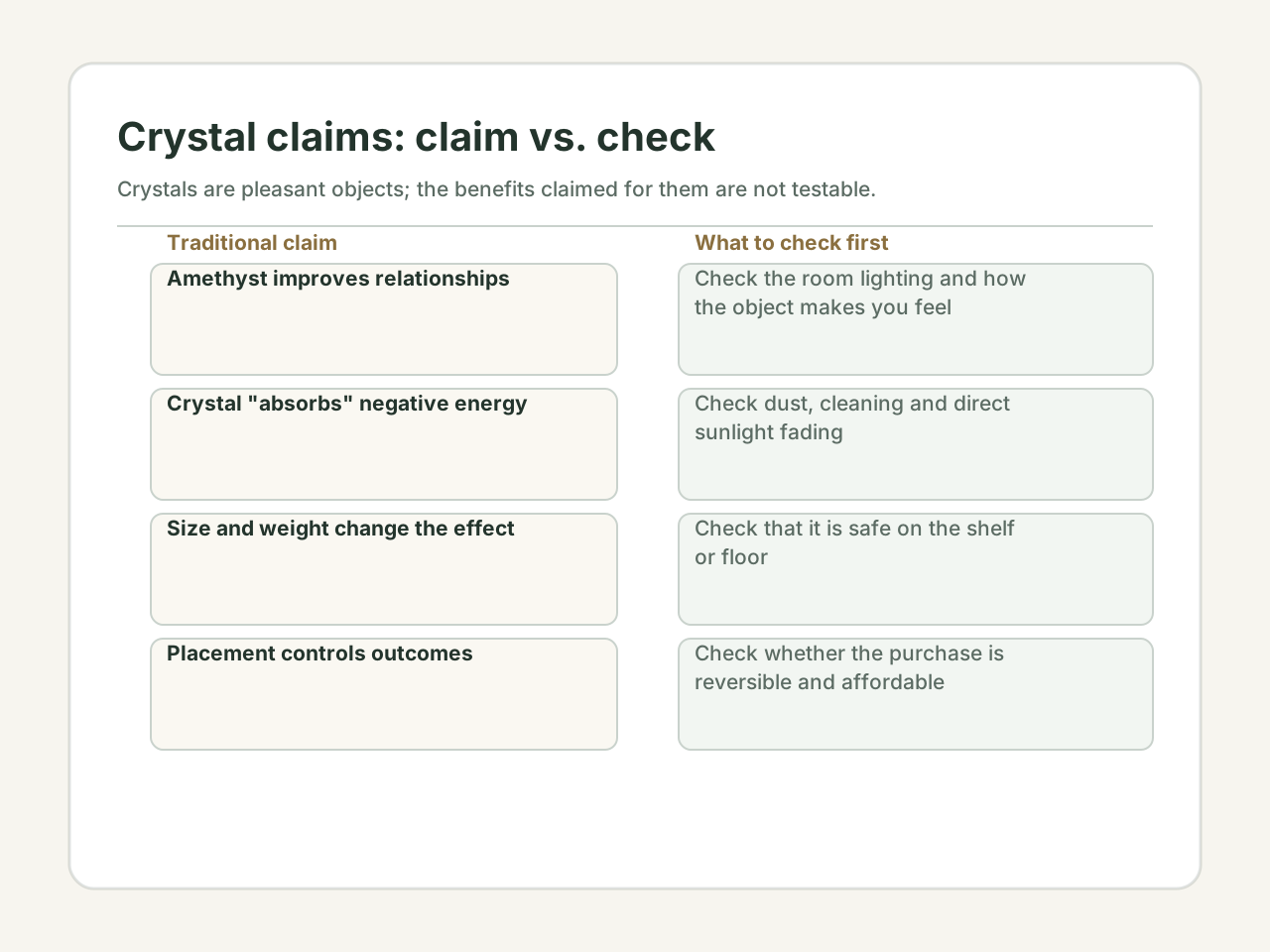
The anachronism problem
The classical residential texts were written in a world where amethyst was not a traded decorative commodity in China. That is a structural point rather than a citation: a manual cannot prescribe the placement of an object its readers did not own.
So claims that a traditional method specifies where a crystal cluster goes are anachronistic, however confidently they are made. The 晶洞 in the wealth corner is a modern retail convention, which does not make it worthless as a decorating habit — it makes it modern, and worth labelling as such.
The same test applies to most crystal advice. If a claim is presented as ancient, ask which text, and in what period that object was available to the text's readers.
Three questions that are actually about the room
Placement, stripped of the metaphysical layer, comes down to three questions with visible answers.
Will it be damaged here? Direct summer sun fades the colour; a windowsill above a radiator adds heat cycling; a bathroom adds steam and the risk of a wet hand. A shelf away from both is the answer, and it is the same answer the material gives.
Will it stay put? A geode is heavy and a point is top-heavy. Anything on a narrow ledge above a walkway is a hazard, and the tradition's own rule against placing an object above head height happens to agree.
Will you actually see it? A crystal behind a monitor or on top of a bookcase is a purchase, not a feature. If the point is that the object marks something, it has to be in the sightline where that something happens.
A desk, a spare bed, and a cluster nobody looked at
A man works from a small room that doubles as a guest room. His desk faces a wall and the flat surfaces have filled with paper, cables and stationery. A friend gives him an amethyst cluster and tells him it will improve his focus.
The cluster goes on the corner of the desk, where it takes up the only clear space and gets in the way of the mouse. Within a fortnight it is on the windowsill, where the afternoon sun hits it, and within a year it has visibly paled.
Neither move was about focus. The first was about desk area, the second about not being annoyed. The useful version of the advice would have been: clear the desk first, then put the object where the clearing happened, out of direct sun. That is a furniture recommendation, and it is the only part of the original suggestion that has an observable outcome.
What the stone does and does not do
It looks like something, it holds a colour, and it marks a place. Those effects are real and they are visual, which means they can be checked by anyone standing in the room.
It does not heal, attract money, improve concentration, or change a relationship. Where people report that it did, the mechanism on offer is expectancy: an object given meaning, placed deliberately, in a room that was also tidied at the same time. That is worth having. It is not worth paying a premium for, and it is not what the label claims.
Disclaimer: This content is for informational and cultural reference purposes only. It does not constitute professional medical, legal, financial, or psychological advice. Readers should exercise their own judgment and consult qualified professionals for specific concerns.
Sources and review basis
Traditional references explain historical vocabulary and context. Official practical sources support only the observable safety, comfort, or environmental points noted in the article; they do not validate metaphysical claims.
Traditional reference
Huangdi Zhaijing (黄帝宅经)Wikisource digital text · Accessed 2026-07-14
Historical context for traditional residential orientation and spatial vocabulary. Modern recommendations are judged against real conditions.
Practical source
APA Dictionary: Placebo effectAmerican Psychological Association · Accessed 2026-10-14
Defines the placebo effect, which matters when an object or ritual is credited with a change that expectation alone could explain.