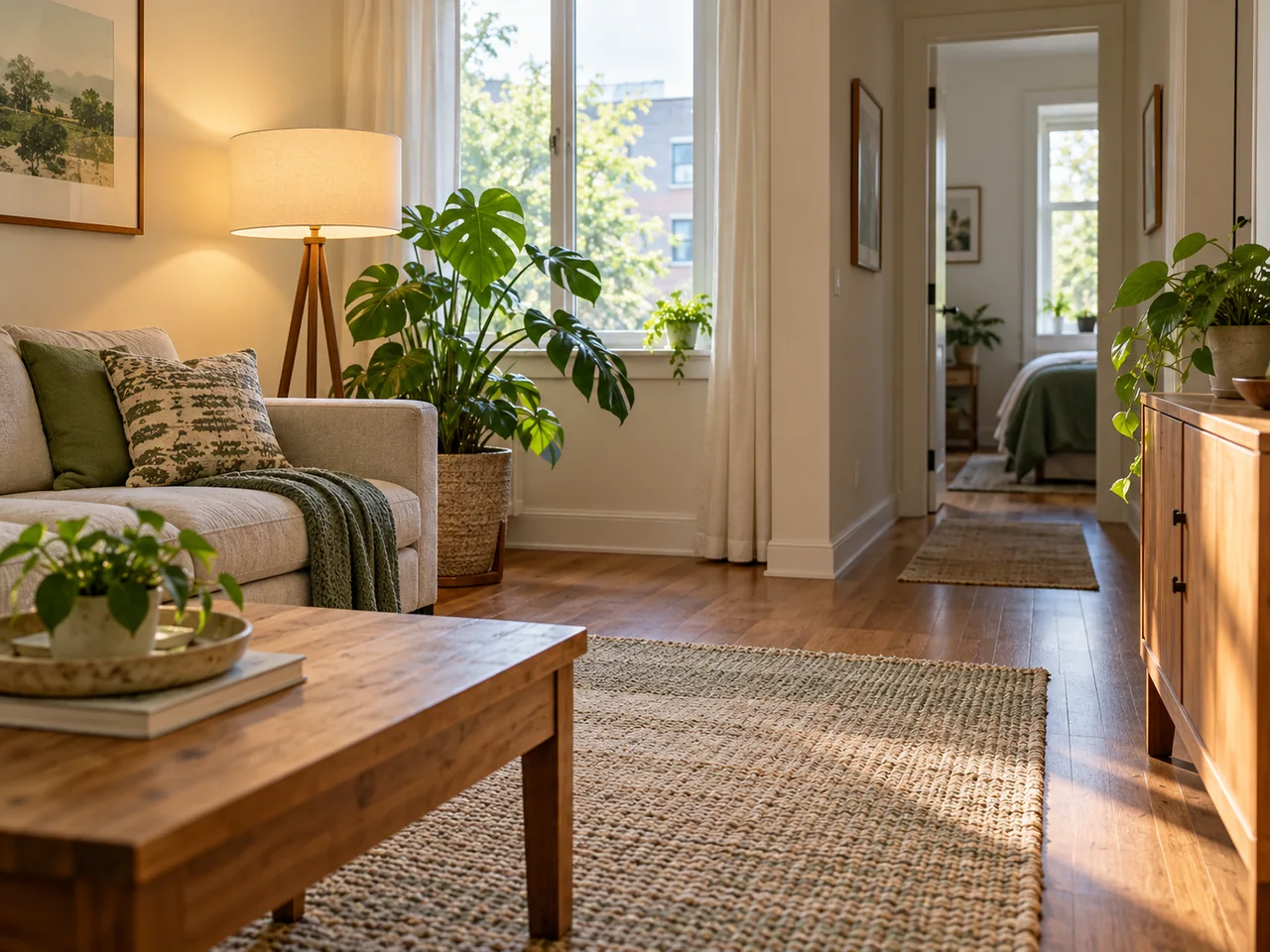
Light at the spot decides placement, and you can measure it
Most plant advice starts with the species: which plant brings money, which one clears stale energy, which one is lucky. Species matters less than placement, and the part of placement that decides the outcome can be measured. A plant in the right light will grow, forgive a missed watering and put out new leaves. The same plant a metre away, in the wrong light, will decline for a year while the watering, the soil and the pot all get blamed in turn.
You do not need equipment for the first check. In December or January, at about ten in the morning and again at two in the afternoon, stand where the plant would go and try to read a line of newsprint. If you have to switch a light on, the spot is low light. If you can read it easily but no direct sun ever falls on the page, the spot is medium. If sun lands on the page for an hour or more, the spot is bright.
A phone light-meter app gives you a number, which is more useful than a label. Point the sensor at the window rather than at a lamp, and take three readings: at the glass, one metre into the room, and at the spot you are considering. The magnitudes to expect in daytime are a few hundred lux in a shaded corner, one to five thousand lux within a metre of a bright window, and tens of thousands in direct sun. The absolute figure matters less than the ratio between the glass and the spot: once the spot reads below roughly a tenth of the glass, treat it as low light and choose the plant accordingly.
Two cautions. The app is approximate, so do not argue over a hundred lux in either direction. And measure in winter. A spot that works in January will work in July; the reverse is not true, and a summer reading is the most common reason a plant ends up somewhere it cannot live.
How far daylight actually reaches into a room
Daylight does not fill a room evenly. It falls away quickly with distance from the glass, and there is a rule of thumb from daylighting design that is accurate enough for choosing where a plant goes: useful daylight reaches roughly twice the height of the window head. If the top of the glass sits 2.1 metres above the floor, the first four metres of the room are lit well enough for most foliage plants, and the far half is living on reflected light.
How much arrives in the first place depends on window size, orientation, season, and how clean the glass is — a point the occupational-health literature makes bluntly, because daylight through a dirty window is daylight you paid for and did not get. An overhang, a balcony above, a deep reveal or a building opposite cuts the top of the window's view of the sky, and the top of the window is the part that reaches furthest into the room. That is why a room can look bright to your eye and still read low on a meter: your pupil adapts within seconds, and the meter does not.
Orientation changes the character of the light more than the quantity, which is why the four exposures need different plants rather than more or fewer of the same one:
| Orientation | Direct sun | Useful depth | What belongs near the glass |
|---|---|---|---|
| South | Four to six hours in winter; the summer sun is higher, so it reaches less far in | The deepest of the four, up to two window heights | Succulents, cacti, herbs, flowering plants; foliage plants a metre back |
| East | Two to four hours, morning, softer than afternoon | Middle distance, one to one and a half window heights | Most foliage plants; the most forgiving exposure for a first plant |
| West | Two to four hours, afternoon, hotter and stronger | Similar depth to east, at higher intensity | Sun-tolerant plants; watch for scorch on leaves in July and August |
| North | None, or a brief touch at midsummer | The shallowest, often under one window height | Ferns, peace lily and calathea close to the glass; nothing deep in the room |
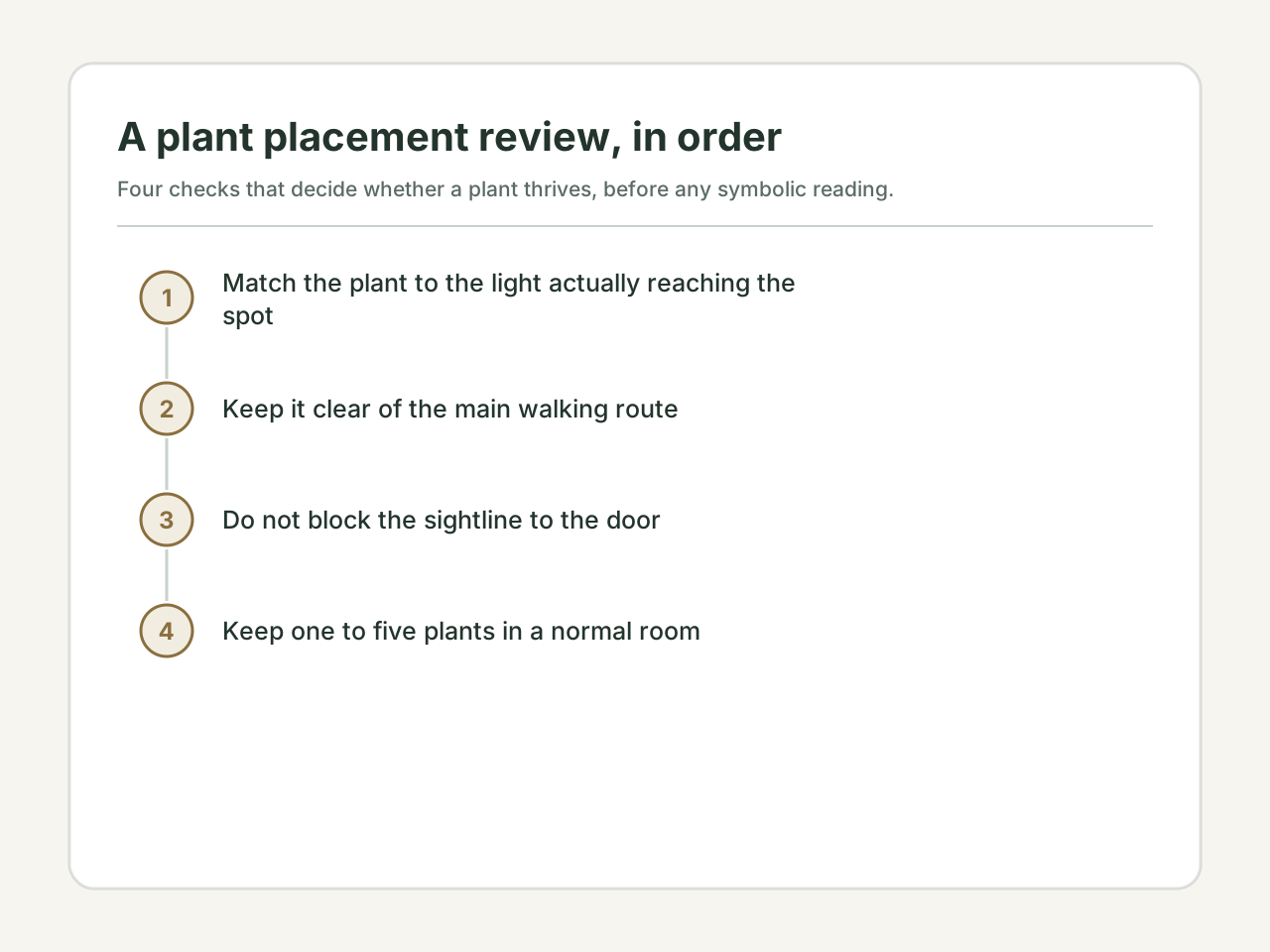
Room by room, and the constraint that decides the spot
The same plant can be right in one room and wrong in the next, because rooms differ in light, humidity, heat and how much of the floor is walked on. What follows is the room-by-room version, with the constraint that actually decides the position rather than the compass direction of the corner.
Two of these rooms deserve a warning. A bathroom without a window has no plant-friendly light however humid it feels, and humidity is not light. A bedroom is dark for the eight hours it is used, which is fine for a tolerant plant and hopeless for a flowering one.
| Room | What the light is really like | What will grow there | The constraint that decides the spot |
|---|---|---|---|
| Living room | Usually the best-lit room, but the light is at the perimeter and the middle runs on the ceiling light | Near glass: fiddle-leaf fig, monstera, rubber plant, areca palm. Further in: pothos, snake plant | The route from door to sofa; a plant that narrows it below about 60 cm gets brushed every day |
| Bedroom | Built for sleeping, so it is dark for eight or nine hours once the curtains close | Snake plant, ZZ plant, pothos | Nothing within reach of the bed head; a pot of wet soil should not hang above the pillow |
| Kitchen | Bright, but hot near the hob, greasy, and dry | Herbs on the windowsill, pothos, spider plant | 60 cm clear of the hob, and the counter space is already in use |
| Bathroom | Usually the darkest room in the house | Only with a window or a skylight: ferns, pothos, peace lily near it | No window means no plant, whatever the humidity reads |
| Home office | Screens and a desk lamp do the work; daylight is often behind you | ZZ plant, snake plant, a small pothos at the side of the desk | Keep the sightline to the door clear, and keep water away from the back of the monitor |
| Entry or hallway | A transitional space, often windowless | One tolerant plant if there is borrowed light; otherwise none | The door swing and the place where bags and shoes land |
The pot, the weight, and the space the plant takes
The pot is part of the placement decision because it fixes both the weight and the footprint. One rule prevents most repotting problems: the new pot should be 2 to 5 cm wider than the root ball. Moving a plant straight from a 15 cm nursery pot into a 30 cm decorative one leaves a mass of wet soil with no roots in it, and that soil stays wet for weeks.
Weight is the number people skip. Wet potting mix is close to 1 kg per litre, so pot and contents can be fifteen to forty kilos before the plant is counted. On a concrete floor that is nothing; on a timber balcony, a floating shelf or a window board it is a load to check. The table below is that arithmetic with a pot and a plant added.
Clearance decides whether the plant survives being lived around. Main walking routes want about 90 cm, secondary routes about 60 cm. A plant that narrows a route below that is brushed on every pass, loses leaves on the way past, and is the first thing moved when the room is rearranged. The same logic runs vertically: a plant that grows past the height of the window head puts its new leaves into the shadow of the reveal, and the top of the plant stalls even though the room is bright.
| Pot diameter | Volume of mix | Loaded weight | Where it can sit |
|---|---|---|---|
| 15 cm | About 2.5 litres | 3 to 4 kg | Windowsill or shelf |
| 20 cm | About 4 litres | 5 to 6 kg | Side table, desk, low shelf |
| 25 cm | About 8 litres | 10 to 11 kg | Floor, or a shelf built for the load |
| 30 cm | About 12 litres | 15 to 16 kg | Floor only |
| 40 cm | About 30 litres | 35 to 40 kg | Floor, or a balcony after checking what it is rated for |
A worked example: the fig that stalled at 1.8 metres
A fiddle-leaf fig, 1.8 metres tall, stood in a living room the owner described as bright. It was two metres from a north-facing window, with a balcony directly above that window. Measured at noon in December, the leaves read about 350 lux; the glass read about 3,000. The ratio was under one eighth. The plant had produced no new leaf for eleven months and was dropping its lowest leaves one at a time.
The watering was blamed first, then the soil, then the pot. All three were fine: the pot drained, the mix dried between waterings, and the roots were healthy when they were checked. The plant was spending most of the day below the light level at which it gains more from photosynthesis than it uses, which is a slow way to starve.
The fix took ten minutes and cost nothing. The fig moved 50 cm from the glass, where the leaves read about 1,800 lux. The balcony still cut the sky view; distance did most of the work. It put out four leaves the following spring. The useful part of the story is not the number — it is that the gap between a bright room and a bright spot was one metre, and neither the species nor the compass direction of the corner would have predicted it.
Pets, children, and the plants that are not worth the risk
Check the species against a toxicity list before buying, not after. The ASPCA list is the usual reference and it separates two very different groups. In the first, the danger is real: true lilies cause kidney failure in cats and the pollen alone is enough, sago palm causes liver failure in dogs, and oleander is dangerous to both. In the second, the plant is irritating rather than lethal — peace lily, pothos and philodendron contain calcium oxalate crystals that cause immediate mouth pain, drooling and vomiting, and rarely anything worse.
The distinction changes what you do with the plant. A lily in a house with a cat is a plant not to own, because no shelf is reliably out of a cat's reach and no amount of care compensates for a grain of pollen on the floor. A pothos on a high shelf in a house with a dog is a risk you can manage. Naming which group a plant belongs to is more useful than the blanket instruction to keep everything out of reach.
Children change the risk from leaves to soil. A pot of wet soil at floor level is something to dig in, and toddlers put what they dig up in their mouths. Gravel on the surface does not solve it; a taller pot, a shelf, or two more years does. And the air-purification claim is worth retiring: chamber studies do show plants taking up volatile compounds, but the EPA's guidance on indoor air puts source control and ventilation first, because the rate a plant works at does not add up to a measurable change in a normal room. Keep the plant because you want one and will look after it, which is the only reason that survives a busy week.
Five placement mistakes that explain most failures
These are the errors that turn up again and again, and none of them is about the compass:
- Measuring in summer. A July reading in a north-facing room can look adequate because the sun is high and the days are long; the same spot in January is far dimmer and the plant spends the winter losing ground.
- Treating a north window and a north-facing room as the same thing. The window is a light source; the room is what the light has to cross. Three metres back from a north window is not a north-window spot.
- Putting the plant in the corner of the room instead of the corner of the window wall. The decorative instinct is the far corner, the light is at the perimeter, and the two are rarely the same place.
- Ignoring the weight. A 30 cm pot is about 15 kg loaded, and shelves, window boards and balcony railings are not all built for that. It is a two-minute check that prevents a slow sag or a sudden failure.
- Buying many small pots instead of one plant of the right size. Five 15 cm pots on a shelf read as clutter and each gets a fraction of the attention; one 25 cm plant in the same place reads as a decision.
Checklist before you buy or move a plant
Run through this at the spot rather than in the shop. It takes about ten minutes and it prevents most of the losses that later get blamed on the position:
- Measure at 10:00 and 14:00 in winter, at the glass and at the spot, and write both numbers down.
- Check the window head height and whatever sits above the window — balcony, awning, deep reveal — before assuming a distance is safe.
- Look the species up on a toxicity list if there is a cat, a dog or a child in the house, and note which group it falls into.
- Confirm the pot has a drainage hole, a saucer you will actually empty, and a diameter 2 to 5 cm wider than the root ball.
- Weigh it before it goes on a shelf or a balcony: litres of mix times one kilogram, plus the pot and the plant.
- Keep 90 cm clear on main routes and 60 cm on secondary ones, and check the door swing.
- Give it four to six weeks and judge by new growth rather than by how it looks in the first week.
What a position has to give a plant
A plant does not need a compass bearing. It needs light at the leaf, a pot it can drain, and enough room that nobody has to step around it. Get those three right and the room looks after itself; get them wrong and no arrangement of symbols will keep the leaves on. The tradition is not wrong to treat a thriving plant as a good sign — it is only wrong about the mechanism, which is light and water and space rather than the direction of the corner.
Disclaimer: This content is for informational and cultural reference purposes only. It does not constitute professional medical, legal, financial, or psychological advice. Readers should exercise their own judgment and consult qualified professionals for specific concerns.
Sources and review basis
Traditional references explain historical vocabulary and context. Official practical sources support only the observable safety, comfort, or environmental points noted in the article; they do not validate metaphysical claims.
Traditional reference
Huangdi Zhaijing (黄帝宅经)Wikisource digital text · Accessed 2026-07-14
Historical context for traditional residential orientation and spatial vocabulary. Modern recommendations are judged against real conditions.
Practical source
ASPCA: Toxic and Non-Toxic PlantsAmerican Society for the Prevention of Cruelty to Animals · Accessed 2026-07-14
A plant-safety reference for homes with cats, dogs, or other pets.
Practical source
US EPA: Indoor Air QualityUnited States Environmental Protection Agency · Accessed 2026-07-14
Practical background for ventilation, pollutants, combustion sources, and indoor air concerns.
Practical source
CCOHS: Lighting ErgonomicsCanadian Centre for Occupational Health and Safety · Accessed 2026-10-14
Summarises lighting levels, glare, and contrast guidance for indoor work, reading, and circulation areas.
Practical source
CCOHS: Office ErgonomicsCanadian Centre for Occupational Health and Safety · Accessed 2026-07-14
Practical guidance for workstation setup, posture, reach, lighting, and office comfort.