The animal, before it became a money charm
貔貅 appears in the Records of the Grand Historian as one of the fierce animals the Yellow Emperor is said to have trained for the battle at Banquan: 教熊羆貔貅貙虎. Bears, brown bears, 貔貅, 貙 and tigers, in one list, as troops. Nothing in that sentence is financial.
The wealth reading is a later folk development, and the motif everyone repeats — that the creature eats gold and silver and has no anus, so wealth goes in and never comes out — is the legend that explains the reading rather than a doctrine found in a classical text. That distinction is not pedantry. It tells you what kind of claim you are being sold: a mythical animal with a long iconographic history, onto which a money function was attached by custom, with the strength of the attachment varying by region and by decade.
开光 is a consecration rite, not a product feature
In Buddhist practice, 開光 is the consecration of an image — the rite that marks a statue or painting as an object of veneration rather than a piece of craft. It is performed by clergy, in a temple, with a liturgy, and its central gesture is the eye-opening: the moment the image is treated as present rather than depicted. Daoist practice has analogous consecration rites with their own procedures.
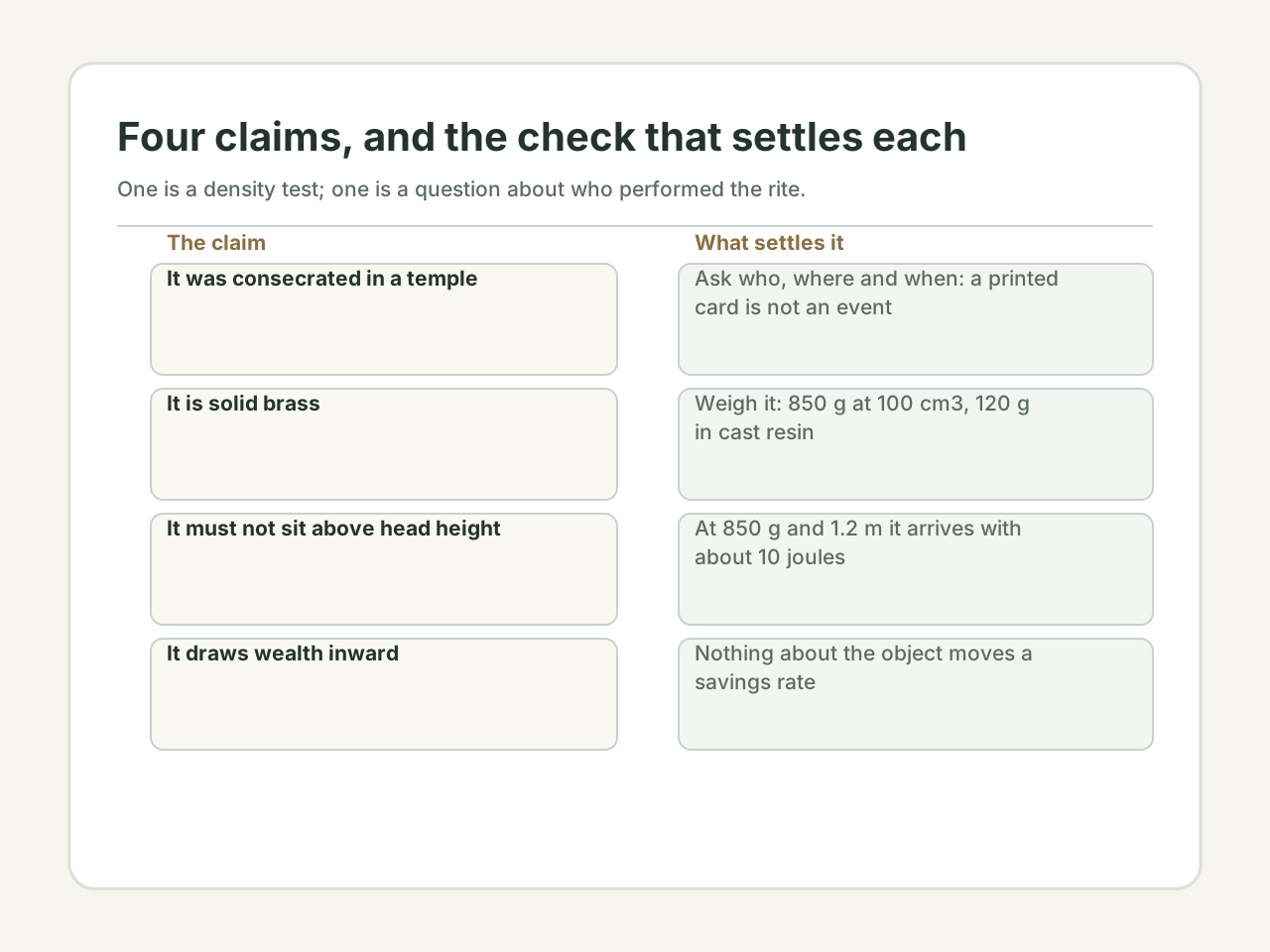
The authority in the tradition comes from who performs the rite and where. That is why a certificate is not the same thing as a consecration: a printed card asserting that an object was blessed carries no information about who did it, in what setting, under what liturgy. None of this requires a belief in the result. It only requires noticing that the word names an event with participants, and a shop label is not an event.
The category the modern version skips
Classical 開光 is for 神像 and 佛像 — images made to be venerated. A decorative figurine on a desk is not an image of that kind, and applying the rite to it is an extension rather than an inheritance.
Saying so is not disrespectful to the practice; it is what the categories say. A temple consecrates an image because the image is the focus of worship. A resin lion on a shelf is the focus of a decorating decision. Both can be meaningful, but they are not the same kind of object, and the vocabulary borrowed from the first does a lot of commercial work in the second.
What the piece is made of, and the check that settles it
Almost every 貔貅 sold online is cast in one of four materials, and the four differ in density by a factor of seven. Take cast brass at about 8.5 g/cm3, a zinc die-casting alloy at about 6.6, nephrite at about 3.0, and cast resin at about 1.2. These are working values of the kind a materials table gives; the check below depends on the ratio, not on the third decimal.
Fill a measuring jug to a marked line, lower the piece in on a thread, and read how far the level rises. A palm-sized lion about 8 cm tall displaces roughly 100 cm3, which is worth confirming rather than assuming. Multiply by the density and the piece should weigh 850 g in solid brass, 660 g in zinc alloy, 300 g in nephrite, or 120 g in resin. A figure sold as brass that comes in at 200 g is hollow, plated, or neither, and no certificate changes the reading on the scale.
| Material | Density, g/cm3 | What 100 cm3 weighs |
|---|---|---|
| Cast brass | 8.5 | 850 g |
| Zinc die-casting alloy | 6.6 | 660 g |
| Nephrite | 3.0 | 300 g |
| Cast resin | 1.2 | 120 g |
Two quicker tests, and where each one fails
The tap test needs no equipment: a hollow casting rings and a solid one thuds. It fails on thick-walled hollow pieces, which ring less than expected, and on a piece with a loose base plate.
The seam test is the most reliable of the three. Die-cast and plated pieces carry a mould seam and a fill plug, usually under the base or along one flank. A hand-finished brass piece may show a chased seam but rarely a plug. Turn the object over before you look at the front: the base tells you how it was made, and the front tells you how it was sold.
Weight decides how much the height rule matters
The traditional rule says not to place the creature above your head, and gives disrespect as the reason. The practical reason is the one that survives scrutiny: an object can fall. The energy is mass times gravity times height, so the 850 g brass figure on a shelf at 1.2 m arrives with about 10 joules, and the 120 g resin copy of the same mould arrives with about 1.4.
Two more figures make the tipping question concrete. A free-standing object tips when its centre of mass passes the edge of its support, which for a symmetric figure means overhanging by more than half the base. And the base has to sit wholly on the surface rather than mostly on it, so a 12 cm base on a 10 cm ledge is already past the line.
That gives the rule a measurable form: keep the whole base on the surface, keep the centre of mass inside it, and put the piece high only if it is light. On a brass figure the height rule is a safety rule. On a resin one it is mostly a courtesy.
Placement rules, and the two logics inside them
The traditional placement rules are consistent within their own logic: face the door or window to draw wealth inward, keep it out of bedrooms and bathrooms because those spaces are impure, do not let it sit higher than your head, do not let others touch its eyes or mouth once consecrated. Each rule follows from the object being a vessel rather than a decoration.
The practical readings of the same rules often coincide, which is why the advice survives. Facing the door makes the object visible. Bedrooms and bathrooms are where things get knocked over, steamed, or greasy. Height above eye level means it falls on someone. Handling wears the finish and, on a metal piece, the plating.
Where the two logics part company is what happens when they conflict — a flat with no surface facing the door, for instance. The traditional answer is that the rule cannot be kept. The practical answer is that visibility was the point, so put it where you look.
| Rule | Traditional reason | What it also achieves |
|---|---|---|
| Face the door or window | Draw wealth inward from outside | Puts the object in your sightline when you enter |
| Keep out of bedroom and bathroom | Those rooms are impure | Avoids steam, grease, and knocked-over objects |
| Do not place above head height | Disrespect to the creature | Avoids a heavy object falling |
| Do not let others touch eyes or mouth | The consecration is disturbed | Protects the finish from handling |
| Keep it clean | Neglect offends the creature | A dusty object stops being a reminder |
A gift 貔貅 in a one-bedroom flat
A relative gives a young professional a small brass 貔貅 and tells her it will bring wealth. She lives in a one-bedroom flat where the living room is also the dining table and the desk. The only surface near the door is a console 30 cm deep, already carrying a key tray, a lamp and the post.
Facing the door, as the rule says, means putting the figure on that console. The piece measures 14 cm across the base, so it needs 14 cm of clear depth plus a margin to stop the front paws overhanging; the console offers 30 cm minus a tray and a lamp base, which leaves about 11 cm.
She puts it on the desk instead, at the edge of the space where she pays bills and checks her account. That is the whole of the decision, and it is a decision about furniture. Whether her savings improved afterwards is not evidence for the object, because she also changed her routine in the same months and there is no version of her life in which she did not. What can be said without overreach is narrower: the object ended up where the behaviour happens.
What to expect from it
A 貔貅 is a decorative object with a religious and folk history. Its defensible functions are three: it looks like what it is, it can serve as a reminder of an intention, and it can carry family meaning when it was a gift.
What it does not do is generate money. Advertisements that promise wealth attraction are making a claim with no evidence behind it, and the honest version of the tradition does not require that claim — the animal was a guardian long before it was a wallet.
A five-minute check before you buy
Do this with a kitchen scale and a measuring jug, in the shop or after delivery while the return window is open.
- Weigh the piece and compare it with the density table for its claimed material.
- Displace water to get the volume, then divide the weight by it: 8.5 for brass, 1.2 for resin.
- Tap the base; a ring means hollow, a thud means solid.
- Turn it over and look for a mould seam and a fill plug.
- Measure the base and the surface it is going on; the whole base has to fit.
- Check the height against what it weighs, not against what the rule says.
- Ask who performed any consecration, where, and on what date. A card with no name is a card.
Disclaimer: This content is for informational and cultural reference purposes only. It does not constitute professional medical, legal, financial, or psychological advice. Readers should exercise their own judgment and consult qualified professionals for specific concerns.
Sources and review basis
Traditional references explain historical vocabulary and context. Official practical sources support only the observable safety, comfort, or environmental points noted in the article; they do not validate metaphysical claims.
Traditional reference
Records of the Grand Historian, Annals of the Five Emperors (史記·五帝本紀)Wikisource digital text · Accessed 2026-11-02
The chapter that lists 貔貅 among the animals the Yellow Emperor trained for the battle at Banquan: 教熊羆貔貅貙虎,以與炎帝戰於阪泉之野. It is cited only for that occurrence and for the absence of any financial sense there; it says nothing about a money charm.
Traditional reference
Huangdi Zhaijing (黄帝宅经)Wikisource digital text · Accessed 2026-07-14
Historical context for traditional residential orientation and spatial vocabulary. Modern recommendations are judged against real conditions.
Practical source
APA Dictionary: Placebo effectAmerican Psychological Association · Accessed 2026-10-14
Defines the placebo effect, which matters when an object or ritual is credited with a change that expectation alone could explain.
Practical source
APA Dictionary of Psychology: Barnum effectAmerican Psychological Association · Accessed 2026-07-14
A psychology reference for why broad, favourable personality descriptions can feel personally accurate. It does not evaluate BaZi calculations themselves.