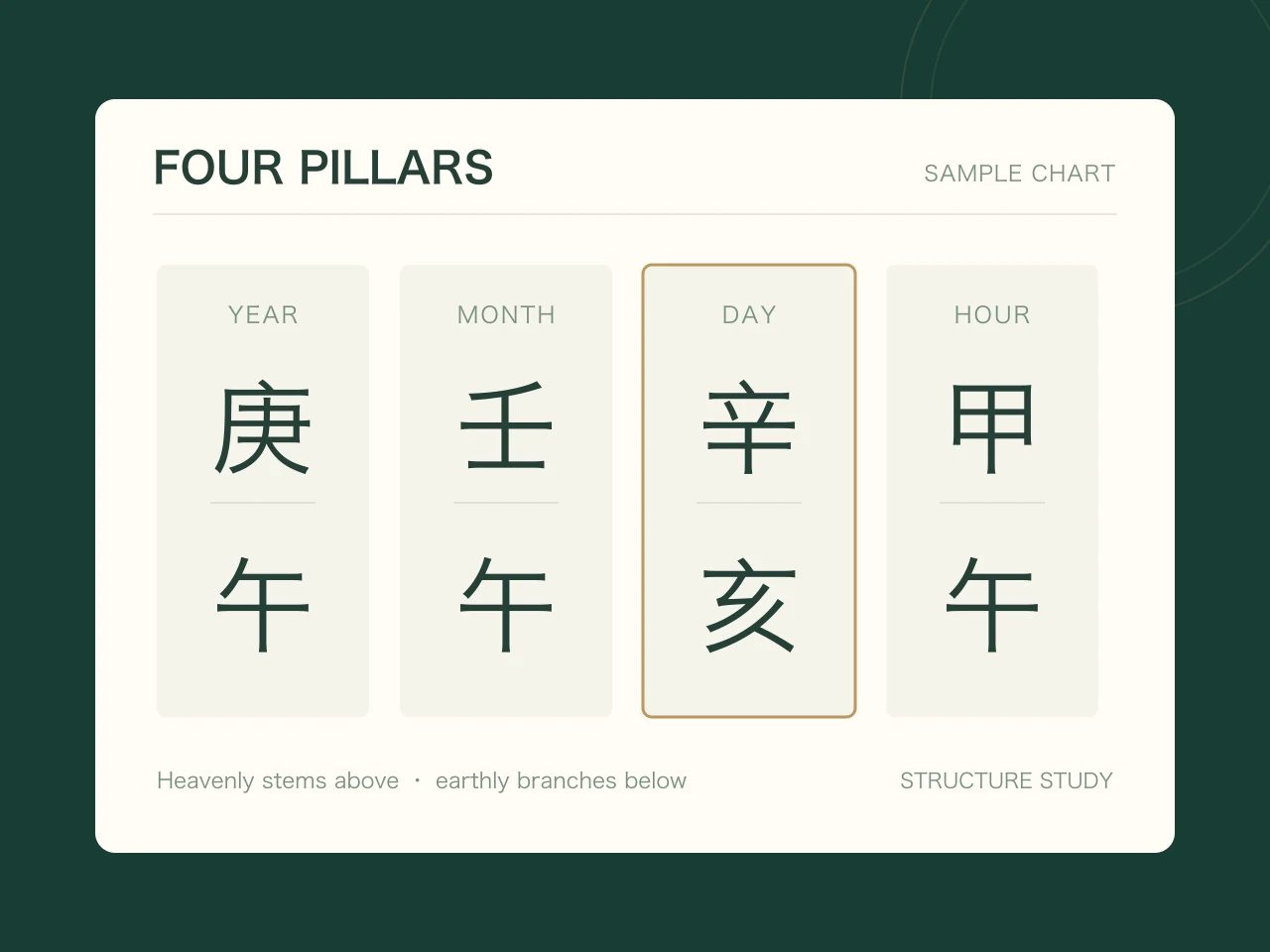
A luck pillar is the month pillar stepped forward or back
The natal chart never changes. A luck pillar (大運) is a second, moving layer laid over it: one stem-branch pair per decade, taken from the month pillar and walked through the sixty-cycle in a single direction. Nothing else in the chart generates it, and it is not derived from the Day Master.
Direction is decided by the polarity of the year stem together with sex. It is not decided by the Day Master, and not by the year branch. Take 庚午 丁亥 乙酉 辛巳, born 16 November 1990 at 10:00. The year stem is 庚, yang. A male walks forward from the month pillar: 戊子, 己丑, 庚寅, 辛卯, 壬辰, 癸巳. A female walks backward: 丙戌, 乙酉, 甲申, 癸未, 壬午, 辛巳. Same birth, same four pillars, two sequences that share almost nothing.
| Year stem | Sex | Direction | Sequence from 丁亥 |
|---|---|---|---|
| yang (庚) | male | forward | 戊子 → 己丑 → 庚寅 → 辛卯 |
| yang (庚) | female | backward | 丙戌 → 乙酉 → 甲申 → 癸未 |
| yin (辛) | male | backward | 丙戌 → 乙酉 → 甲申 → 癸未 |
| yin (辛) | female | forward | 戊子 → 己丑 → 庚寅 → 辛卯 |
The starting age is a division you can redo by hand
Count from the birth moment to the nearest 節 in the direction of travel — one of the twelve 節 that open a month, not a 中氣 that falls inside one — then convert at three days to a year, one day to four months, one 時辰 to ten days.
For the 1990 chart: born 16 November at 10:00, 立冬 fell on 8 November, 大雪 on 7 December at 17:14. A male travels forward, so the count runs to 大雪 — 21 days 7 hours 14 minutes. That converts to 7 years 1 month 6 days, and the first pillar opens on 22 December 1997 at about 14:20. A female travels backward to 立冬, roughly eight days, which converts to 2 years 9 months 18 days and a first pillar opening on 3 September 1993.
The three-days-to-a-year rule is shorthand for that arithmetic, not a separate method. It agrees to within a few days in the middle of a month and disagrees by weeks near a boundary, which is why two calculators can differ over whether someone was seven or eight at 交運. The boundary case is not a flaw in either program; it is a convention difference that the reader is entitled to see.
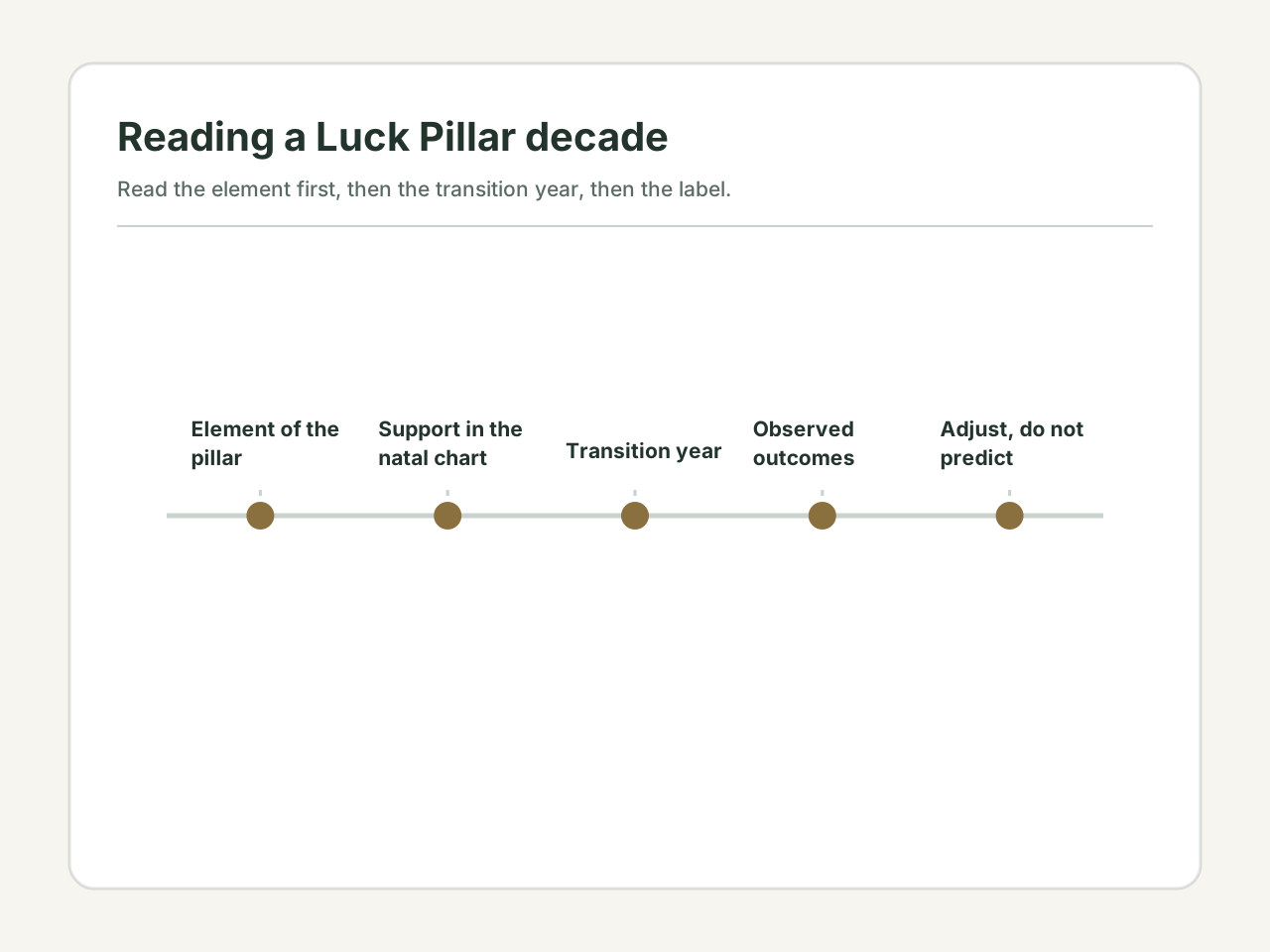
The stem names a ten god; the branch does the structural work
Read a pillar in two halves. The stem is compared with the Day Master and receives a ten-god name. The branch is compared with each natal branch and receives a relation — 沖, 合, 害, or nothing at all.
For 乙 as Day Master, the stems in the male sequence resolve as 戊 正財, 己 偏財, 庚 正官, 辛 七殺, 壬 正印, 癸 偏印, 甲 劫財. That is the sentence most readings stop at, and on its own it says almost nothing about the decade.
The branch is where a decade becomes specific. 己丑 meets two natal branches. It 害 the year branch 午, which touches family background rather than the person. More consequentially, 丑 completes 巳酉丑 with the natal 酉 and 巳, closing a full metal 三合 around the chart. A 乙 Day Master inside a completed metal frame sits in 官殺 whether or not any stem says so, and that is a checkable fact about the decade rather than an interpretation.
The same reading applied across the sequence shows how unevenly the decades are built. 辛卯 clashes the day branch outright; 壬辰 combines with it; 癸巳 clashes the month branch. Three consecutive pillars, three different palaces, and none of it visible from the stem names alone.
| Pillar | Ages | Stem as ten god | Branch against the natal chart |
|---|---|---|---|
| 戊子 | 7–16 | 正財 | 子 沖 午 (year branch) |
| 己丑 | 17–26 | 偏財 | 丑 害 午; 丑 completes 巳酉丑 with 酉 and 巳 |
| 庚寅 | 27–36 | 正官 | 寅 合 亥 (month); 寅 半合 午; 寅 害 巳 (hour) |
| 辛卯 | 37–46 | 七殺 | 卯 沖 酉 (day); 卯 半合 亥 |
| 壬辰 | 47–56 | 正印 | 辰 合 酉 (day) |
| 癸巳 | 57–66 | 偏印 | 巳 沖 亥 (month); 巳 半合 酉 |
| 甲午 | 67–76 | 劫財 | 午 duplicates the year branch 午 |
Two clocks running at once
A decade sets the allowance; a year sets the trigger. In 2026 the year pillar is 丙午. For the same 乙 Day Master inside the 庚寅 decade, 丙 is 傷官 — the output star whose name states that it damages the 官 — while the decade's stem is 庚 正官. That pairing is 傷官見官, and it is visible from three characters with no interpretation added.
The year branch complicates the picture instead of confirming it. 午 is 乙's 長生, and 午 半合 the decade's 寅 into fire. So the year feeds a fire half-frame while its stem attacks the decade's authority star. A reading that reports only the 傷官見官 warning has thrown away half of what the three characters say.
The hierarchy matters when the layers disagree. 命局 decides what is possible, 大運 decides what the decade permits, 流年 decides what is triggered this year. A year cannot grant a structure the chart does not have, and a decade cannot overrule a chart that contradicts it.
Where the arithmetic stops being decisive
Three conventions produce different pillars from identical birth data, and none of them is an error. Direction can be read from the year stem, which is the common rule, or from the year branch, which is a minority reading. The count can run to the next 節 or to the next 中氣. The conversion can use whole days or exact hours, shifting 交運 by weeks.
Then there is the label problem. 七殺運 sounds like a decade of pressure, and it is, until the element that 七殺 supplies turns out to be the chart's 用神. A 七殺 decade can be the best ten years in the sequence for a chart that needs metal; a 正財 decade can be the worst for a chart already oversupplied with it. The name records a relation to the Day Master. It is not a verdict on the decade, and treating it as one is how a timing tool turns into a fortune cookie.
What a decade reading can and cannot do
It can name the palace a decade touches — the day branch for partnership, the month branch for work and standing, the year branch for family background — and it can say which ten god is being supplied or attacked. Those are specific claims about the model, and two readers using the same conventions should be able to agree on them without negotiating.
It cannot say what happens. 辛卯 clashes the spouse palace for this 乙 Day Master; that is a fact about the branches and it can be checked by anyone holding the same four pillars. Whether the decade brings a separation, a relocation, a new business partner, or nothing the person would notice is not contained in those characters, and further reading will not put it there. What the decade offers is a named pressure with a known palace. What a person does inside that pressure is the part the chart was never going to answer.
Disclaimer: This content is for informational and cultural reference purposes only. It does not constitute professional medical, legal, financial, or psychological advice. Readers should exercise their own judgment and consult qualified professionals for specific concerns.
Sources and review basis
Traditional references explain historical vocabulary and context. Official practical sources support only the observable safety, comfort, or environmental points noted in the article; they do not validate metaphysical claims.
Traditional reference
Yuanhai Ziping (渊海子平)Wikisource digital text · Accessed 2026-07-14
A classical source for Four Pillars terminology, element relationships, and the Day Master framework.
Traditional reference
Sanming Tonghui (三命通会)Wikisource digital text · Accessed 2026-07-14
A historical compilation used to cross-check traditional BaZi concepts; it is not scientific validation.