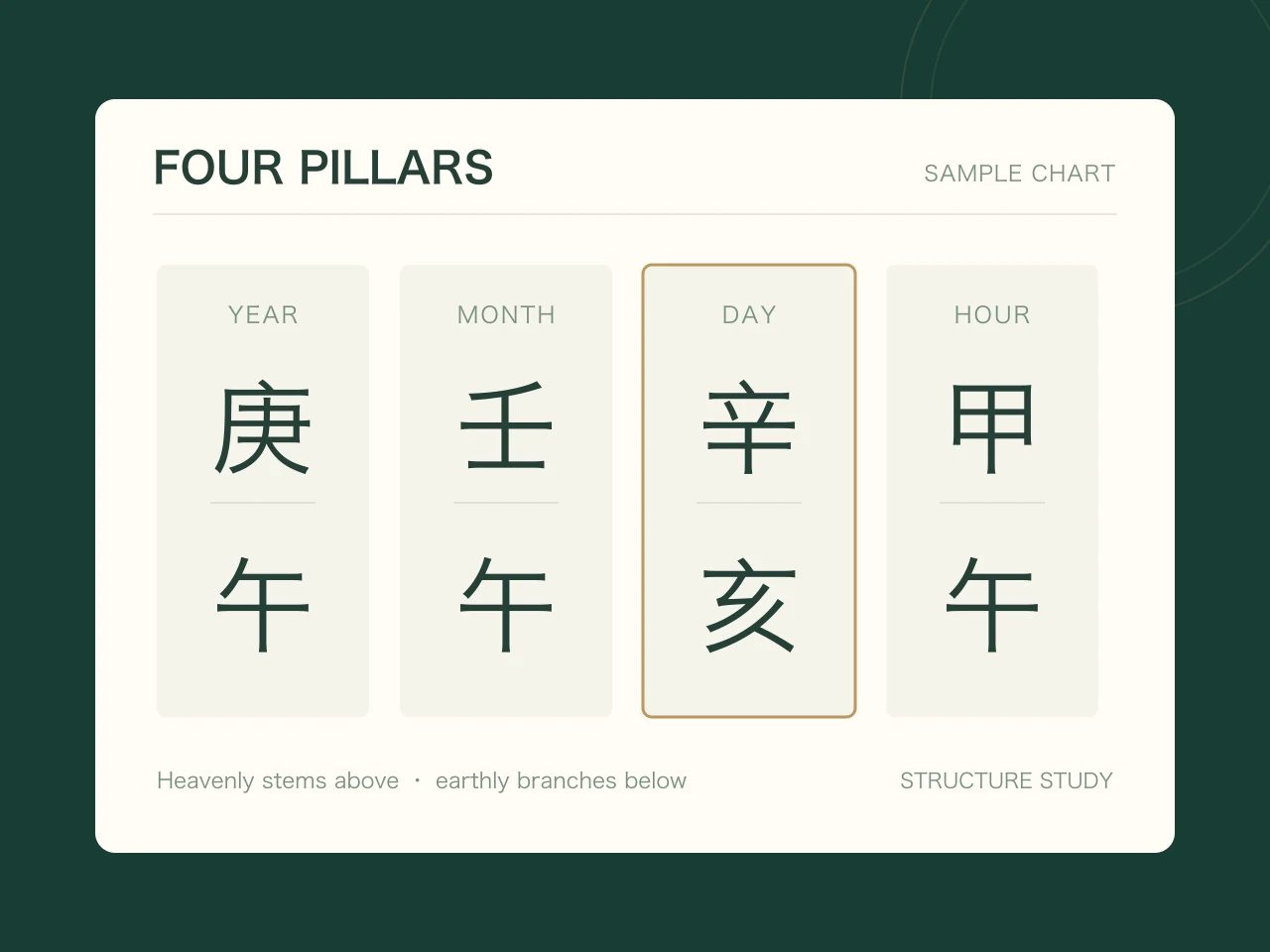
The day boundary sits inside 子, not between two hours
The twelve double-hours are counted from 子, and 子 runs from 23:00 to 01:00. Midnight therefore falls in the middle of a block rather than on the seam between two, and that single placement is where the whole disagreement comes from. 23:00 to 24:00 is 晚子, the late 子; 00:00 to 01:00 is 早子, the early 子. Both are the 子 hour. Under one convention they belong to different days.
What the pillars do at 23:00, computed
Take 5 December 2026. At 22:30 the chart reads 癸丑 day and 癸亥 hour. At 23:00 the day pillar steps to 甲寅 and the hour to 甲子 — one step forward in both, at the moment the hour branch leaves 亥 and enters 子. Nothing further happens at midnight: 23:59 and 00:00 return the same two pillars.
While the pillars move, the calendar does not. At 23:30 the lunar date is still 十月廿七, and it only becomes 十月廿八 at 00:00. So there is one hour in which a chart and a date stamp describe different days, and anyone reconciling a birth record against a chart walks straight into it.
The same jump appears on any date. On 15 March 2026 the sequence runs 戊子 and 癸亥 at 22:59, then 己丑 and 甲子 at 23:00.
| Clock time | Day pillar | Hour pillar | Lunar date |
|---|---|---|---|
| 2026-12-05 22:30 | 癸丑 | 癸亥 | 十月廿七 |
| 2026-12-05 23:00 | 甲寅 | 甲子 | 十月廿七 |
| 2026-12-05 23:59 | 甲寅 | 甲子 | 十月廿七 |
| 2026-12-06 00:00 | 甲寅 | 甲子 | 十月廿八 |
| 2026-03-15 22:59 | 戊子 | 癸亥 | 正月廿七 |
| 2026-03-15 23:00 | 己丑 | 甲子 | 正月廿七 |
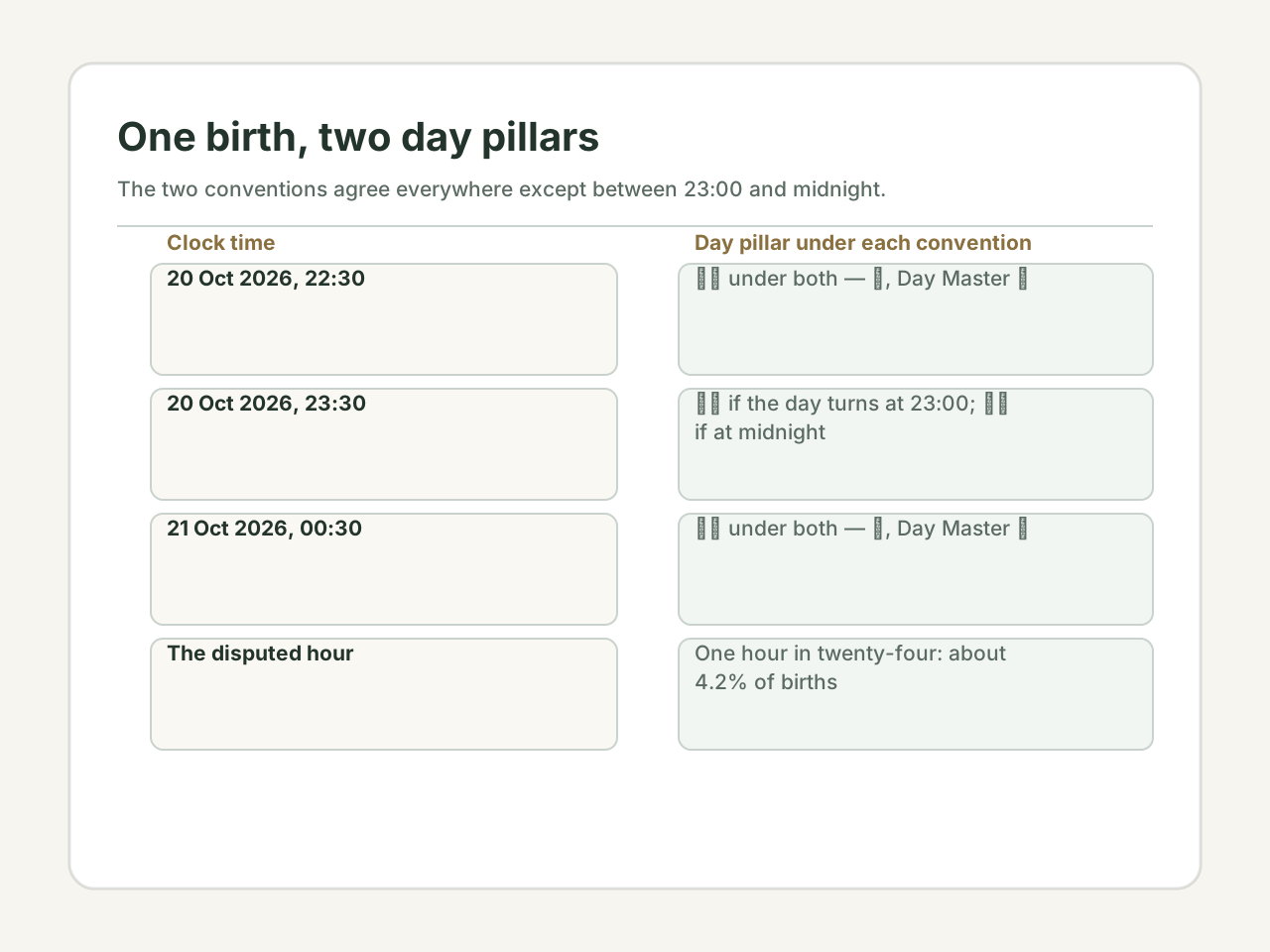
The two conventions differ in two pillars, not one
One convention turns the day at 23:00. Under it a birth at 23:30 on 5 December 2026 is a 甲寅 day, and its hour is the 子 hour of a 甲 day, which is 甲子.
The other convention turns the day at midnight and keeps 23:30 on the previous day. The day pillar stays 癸丑. But the hour pillar cannot stay where it was, because the stem of an hour is derived from the stem of its day: a 子 hour on a 癸 day is 壬子, not 甲子.
So the two readings differ in the day pillar and in the hour stem at once. Two of the four pillars change. The hour branch, 子, is the only part they agree on.
| Convention | Day pillar at 23:30 | Hour pillar at 23:30 | Day Master |
|---|---|---|---|
| turns the day at 23:00 | 甲寅 | 甲子 | 甲 |
| turns the day at 00:00 | 癸丑 | 壬子 | 癸 |
The hour stem follows the day stem, which is why both move
The derivation is a fixed lookup, 五鼠遁, five rats in flight: 甲 and 己 days begin their 子 hour at 甲子, 乙 and 庚 at 丙子, 丙 and 辛 at 戊子, 丁 and 壬 at 庚子, 戊 and 癸 at 壬子. Because the hour stem is a function of the day stem, moving the day moves the hour with it whether or not that was intended. Outside 23:00–24:00 the two conventions agree everywhere, since day and hour are then derived the same way.
The day stem is the reference every other judgement is named against
The day stem is the Day Master, and nothing in a chart is described in absolute terms — every other character is described relative to it. Strength is judged against it, the favourable element is chosen relative to it, and the ten gods are named from the relation each character bears to it.
A 癸 Day Master and a 甲 Day Master reading the same chart do not disagree about emphasis. They disagree about what the characters are. A 庚 in the chart is 正印, the direct resource, to 癸 — yang metal generating yin water. The same 庚 is 七杀, the seven killings, to 甲 — yang metal cutting yang wood. The 子 branch of the disputed hour is 比肩, a peer, to 癸, and 正印, a resource, to 甲.
That is why the convention has to be settled before anything else. Every later step — which element is favourable, which decade is hard, which palace is under pressure — is computed from a day stem, and there is no way to carry two of them through the rest of the reading.
Clock 23:00 is not solar 23:00, and across China the gap is two hours wide
Before either convention can be applied, the clock reading has to become a solar one, because the double-hours divide apparent solar time and the clock does not. The conversion is one line: solar time equals clock time, plus (longitude − 120°) × 4 minutes, plus the equation of time.
The longitude term is the large one. China keeps a single zone, UTC+8, centred on 120°E, while the country spans about 62 degrees of longitude — roughly four hours of solar time. On 5 December the equation of time is about +8.6 minutes, so the correction is close to the longitude term alone.
The same clock minute therefore produces three different branches. In Beijing it is still 亥 and outside the disputed window altogether. In Shanghai it is already 子 and inside it. In Ürümqi it is 戌, two blocks earlier, in a different half of the evening. So "born at 23:00" is not yet a statement about a chart; it needs a longitude before it is one.
The equation of time adds a second, smaller wobble: about +8.6 minutes in early December, about −14.6 minutes around 11 February, a drift of more than twenty minutes across the year. Reading the clock directly, with neither term applied, is off by up to two hours in the west of the country.
| City | Longitude | 23:00 on the clock equals | Hour branch |
|---|---|---|---|
| Beijing | 116.4°E | 22:54 | 亥 |
| Chengdu | 104.1°E | 22:04 | 亥 |
| Shanghai | 121.5°E | 23:14 | 子 |
| Ürümqi | 87.6°E | 20:59 | 戌 |
How wide the window actually is
23:00 to midnight is one hour in twenty-four, so if births were spread evenly about 4.2% would land inside it. They are not spread evenly — hospital schedules and induction rates bend the daily curve — so 4.2% is an order of magnitude rather than a rate. Four things widen it further:
- Recording to the nearest half hour. A 22:50 birth written down as 23:10 crosses the line on paper only, and then the chart is built on the wrong side of it.
- Summer time. China ran daylight saving from 1986 to 1991, so a 23:30 record from a 1988 summer night was 22:30 standard time — outside the window entirely.
- Longitude, as above: one clock hour is three different branches across the country, and only some of those land in 子.
- Branch-only entry. Picking 子 from a list of double-hours usually evaluates the middle of the block, 00:30, which sits on the early-子 side. A 23:30 birth entered that way receives the previous day pillar, and nothing in the output flags it.
What to record, and what to say out loud
Five habits make the boundary answerable instead of arguable:
- Record the minute and the zone it was written in. "About eleven at night" is the one answer that cannot be resolved, because it straddles the boundary by construction.
- Check for summer time before converting anything: 1986–1991 in China, and whatever period the birth country ran.
- Ask which convention the reading uses. A chart that does not state its convention has not answered the question.
- If the birth falls inside 23:00–24:00, present both pillars and name the difference. Two charts with the disagreement stated is a better answer than one chart presented as certain.
- If only a double-hour is known, say so as well. A 子 answer covers two hours and both sides of the boundary; collapsing it to a single time invents a precision the record does not have.
Disclaimer: This content is for informational and cultural reference purposes only. It does not constitute professional medical, legal, financial, or psychological advice. Readers should exercise their own judgment and consult qualified professionals for specific concerns.
Sources and review basis
Traditional references explain historical vocabulary and context. Official practical sources support only the observable safety, comfort, or environmental points noted in the article; they do not validate metaphysical claims.
Practical source
NOAA Solar CalculatorNOAA Global Monitoring Laboratory · Accessed 2026-10-16
Used to check local solar noon and the equation of time, which is the part the true-solar-time correction adds to or subtracts from clock time.
Practical source
IANA Time Zone Database (tzdata)Internet Assigned Numbers Authority · Accessed 2026-10-16
The reference dataset for historical UTC offsets and daylight-saving transitions. Its Asia/Shanghai rules are the source for the 1986–1991 China summer-time dates used above.