A tip is worth acting on only if you can say what would show it failed
Home feng shui arrives as a thousand rules, and the usual response is to ask which of them are true. That is the wrong question, because most of them cannot be answered either way. The useful question is narrower: which of these can be checked, and how would you know?
A tip passes three tests. You can state, before you do it, the observation that would show it did not work. The change is perceptible within a day rather than within a decade. And it fails in a way you would actually notice, rather than quietly doing nothing. A recommendation that cannot fail any of those tests is not a weak tip; it is not a tip at all, because there is no way to revise it.
None of this makes the unfalsifiable practices false. It makes them uncheckable, which is a different thing, and the difference matters most where money and attention are limited: an item that cannot be checked competes for the same budget as one that can, and it usually wins, because it is more memorable.
The test applied to the tips that get repeated most
Run the common recommendations through the first test — name the observation that would refute it — and the list sorts itself:
| The tip | What would show it failed | Verdict |
|---|---|---|
| Fix the front door that needs a shoulder | You still have to push it | Passes — and the failure is immediate |
| Open a window in the bedroom | Carbon dioxide is still above 1,000 ppm by morning | Passes, with a meter |
| Keep the main walkway clear | You still turn sideways to get past | Passes — the width is measurable |
| Do not sleep directly under a beam | You stop noticing it when you lie down | Passes — it is a field-of-view claim |
| Hang a bagua mirror above the door | Nothing you could observe | Fails — no observation counts |
| Paint the front door your lucky colour | Nothing you could observe | Fails — the colour and the outcome are unlinked |
Air: the one home measurement that has a number on it
Outdoor air sits at about 420 parts per million of carbon dioxide. A closed bedroom with two adults in it will pass 2,000 by morning, and the usual indoor target is to stay under about 1,000. That is what "stale air" means in a form you can read off a screen: not a quality with no unit, but a concentration that doubles overnight in a room with the door shut.
Humidity has a band too. The United States Environmental Protection Agency puts indoor relative humidity at 30 to 50 per cent, with mould becoming a problem above 60 and dry eyes and irritated airways below 30. Both numbers are available from a meter that costs less than a takeaway meal, and both change what a room does to its occupant without any change of layout.
The test takes one night. Put the meter in the bedroom, shut the door, sleep, and read it in the morning. If it is above 1,000, the room needs a vent or a gap, and no arrangement of furniture will substitute for one.
Sound and temperature: the two numbers sleep guidance actually gives
For a bedroom at night the guidance is about 30 decibels, A-weighted — roughly the level of a quiet room with nothing running. A refrigerator is around 40, and a residential street at night reaches the mid-thirties through single glazing. That is why a bedroom facing the street is a different room from one facing a courtyard, and why the difference is worth measuring rather than debating: a phone sound-level app held at the pillow for a minute will tell you which side of 30 you are on.
Temperature has a similar published range: most sleep guidance puts the bedroom at roughly 16 to 19°C. Both numbers are cheap to obtain and both are properties of the room, not of the person. Neither appears in traditional house reading, and both do more for a night's sleep than any object placed on a bedside table.
Circulation: "flow" as a width and a force
Flow is the word that carries the most weight and the least content in home feng shui. It has three measurable parts. The first is clear width: the accessibility figure for a main route through a home is about 90 cm, and a path narrower than that is one you turn sideways to use, which is the physical version of what people describe as a room feeling blocked.
The second is opening force. Accessibility standards cap an interior door at about 22 newtons, and a door that needs a shoulder is well past that. The third is the drip. A tap dripping once a second is worth roughly 15 litres a day, which is a figure worth distrusting until you have checked it — put a measuring jug under the spout, time one minute, multiply by 1,440.
All three are checkable in an afternoon with a tape measure, a spring scale and a jug, and all three are what "the energy does not move" turns into when it is written down.
The ten-minute reset, and what it actually changes
The daily reset survives the test, but not for the reason usually given. It changes three things that can be named:
- Odour. A bin that has been sitting, a sink with food in the trap, a bathroom without a dry surface. Smell is the fastest sense to adapt to and the slowest to stop acting on.
- Pests. Food and standing water are the two things that decide whether a kitchen has insects, and clearing both nightly is the whole of the prevention.
- The visual field. Surfaces are the largest thing in a room after the walls, and a cleared surface is one fewer object competing with whatever you were about to do. This is why the reset works best on horizontal surfaces specifically, and why a tidy room with a cluttered table still reads as cluttered.
- A made bed is the exception here. It changes nothing measurable, and it earns its place purely because it is the cheapest available signal that the room was attended to.
What fails the test, and why that is not the same as calling it false
The bagua mirror, the front-door colour matched to a birth element, the house number that has to add up, the exact compass bearing of the sofa: none of these can be checked. There is no observation that would count against them, which means no experience of living with one can ever update it.
Two things follow, and both are practical rather than dismissive. The first is that they belong at the end of the list, after everything measurable has been dealt with, because a home with a correct mirror and a bedroom at 2,500 ppm has solved the smaller problem. The second is that a person who wants them should have them — a room you like is worth something, and decoration is a legitimate reason to choose an object.
What should not happen is the reverse: treating a measurable problem as though it were symbolic. A dripping tap is not bad luck, and a bedroom that reaches 2,500 ppm overnight is not a matter of arrangement.
The order, by what it costs to find out
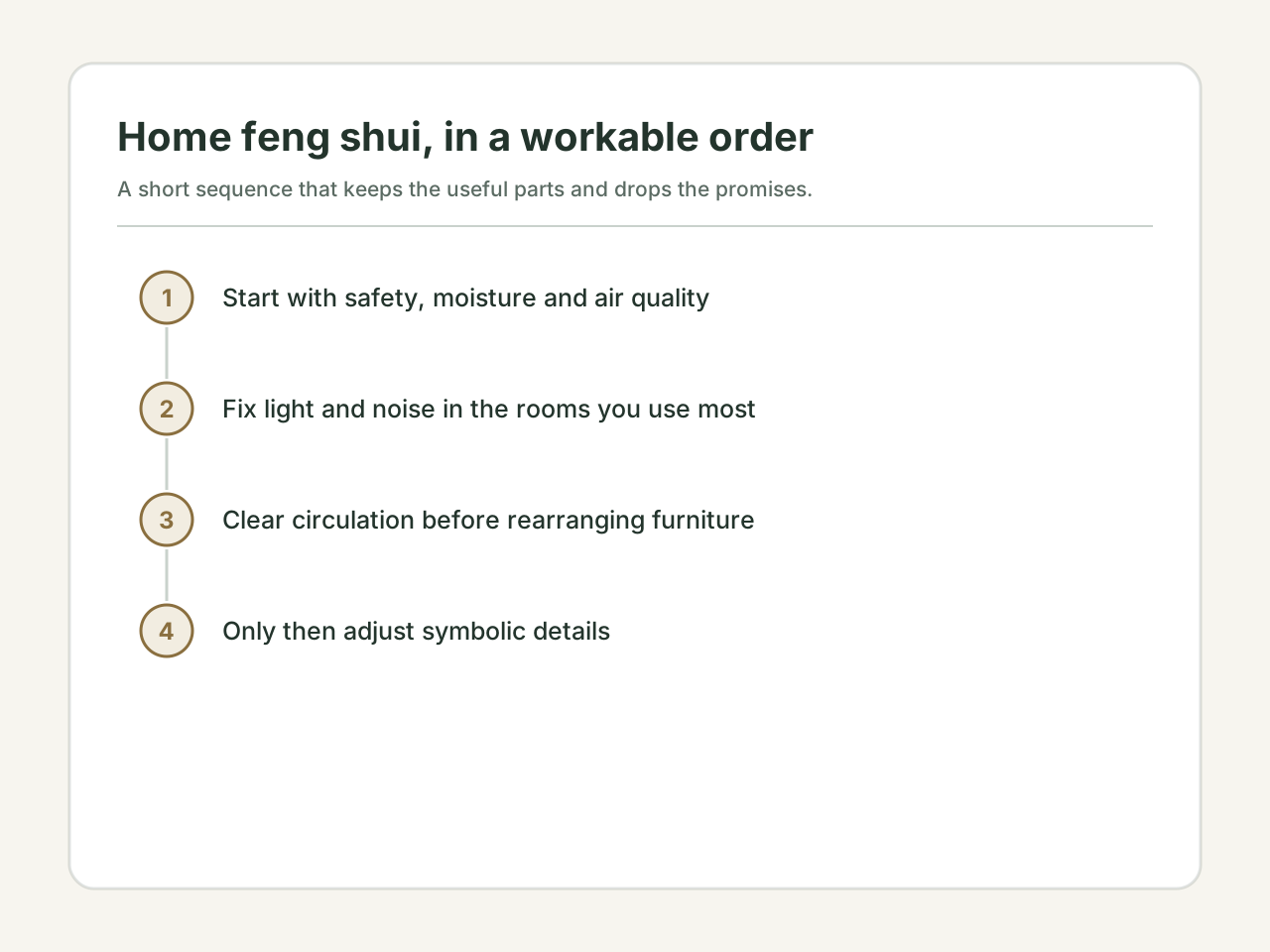
Cheapest first, because the cheap steps also tell you whether the expensive ones are needed:
- Measure. A carbon dioxide and humidity meter, a thermometer, a sound-level app, a tape measure. Under an hour, and it converts every item below from advice into a decision.
- Fix what the measurements condemn. A vent or a door gap for carbon dioxide, a seal or glazing for noise, a sweep for the door, a washer for the tap.
- Do the free things. Open a window for ten minutes, clear the main path to 90 cm, take the bin out, wipe the sink dry.
- Then spend. Lighting layers, glazing, a better door. These are the items that cost real money, and they should be chosen after the measurement rather than before it.
- Only then the symbolic layer, if it matters to you, with the understanding that it is decoration and that nothing about it can be confirmed.
Disclaimer: This content is for informational and cultural reference purposes only. It does not constitute professional medical, legal, financial, or psychological advice. Readers should exercise their own judgment and consult qualified professionals for specific concerns.
Sources and review basis
Traditional references explain historical vocabulary and context. Official practical sources support only the observable safety, comfort, or environmental points noted in the article; they do not validate metaphysical claims.
Traditional reference
Huangdi Zhaijing (黄帝宅经)Wikisource digital text · Accessed 2026-07-14
Historical context for traditional residential orientation and spatial vocabulary. Modern recommendations are judged against real conditions.
Practical source
US EPA: Indoor Air QualityUnited States Environmental Protection Agency · Accessed 2026-07-14
Practical background for ventilation, pollutants, combustion sources, and indoor air concerns.