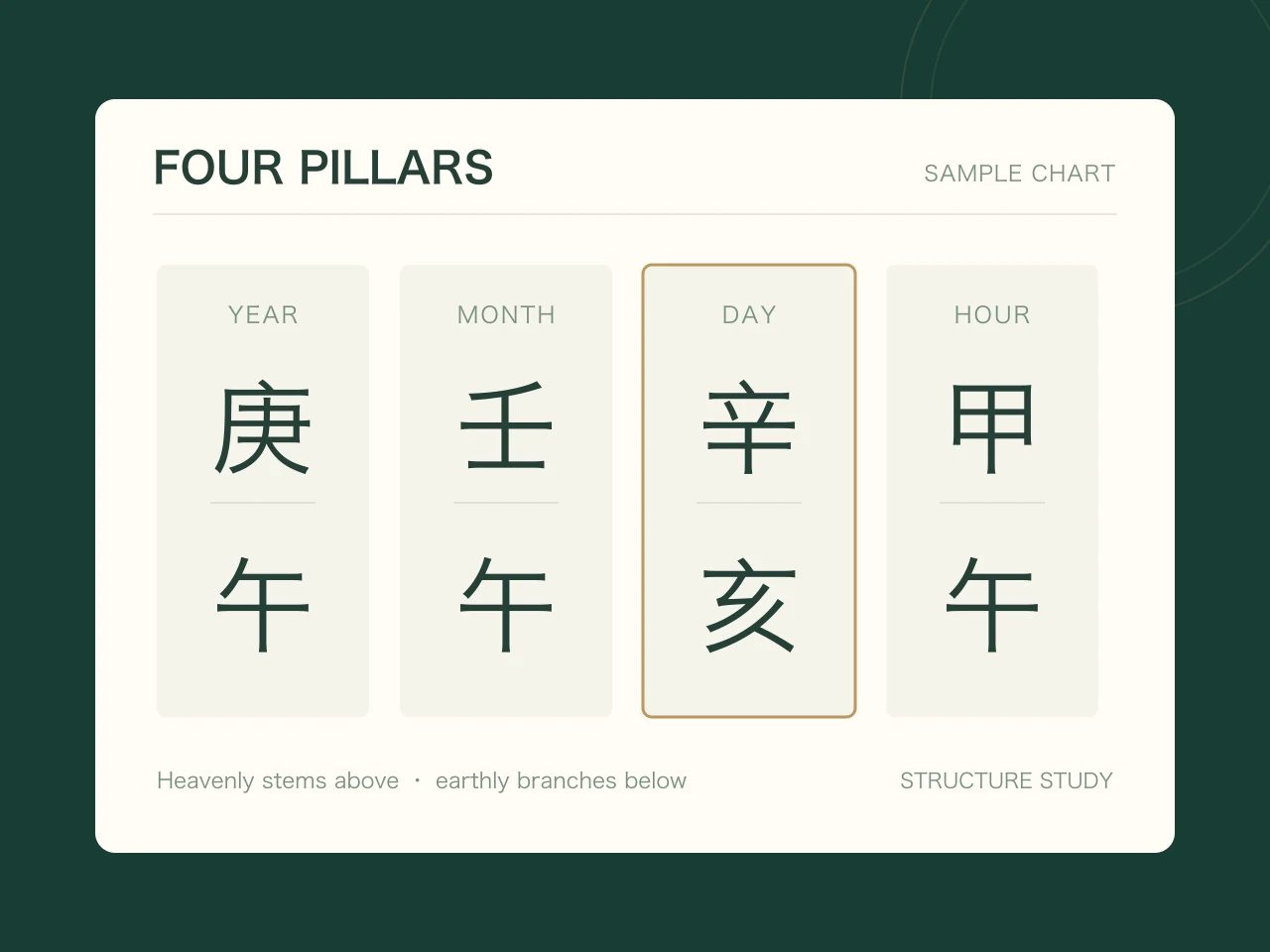
Frost's Descent in 2026, and the job a 中气 actually does
Frost's Descent (霜降, Shuāngjiàng) is the eighteenth of the twenty-four solar terms and the last of autumn. In 2026 the sun reaches 210° of apparent longitude at 17:37 on Friday 23 October, China Standard Time. The month pillar on 22 October is 戊戌. On 24 October it is still 戊戌. On a BaZi chart, nothing happens on this date.
Which kind of term it is explains why. 霜降 is a 中气, one of the twelve middle qi, and middle qi do not open solar months — they anchor lunar ones. A lunar month takes its identity from the 中气 that falls inside it, and 2026 makes that easy to watch: lunar month nine runs from 10 October to 8 November, and the only 中气 in that window is Frost's Descent on 23 October. The ninth month is, literally, the month Frost's Descent falls in.
The anchoring has a visible consequence. If a lunar month contains no 中气 at all, a leap month has to be inserted. 2025 is the worked example: its intercalary sixth month ran from 25 July to 22 August, twenty-nine days with no 中气 inside — 大暑 had already passed on 22 July, and 处暑 would not arrive until 23 August. In 2026 all twelve lunar months receive one 中气 each, so the year has no leap month.
For a chart, then, 23 October is a date on which the month pillar holds. It last moved on 8 October at Cold Dew and next moves on 7 November at Winter Begins. What this date can tell you is where you sit inside 戊戌 month — a different question from the one most people ask, and the only one the date answers.
The split most calendars blur: 节 and 中气
The twenty-four terms alternate between two kinds, and the difference matters more than it looks.
Twelve of them are 节 (jié, nodes): 立春, 惊蛰, 清明, 立夏, 芒种, 小暑, 立秋, 白露, 寒露, 立冬, 大雪, 小寒. Each one opens a solar month. The other twelve are 中气 (zhōngqì, middle qi): 雨水, 春分, 谷雨, 小满, 夏至, 大暑, 处暑, 秋分, 霜降, 小雪, 冬至, 大寒. Each falls in the middle of one.
霜降 is a 中气. That single fact settles the common question about whether Frost's Descent changes your BaZi month. It does not.
Many almanac apps treat every solar term as a month boundary. Run the calculation and the difference becomes visible. On 7 October 2026 the month pillar is 丁酉. On 8 October, Cold Dew, a 节, it becomes 戊戌. It then stays 戊戌 through Frost's Descent on 23 October, through the rest of the month, and all the way to 6 November. On 7 November, Winter Begins, another 节, it changes to 己亥. Frost's Descent sits in the middle of that run and the pillar does not move.
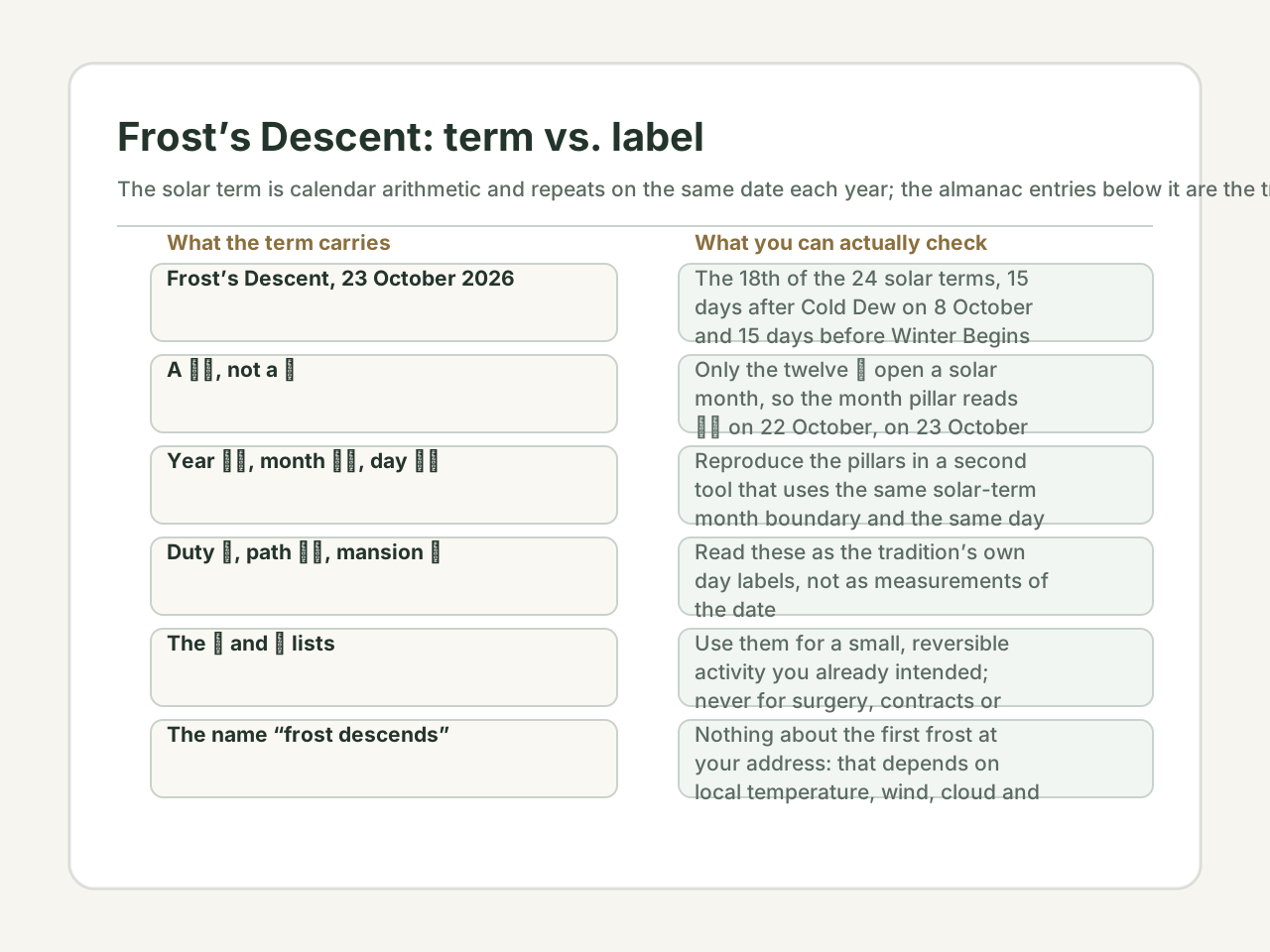
23 October 2026 as the almanac prints it
The almanac entry for 23 October 2026 reads year pillar 丙午 (the year of the Horse), month pillar 戊戌, day pillar 庚午. The twelve duties give 成, the yellow-and-black path gives 天刑, the twenty-eight mansion is 牛, and the branch the day clashes with is 子 (Rat), with the sha placed to the north.
The 宜 list reads 嫁娶, 纳采, 订盟, 开市, 交易, 立券, 挂匾, 祭祀, 祈福, 开光, 造车器, 出行, 入宅, 移徙, 安床, 安门, 拆卸, 修造, 动土, 栽种, 安葬, 破土, 启钻, 除服, 成服, 入殓, 立碑. The 忌 list reads 探病, 纳畜, 伐木, 起基, 作梁, 盖屋.
Those entries belong to three different categories: an astronomical position, values computed from fixed cycles, and traditional recommendations. The table below keeps the three apart and answers one question: where the month pillar actually moves.
| Solar term | Kind | Date in 2026 | Month pillar from that date |
|---|---|---|---|
| Cold Dew (寒露) | 节 — opens a solar month | 8 October | Changes here: 丁酉 becomes 戊戌 |
| Frost's Descent (霜降) | 中气 — sits in the middle of a solar month | 23 October | Unchanged: still 戊戌 |
| Winter Begins (立冬) | 节 — opens a solar month | 7 November | Changes here: 戊戌 becomes 己亥 |
Why the name is not a frost forecast
The 七十二候 (seventy-two pentads) system divides each solar term into three five-day pentads and gives each a phrase. For Frost's Descent they are 豺乃祭兽 (the jackal makes offerings of its prey), 草木黄落 (grass and trees yellow and fall), and 蛰虫咸俯 (hibernating insects all bow down). These are seasonal descriptions written for a particular region, not measurements.
The practical point is sharper. Frost is a local, ground-level event. It depends on the night's temperature, wind, cloud cover, humidity, and the elevation of the particular garden or field. Two places a hundred kilometres apart at the same latitude can see first frost weeks apart. Frost's Descent is therefore a date you can look up, and the first frost where you live is a date you have to observe.
That is not a modern correction bolted onto an old system. It follows from what the term is: a fixed point on the sun's path, defined astronomically and therefore identical for everyone.
Five checks before you use 23 October
None of these asks you to accept anything on authority. Each one runs in about a minute:
- Decide first whether your question is about the calendar or about the weather. The calendar half (which solar month you are in, whether the month pillar moved) has one correct answer. The weather half does not.
- Test your software on the boundary itself. Enter 22 October and 23 October 2026 and compare the month pillar. If it changes on 23 October, the tool treats every solar term as a month start, and its month pillars will run roughly half a month ahead of a traditional almanac.
- Keep the 宜 and 忌 lists out of high-consequence decisions. They are a traditional annotation on the date, and the table above already sets out what that annotation can and cannot carry.
- If you want to act on the season, act on the observable part: frost protection for tender plants, a heating check, gutters cleared before the first hard freeze. Those depend on your local forecast, not on the almanac.
- Then start one private record: the first morning your own balcony or garden shows frost, written beside 23 October. After a few years that page describes your own ground, not the northern plain the term was named for.
What a solar term does not do
It carries no information about an individual. A solar term is a mark on the sun's apparent position, identical for everyone alive at that moment, so it cannot separate you from anyone else or say what will happen to you.
It cannot rank dates for you. Every day of the year belongs to some solar term, so if each term were a reason to avoid a date, the filter would remove nothing.
It is not a substitute for the constraints that actually decide timing. Deadlines, stock, weather windows and other people's schedules are what choose a date for a decision that matters, and a term name supplies none of them.
It is also the kind of statement that feels personal without being so. A term name plus a date is general enough to fit almost anyone, which is exactly why it reads as accurate and why it can never be checked against a specific outcome.
Disclaimer: This content is for informational and cultural reference purposes only. It does not constitute professional medical, legal, financial, or psychological advice. Readers should exercise their own judgment and consult qualified professionals for specific concerns.
Sources and review basis
Traditional references explain historical vocabulary and context. Official practical sources support only the observable safety, comfort, or environmental points noted in the article; they do not validate metaphysical claims.
Traditional reference
Yuanhai Ziping (渊海子平)Wikisource digital text · Accessed 2026-07-14
A classical source for Four Pillars terminology, element relationships, and the Day Master framework.
Traditional reference
Sanming Tonghui (三命通会)Wikisource digital text · Accessed 2026-07-14
A historical compilation used to cross-check traditional BaZi concepts; it is not scientific validation.
Traditional reference
Yuxia Ji (玉匣記)Wikisource digital text · Accessed 2026-10-15
A household almanac whose 入宅 and 移徙 sections show how traditional date selection for moving house was organised. It documents a convention, not evidence that a date changes an outcome.
Practical source
APA Dictionary of Psychology: Barnum effectAmerican Psychological Association · Accessed 2026-07-14
A psychology reference for why broad, favourable personality descriptions can feel personally accurate. It does not evaluate BaZi calculations themselves.