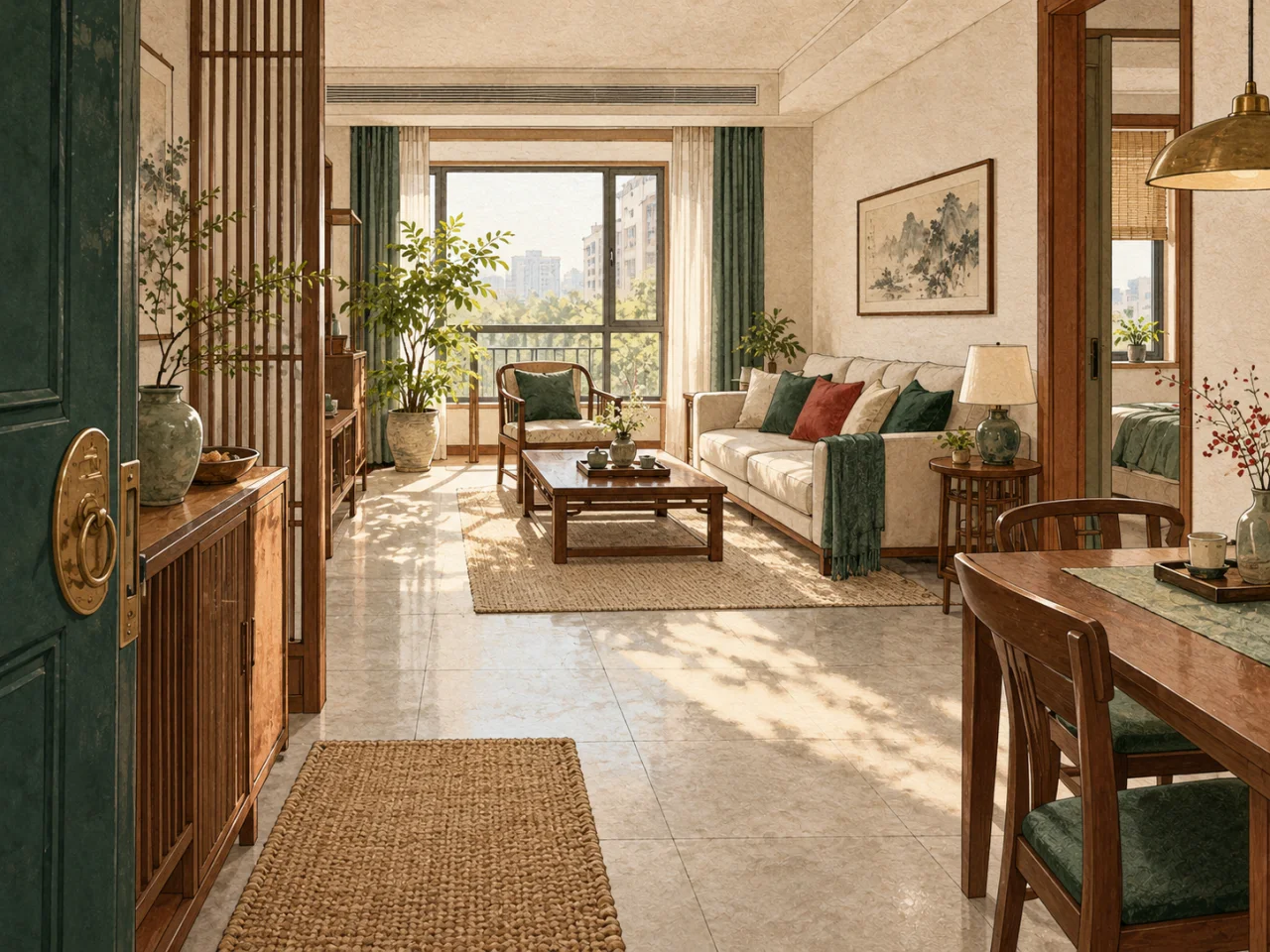
The rules sort by whether anything about them can be measured
Front-door advice is the most repeated advice in the whole tradition and the least sorted. A rule that says the door's facing decides a household's fortune and a rule that says a sticking hinge should be fixed arrive in the same list, in the same tone, with no way to tell which is which. The useful first move is not to accept or reject the list but to sort it by what could be measured if you tried.
Sorting that way produces three piles. Some rules describe something you can put a number on today — a height, a width, a sightline, a pressure. Some describe something that would need equipment and a birth chart and a school you have already chosen. And some describe nothing at all. Only the first pile is worth acting on before you have decided anything else, and it happens to be the smallest.
The tradition itself ranks the door first among the three things it cares about in a dwelling — 门、主、灶 in 阳宅三要 — and the reason given is structural: the door is the only one of the three that decides both how you get in and what you see when you do. Both of those are measurable, which is why this is the one part of the list that survives the sorting.
The same eight rules, sorted
These are the rules that circulate most. The middle column is what you would actually have to measure to check the claim:
| The rule as it circulates | What could be measured | Verdict |
|---|---|---|
| The facing direction decides the household's fortune | A bearing — but which bearing depends on the school, and it needs a birth chart too | Defer; do not rehang a door over it |
| A straight run from door to back window drains the house | Stack pressure across the two openings, which is a real calculation | Real, and it is a draught |
| A mirror facing the door returns the energy | The sightline it doubles, and what you see at night | Move it, for the sightline |
| The threshold must be raised to hold the energy in | Its height above the floor, against a trip limit | Keep it under 13 mm |
| A screen must block the view of the bathroom | The width of the cone at the screen's distance | Measure it; often 27 cm is enough |
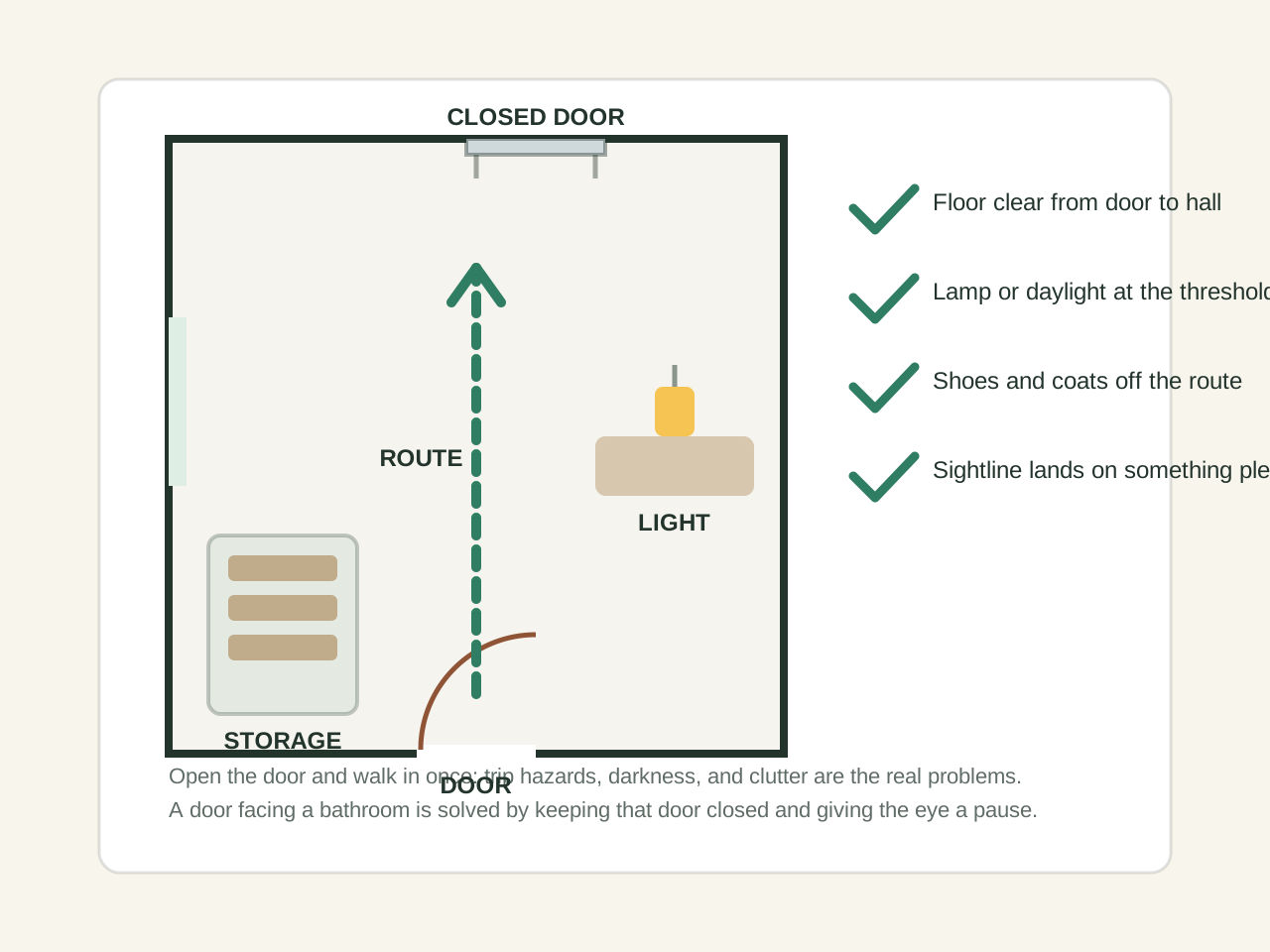
| The door must not face the toilet | Sightline, smell, and whether the bathroom door is shut | Close the bathroom door first |
| The door colour changes your luck | Peeling paint, which is visible from the street | Repaint when it peels |
| An unlucky house number must be changed | Nothing | Ignore |
Four things about a door can be measured
Strip the symbolism and a front door has four properties that produce a number: how high the threshold sits above the floor, how far the leaf can swing before it hits something, how much light lands on the entry, and how much pressure pushes air through the gap when the other end of the house is open. Everything else in the list is either a preference or a claim about the future.
Each of the four has a threshold that comes from outside the tradition, which is what makes them checkable. The rest of this piece works through the three that people get wrong most often, in the order the mistakes cost money: the draught first, because it is the one people misdiagnose as a haunting.
The straight run is a pressure problem, and the number is large
A door at one end of a flat and a window at the other is the classic complaint: the place feels cold, doors slam, and the tradition calls it a draining line. The physics is the stack effect, and it needs only the height between the two openings and the temperature difference.
The pressure difference is Δp = ρ g h ΔT / T. Take air at 1.2 kg/m³, gravity at 9.81 m/s², a height difference of 3 m between the door and the far window, an indoor-outdoor difference of 20 K, and an absolute temperature of 293 K. That gives Δp = 1.2 × 9.81 × 3 × 20 ÷ 293 = 2.41 Pa.
Two pascals sounds trivial until it is turned into a velocity. For a free opening, v = √(2Δp/ρ) = √(4.82 ÷ 1.2) = 2.0 m/s. Comfort guidance for a seated person in a 20°C room puts the acceptable air speed at roughly 0.2 m/s, so the stack effect across that flat delivers about ten times the draught a person will tolerate.
This is why the complaint is real and why the label is wrong. Nothing is being drained. Air is moving, at a speed set by the height of the building and the temperature outside, and the fix is the same as for any draught: break the path, or close one end. A console, a screen or a rug across the line reduces the effective opening; closing the bathroom door at the far end does more.
The screen only has to be as wide as the sightline
The second most common mistake is a screen that is either far too large or in the wrong place. The width needed is a proportion, not a taste: the screen has to cover the same angular width as the thing you are hiding.
If the bathroom door is 80 cm wide and 6 m from the front door, and the screen stands 2 m in, the screen needs 80 × 2 ÷ 6 = 27 cm of width to block the full view. That is a lamp and a narrow console, not a floor-to-ceiling partition, and it is the number that ends most arguments about whether a screen will make the hallway feel cramped.
Two things follow. The further in the screen stands, the wider it must be, so the cheapest position is close to the thing being hidden rather than close to the door. And a screen only blocks sight, not air or sound: if the complaint is the draught from the previous section, a screen across the hall will not stop it, because the pressure path runs around it.
The threshold is a trip measurement
A raised threshold is one of the few traditional door features that people still install deliberately, on the reasoning that it holds something in. Whatever it holds, it is also a step in the one place everyone crosses while carrying things.
Accessibility codes commonly cap a doorway level change at 13 mm when it is vertical and 6 mm when it is bevelled, which is a useful calibration even for a household with no accessibility requirement: it is the height at which a step stops being noticed by the foot. The traditional 3–5 cm threshold is two to four times that, which is exactly why it is felt — and why the elderly visitor and the delivery courier both catch it.
The practical version is not to remove it but to make it visible: a contrasting strip on the leading edge, and a bevelled rather than square profile. A 5 cm threshold that is obvious is safer than a 2 cm one that is the same colour as the floor.
Light is the one the tradition and the building code agree on
Entry and circulation areas are commonly specified at 100–200 lux, which is roughly ten times a dim hallway and roughly a fifth of a bright office. The number matters less than the contrast: what makes an entry feel unwelcoming is usually not a low absolute level but the jump from a bright street to a dark lobby, which the eye takes several seconds to adapt to.
That is why the single most effective change to most front doors is a warm lamp left on, and why the tradition's advice about a bright entrance and the lighting designer's advice about transition zones land in the same place. Both are describing the same second and a half of adaptation.
What the rules that survive have in common
Every rule that came through the sorting intact turned out to be about one of three things: how you get in, what you see when you do, and how much air and light cross the threshold. That is not a coincidence. Those are the only properties of a door that produce a sensation on every single arrival, which is what a rule needs if it is going to be noticed at all.
The rules that did not survive share the opposite property: they produce no sensation, only a claim. A house number, a compass bearing, a colour chosen for luck — none of them changes what the first three seconds feel like, so none of them can be checked by walking through the door.
One pass, cheapest and most reversible first
Clear the floor and the surfaces. Put a warm lamp on the entry and leave it on in the evening. Fix the hinge, the lock and the swing. Close the far door before reaching for a screen. If a straight line to the back window is the complaint, break it at the narrowest point rather than the widest. Then measure the threshold and the screen width before buying anything.
That is the whole list, and every item on it can be checked by walking through the door and looking. None of it predicts luck. What it does is remove the small daily frictions that a door is uniquely able to produce, twice a day, for as long as you live there.
Disclaimer: This content is for informational and cultural reference purposes only. It does not constitute professional medical, legal, financial, or psychological advice. Readers should exercise their own judgment and consult qualified professionals for specific concerns.
Sources and review basis
Traditional references explain historical vocabulary and context. Official practical sources support only the observable safety, comfort, or environmental points noted in the article; they do not validate metaphysical claims.
Traditional reference
Huangdi Zhaijing (黄帝宅经)Wikisource digital text · Accessed 2026-07-14
Historical context for traditional residential orientation and spatial vocabulary. Modern recommendations are judged against real conditions.
Practical source
US EPA: Indoor Air QualityUnited States Environmental Protection Agency · Accessed 2026-07-14
Practical background for ventilation, pollutants, combustion sources, and indoor air concerns.