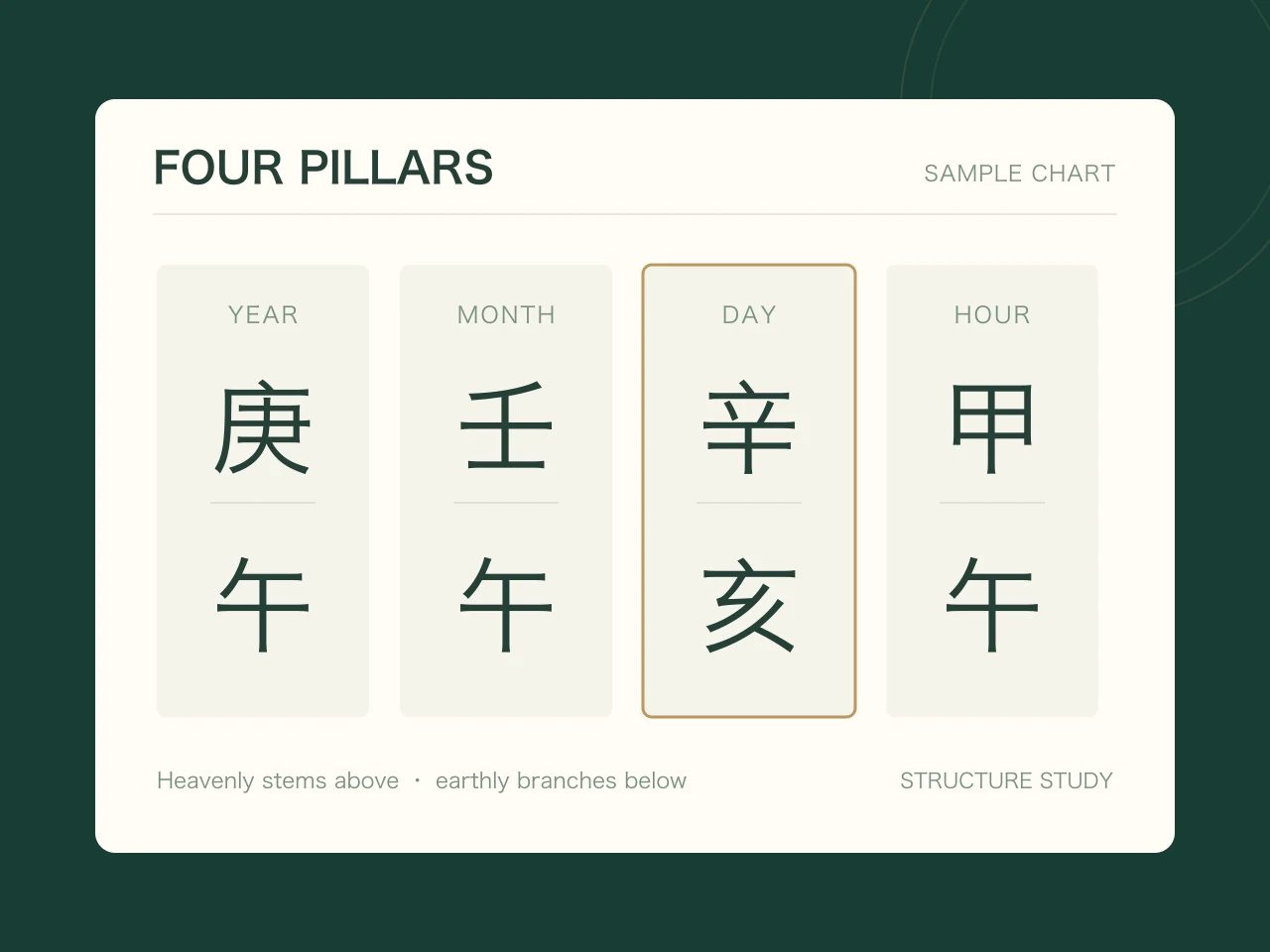
The animal is a branch, and a chart carries four of them
The animal is usually translated as a person's sign, as though there were one per person. A chart has four pillars, every pillar carries a branch, and every branch has an animal. So a chart carries four animals, and the interesting part is not which four but that they are read as a set:
| Pillar | Where the branch comes from | Animal it names |
|---|---|---|
| Year | the 干支 year, changing at 立春 | the one people mean by 生肖 |
| Month | the solar term — the 寅 month begins at 立春 | the month animal |
| Day | a continuous sixty-day count with no seasonal anchor | the day animal |
| Hour | the clock, in two-hour blocks counted from 23:00 | the hour animal |
The four change at four different rates
One per year, one per month, one per day, one per two hours. That single fact explains almost everything about how the four animals are used, because a thing that changes slowly is easy to remember, easy to ask a stranger for, and easy to print on a charm — while a thing that changes daily is useless as an identity and essential as a measurement.
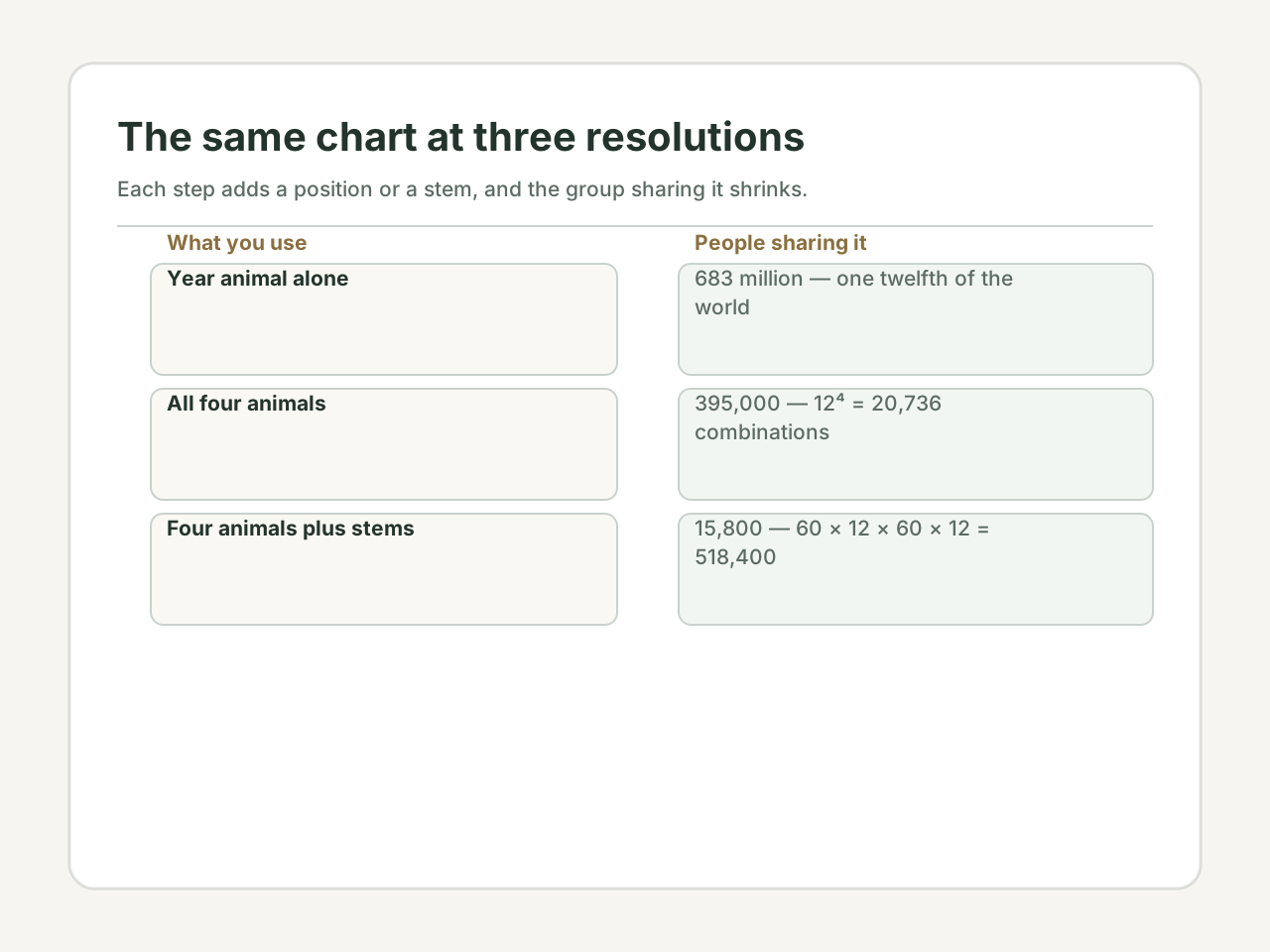
The consequence is a resolution problem, and it can be counted. Twelve possible animals in each of four positions gives 12⁴ = 20,736 distinct four-animal combinations. Against a world population of about 8.2 billion, that is roughly 395,000 people per combination, assuming every combination is equally likely — which it is not, since birth rates vary by season and by hour, but the order of magnitude holds.
Add the stems and the picture changes. The year pillar is one of 60, the month branch is fixed by the solar term, the day is one of 60, and the hour branch is fixed by the clock — so the full four-pillar configuration is 60 × 12 × 60 × 12 = 518,400. That is exactly 25 times the animal-only figure, and it puts about 15,800 people on the same configuration.
The stems are therefore doing most of the work. Twenty-five-fold is the resolution that the animal names throw away, which is the quantitative version of the observation that a sign is a rough bucket and a chart is not.
Three of the four read off a calendar; the day does not
The year branch turns once a year at 立春. The month branch turns at each of the twelve 節: 立春 for 寅, 驚蟄 for 卯, 清明 for 辰, 立夏 for 巳, 芒種 for 午, 小暑 for 未, 立秋 for 申, 白露 for 酉, 寒露 for 戌, 立冬 for 亥, 大雪 for 子, 小寒 for 丑. The hour branch is a fixed table of clock blocks, so it needs only the birth time.
The day branch advances by one per day and cycles every sixty, with no relation to the month or the year. It cannot be derived from a date the way the year branch can be derived from the year; it has to be counted from a known day or looked up. 26 October 2026 is a 癸酉 day, so its animal is the rooster. 1 January 2000 was 戊午, a horse. Between those two points the count simply ran, and nothing in the sky reset it.
This is why the day pillar is the one part of a chart that cannot be estimated. A year animal can be guessed from a birth year; a day animal cannot be guessed from anything.
| Clock block | Branch | Animal |
|---|---|---|
| 23:00–01:00 | 子 | rat |
| 01:00–03:00 | 丑 | ox |
| 03:00–05:00 | 寅 | tiger |
| 05:00–07:00 | 卯 | rabbit |
| 07:00–09:00 | 辰 | dragon |
| 09:00–11:00 | 巳 | snake |
| 11:00–13:00 | 午 | horse |
| 13:00–15:00 | 未 | goat |
| 15:00–17:00 | 申 | monkey |
| 17:00–19:00 | 酉 | rooster |
| 19:00–21:00 | 戌 | dog |
| 21:00–23:00 | 亥 | pig |
Forty-three per cent of charts repeat an animal
"Two of the four are often the same one" is usually asserted and never counted. It is easy to count. The chance that all four branches differ is 12 × 11 × 10 × 9 ÷ 12⁴ = 11,880 ÷ 20,736 = 57.3%. So 42.7% of charts contain at least one repeated animal.
That is close enough to a coin flip to matter, and it has a practical consequence: a reading that treats the four animals as four independent signals is wrong about four times in ten. A chart with two 酉 is not a chart with two roosters' worth of whatever a rooster means; it is one branch, counted twice.
The repeat is also the reason a chart can look like it is emphasising something. Exactly three of a kind in four named positions is 4 × 12 × 11 ÷ 12⁴ = 528 ÷ 20,736 = 2.5%, which is rare enough to notice. All four the same is 12 ÷ 20,736 = 0.06%, about one chart in 1,700. Two is the common case, and two is what most charts actually contain.
Four animals give six pairs, and the base rate is the point
The branches relate to one another across pillars, and the number of relations you can read grows quadratically: one animal gives no pairs, two give one, four give 4 × 3 ÷ 2 = 6. That is the whole reason a chart reading looks at the set rather than at the year alone — not because four is a mystical number but because four is where the pairs come from.
Six pairs is also where the base rate becomes visible. There are 12 × 11 ÷ 2 = 66 possible pairs of branches, and six of them are a clash (沖), which is 9.1%. If the pairs in a chart were independent, the chance that none of the six clashes is (60 ÷ 66)⁶ = 56.4%, so 43.6% of charts contain at least one clash purely by construction.
That figure is not an argument against reading clashes; it is a calibration. A reading that treats a clash as unusual is misreading a base rate of nearly one in two. What a clash is worth depends on which pillars carry it and what else is in the chart, which is a question about the specific chart and not about the animal.
The definitions of 沖, 合, 刑 and 害, and how the sixteen loaded pairs are counted, belong to a separate piece; what matters here is only that the count of pairs is combinatorial and fixed before any chart is read.
The day branch carries the most weight
Of the four, the day branch is the one that most readings are built on, and the reason is structural rather than traditional: the day stem is the Day Master, and every judgement in the reading is made relative to it. The other three pillars describe circumstances around that point.
This inverts the popular emphasis. The animal people know — the year animal — is the one the reading leans on least, and the animal nobody knows — the day animal — is the one it leans on most. The most quoted animal is the one with the least resolution, and the one with the most resolution is the one nobody can name without a lookup.
Where the four-animal picture stops
Three limits are worth stating plainly:
- It does not describe a temperament. A branch is a position in a count, and nothing in the count measures a person. The 395,000 people sharing a four-animal combination are not sharing a personality.
- It does not survive a wrong birth time. Two hours of error moves the hour animal; an error across 23:00 moves the day animal and the Day Master with it, which changes the pillar the reading is built on.
- It does not settle the year boundary. Whether the year animal starts at 立春 or at the lunar new year changes the animal for anyone born in the gap, and the gap moves from year to year.
What the four animals are good for
Not identification, and not prediction. What they are good for is bookkeeping: four positions, four rates, a fixed set of pairings between them, and a count that can be run without consulting anything. That is a compact notation for a calendar, and it is genuinely useful as one.
The trouble only starts when the notation is mistaken for a description. The year animal identifies a bucket of about 680 million people — one twelfth of the world — and a bucket that large cannot describe anyone. The four-animal set narrows it to about 395,000, and adding the stems narrows it to about 15,800, and even that is a group, not a person.
Disclaimer: This content is for informational and cultural reference purposes only. It does not constitute professional medical, legal, financial, or psychological advice. Readers should exercise their own judgment and consult qualified professionals for specific concerns.
Sources and review basis
Traditional references explain historical vocabulary and context. Official practical sources support only the observable safety, comfort, or environmental points noted in the article; they do not validate metaphysical claims.
Traditional reference
Huainanzi, “Treatise on Celestial Patterns” (淮南子·天文訓)Wikisource digital text · Accessed 2026-10-26
The Han text that states the twelve-year count as an observation of Jupiter: 太陰在四仲,則歲星行三宿;太陰在四鉤,則歲星行二宿。二八十六,三四十二,故十二歲而行二十八宿。 It then fixes the schematic counter that replaces the planet — 天維建元,常以寅始起,右徙一歲而移,十二歲而大周天 — and names the clash as the opposite point: 歲星之所居,五榖豐昌,其對爲衝。 Cited for the period and the vocabulary only; nothing in it predicts anything about a person.
Traditional reference
Sanming Tonghui (三命通会)Wikisource digital text · Accessed 2026-07-14
A historical compilation used to cross-check traditional BaZi concepts; it is not scientific validation.