Home Feng Shui

Floor Color Feng Shui

This page explains Floor Color Feng Shui as a practical cultural reference, covering the core idea, common use cases, careful checks, and responsible limits so readers can compare traditional guidance with real conditions.

2025-10-05 · Updated 2026-06-07

B

Reviewed by BaZi Report Editorial Team

Our editorial team researches classical Chinese metaphysics and feng shui texts, fact-checks references against the original sources, and reviews every article before publication. We aim to keep traditional concepts clear and practical, and we stay transparent about what these readings can and cannot tell you.
Use this guide to understand Floor Color Feng Shui in context, compare several signals, and avoid treating any single traditional rule as a fixed promise.

The floor is the foundation — not just symbolically

In feng shui, the floor is the most under-discussed surface in a room. It is the largest uninterrupted area, the thing your feet touch first, and the visual base that every other colour in the room sits on top of. The classical idea is that the floor represents the Earth element — stability, grounding, the base that supports everything above it. The practical version is simpler: a floor colour that fights the room makes everything else feel off, even if you cannot name why.

The one rule that holds across every room and every style: the floor should be darker than the ceiling and darker than the walls. This creates a visual weight that reads as stable. A floor that is lighter than the walls can make a room feel upside down, and people register that as unease without knowing the cause.

Floor color selection reference showing five element tones for warmth brightness and grounding in home design

Five elements mapped to floor colours

The five-element system (五行) gives a framework for thinking about floor colours, but it works better as a design vocabulary than a strict rulebook. Here is what each element brings to a floor:

ElementFloor coloursEffect on a roomBest used in
Earth (土)Beige, tan, terracotta, warm brown, sandWarm, grounding, stable. The safest choice for almost any room.Living rooms, dining rooms, hallways
Wood (木)Green tones, olive, bamboo, mid-brown woodFresh, growing, alive. Works well in rooms where you want calm alertness.Studies, home offices, reading nooks
Water (水)Dark blue, charcoal, deep grey, blackDeep, quiet, introspective. Absorbs light and makes a room feel smaller and more contained.Bedrooms, meditation spaces
Fire (火)Red, burgundy, terracotta-red, orange-toned woodWarm, active, stimulating. Easily overpowering in large areas.Small accents, entryways in cold climates
Metal (金)White, light grey, pale stone, metallic finishesClean, crisp, modern. Can feel cold and clinical if overused.Bathrooms, kitchens, contemporary spaces

Room-by-room guide

General element theory is a starting point. The room's actual function overrides symbolic categories. Here is what works in practice:

RoomRecommended floor colourWhy
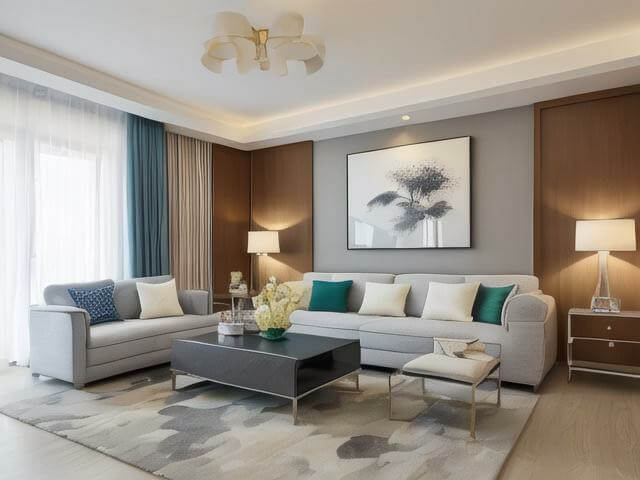
Living roomWarm medium wood, beige, light brownThe room where people gather needs warmth. Cool tones here make the room feel less inviting.
BedroomDark wood, warm grey, muted brownA bedroom needs calm. Darker floors anchor the room and support rest. Avoid very light or very red floors.
KitchenLight stone, warm tile, mid-tone woodCleanability matters first. Light-to-mid tones keep the room feeling clean and bright.
BathroomLight grey, pale stone, neutral tileMoisture resistance is the real priority. Light colours keep a small space from feeling cramped.
Study / Home officeMid-tone wood, olive, muted greenA floor that is calm but not sleepy. Green tones support sustained focus without overstimulation.
EntrywayDarker tones, patterned tile, warm brownThis is the first surface people step onto. It should be practical (hides dirt) and welcoming (warm tone).

Light and room size: the practical override

No element theory survives contact with a dark room. The single most important variable in choosing a floor colour is how much natural light the room gets.

  • A dark-floored room with little natural light becomes a cave. If the room faces north or has small windows, go lighter than the element theory suggests.
  • A very large room with a light floor can feel hollow and ungrounded. In a big open-plan space, a mid-tone or darker floor anchors the volume.
  • South-facing rooms with abundant light can handle almost any floor colour. This is where you have the most freedom.
  • Artificial lighting changes how a floor colour reads. Warm bulbs (2700K–3000K) warm up cool-toned floors; cool bulbs (4000K+) make warm floors look muddy. Test a sample in the room's actual light before committing.

A worked example: choosing between two floor colours

A family is renovating their ground-floor living room. It is a 20-square-metre room with one large east-facing window that gets good morning light but dims by mid-afternoon. The walls are a warm off-white. They are choosing between two floor options: a dark walnut wood-look tile and a light oak wood-look tile.

The dark walnut is beautiful in the showroom. It reads as expensive and grounded. But in their actual room, with only morning light, the dark floor would absorb most of the available brightness and make the room feel smaller and heavier by 3 PM. The light oak, by contrast, would reflect what light there is and keep the room feeling open through the afternoon.

The feng shui recommendation: light oak. The Earth element theory says living rooms benefit from warm, stable tones, and light oak is warm without being dark. The practical reason is stronger: the room simply does not have enough light to carry a dark floor. The decision is a trade-off between the showroom appeal of dark walnut and the lived experience of light oak — and lived experience wins.

The compromise, if they love the dark walnut look: use it in the hallway and entryway, where people pass through rather than sit, and use light oak in the living room where people spend hours.

When you cannot change the floor

Most people do not have the option to replace their flooring. The feng shui tradition does not demand renovation. What you can do:

  • A large area rug in the right colour can override the floor's visual weight. A warm-toned rug on a cold grey floor shifts the room's feel immediately.
  • If the floor is too light and the room feels unstable, layer a darker rug under the main seating area to anchor the conversation zone.
  • If the floor is too dark and the room feels heavy, use lighter rugs, lighter furniture legs, and more reflective surfaces to lift the visual weight.
  • Floor-length curtains in a warm colour can also balance a cold-toned floor without changing the flooring itself.

The honest limit

Floor colour is one ingredient in how a room feels, not the whole recipe. A well-chosen floor colour supports the room's function and makes the space feel right. A poorly chosen one creates a subtle but persistent discomfort that people notice without knowing why. But floor colour does not determine your luck, your wealth, or your relationships. It is a design decision with a feng shui framework attached, not a cosmic lever. Choose the colour that makes the room feel the way you want to feel in it, and let the element theory serve as a vocabulary for articulating why, not as a rulebook that overrides your own eyes.

Disclaimer: This content is for informational and cultural reference purposes only. It does not constitute professional medical, legal, financial, or psychological advice. Readers should exercise their own judgment and consult qualified professionals for specific concerns.

Keep reading

Related articles

Content Note

This article is based on publicly available materials in traditional Chinese metaphysics and feng shui. It is intended as cultural reference and background knowledge only. Metaphysical predictions and feng shui suggestions are not substitutes for professional medical, legal, financial, or psychological advice. We encourage readers to apply their own judgment when interpreting the content. Learn more about our content guidelines