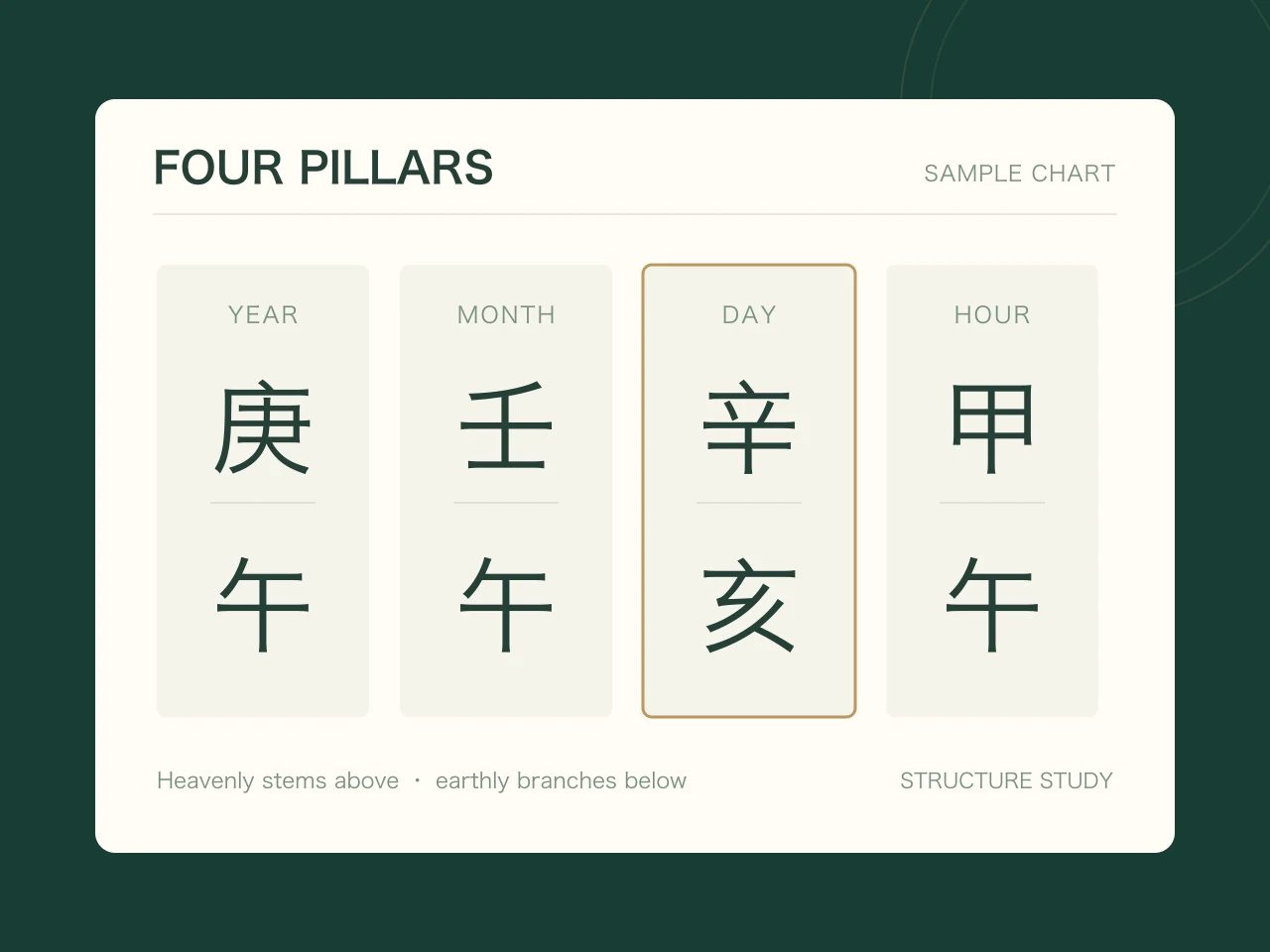
The five flavours are a correspondence table, not a menu
Two classical passages give the same five-row table. The Great Plan chapter of the Book of Documents (尚書·洪範) derives each flavour from the behaviour of its phase: what soaks and descends tastes salty, what flames and rises tastes bitter, what bends and straightens tastes sour, what can be moulded tastes pungent, what accepts sowing and reaping tastes sweet. The Great Treatise on the Correspondences of Yin and Yang in the Inner Canon (素問·陰陽應象大論) reaches the same five pairs from direction and season instead: east generates wind, wind generates wood, wood generates the liver, and sour generates the liver.
Two routes to one table is worth noticing, because it is easy to read as double confirmation. It is not. Both passages are working from the same five-phase schema and sorting the same received material into it. When a system generates its own evidence, agreement between two of its parts is not independent support.
What the table actually claims is modest: five flavours, five organ systems, one correspondence. It does not claim that eating a flavour repairs an organ, and it does not contain a single dose, meal, or recipe.
The full correspondence, with its sources
The flavours are tied to organ systems through a passage usually summarised as the five entries (五入): sour enters the liver, pungent enters the lung, bitter enters the heart, salty enters the kidney, sweet enters the spleen. The same schema carries season and colour, which is why the table appears to be about food when it is really about classification.
One entry is worth flagging because it is the one people get wrong. Earth has no season of its own. The Inner Canon assigns the spleen to late summer and then adds that earth governs the centre, taking eighteen days from each of the four seasons rather than ruling one outright. Any diet advice that assigns earth to a single month is simplifying a point the source text made explicitly.
| Phase | Organ (zang) | Bowel (fu) | Flavour | Season | Colour |
|---|---|---|---|---|---|
| Wood | Liver 肝 | Gallbladder 膽 | Sour 酸 | Spring | Green-blue 青 |
| Fire | Heart 心 | Small intestine 小腸 | Bitter 苦 | Summer | Red 赤 |
| Earth | Spleen 脾 | Stomach 胃 | Sweet 甘 | Late summer, plus 18 days per season | Yellow 黃 |
| Metal | Lung 肺 | Large intestine 大腸 | Pungent 辛 | Autumn | White 白 |
| Water | Kidney 腎 | Bladder 膀胱 | Salty 鹹 | Winter | Black 黑 |
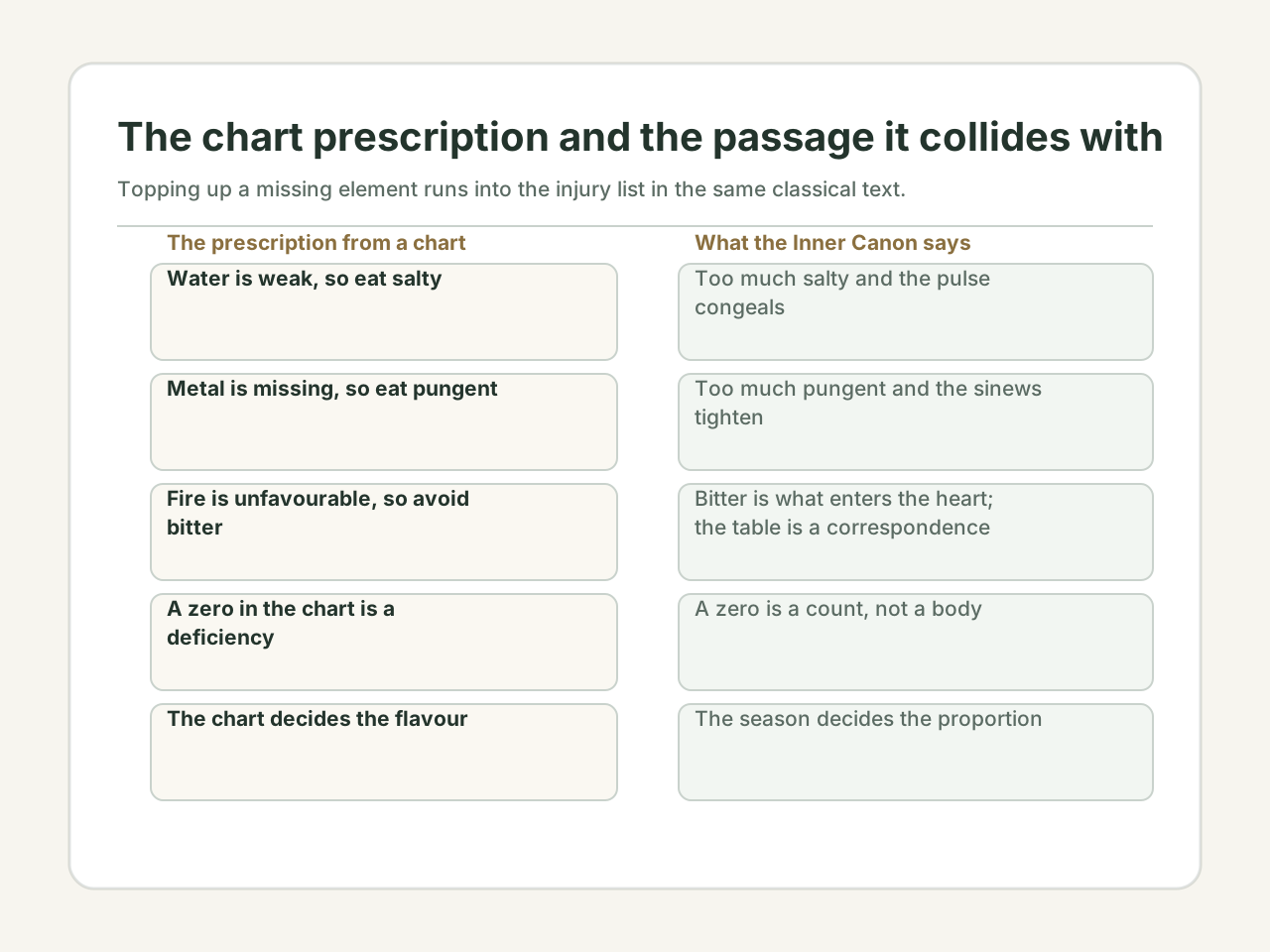
The direction of the classical advice is the opposite of topping up
Popular use of this table runs one way: a chart is short of an element, so eat the flavour that belongs to it. The Inner Canon runs the other way. Its longest passage on the five flavours is a list of injuries: too much salty and the pulse congeals and the complexion changes; too much bitter and the skin dries and the hair falls; too much pungent and the sinews tighten and the nails wither; too much sour and the flesh hardens and the lips pull back; too much sweet and the bones ache and the hair drops.
A second passage states the principle behind that list: whatever is taken for long enough increases its own qi, which is ordinary, and qi increased for long enough becomes the cause of harm. The operative word is duration. The text is not warning about a food, it is warning about a direction maintained too long.
So the prescription a chart-driven diet produces — water is weak, therefore salt — runs directly into the passage that says salt in excess damages the pulse. This is not an outside critique of the system. It is the system's own text, read in order.
Two different woods wearing the same character
The step that breaks is not the correspondence table. It is the transfer between two systems that share a symbol but not a referent.
In a Four Pillars chart, wood is a quantity: how much of a phase is present after the month, the roots, and the allies are counted. In the flavour table, wood is an organ system: a functional description of the liver as the tradition understood it — governs free movement, stores blood, controls the sinews, opens into the eyes. The character is the same. The object is not.
Crossing from one to the other requires two links that nobody has established. First, that a chart short of wood means this person's liver is weak — no such mapping is defined anywhere in either text. Second, that a weak liver should be given sour — which is the exact direction the injury list warns against. Skip both links and the advice looks obvious. Spell them out and it stops looking like advice at all.
One chart, and the prescription it produces
Take 26 January 1979, 22:40: 戊午 乙丑 癸巳 癸亥. The day master is 癸 water, born in 丑, which is winter, where water prospers and metal rests. Counts are wood 1, fire 2, earth 2, metal 0, water 3. Metal is absent.
The chart-driven reading writes itself: metal is missing, pungent belongs to metal, therefore eat more pungent. That is the standard move, and it is the move the injury list contradicts — too much pungent, the sinews tighten and the nails wither. Pungent is not being recommended by the tradition here; it is being flagged as the flavour that damages the wood phase, and this chart's day master is water supported by a thin wood stem on the month.
There is a second problem, and it is the more interesting one. This chart is not short of anything that a diet could address. Water prospers in winter and is reinforced twice on the hour pillar; the missing metal is missing as a count, which is a statement about the chart's internal arithmetic, not about a body. A count of zero is not a deficiency. It is a zero.
What the source text actually adjusts for: the season, not the birth chart
The Inner Canon does give seasonal guidance, and it is organised by season rather than by individual. Liver governs spring, heart governs summer, spleen governs late summer, lung governs autumn, kidney governs winter. The adjustment is to what is on the table now, and it applies to everyone alive in that season.
This is a weaker claim than a personalised chart reading, and it has the advantage of being checkable against ordinary practice: seasonal produce, seasonal cooking, the same five flavours in different proportions through the year. It also has a clear limit. It says nothing about a person born on a particular day, and it never claims to.
The boundary that has to be stated plainly
None of this is medical or nutritional advice, and the five-phase table is not a treatment plan. A flavour correspondence compiled to organise a classification system cannot tell anyone what to eat for a condition, and it cannot be used to replace a diagnosis.
The cases where the confusion does damage are specific and worth naming: pregnancy, chronic illness, anything managed with medication, and restricted diets where removing a whole flavour group changes actual nutrient intake. In those cases the safe reading is that the table is about vocabulary, and a clinician is about the body.
There is also a milder failure that costs nothing but time: turning a chart into a list of forbidden foods. A person who avoids bitter vegetables because fire is unfavourable has removed a food group on the strength of a symbol.
Three ways to keep the table useful
First, keep all five flavours present and stop adding. The classical warning is about excess and duration, so the safe default is variety rather than a supplement aimed at a gap.
Second, adjust by season rather than by chart. That is what the source text does, it applies to the household rather than to one person, and it produces ordinary decisions — what is in the market this month.
Third, treat a chart's unfavourable element as a description of preference, not a prohibition. If a reading says fire is unfavourable, the useful translation is that heat, stimulation, and fast tempo wear you down — which is a statement about conditions, and one you can test against your own week.
Disclaimer: This content is for informational and cultural reference purposes only. It does not constitute professional medical, legal, financial, or psychological advice. Readers should exercise their own judgment and consult qualified professionals for specific concerns.
Sources and review basis
Traditional references explain historical vocabulary and context. Official practical sources support only the observable safety, comfort, or environmental points noted in the article; they do not validate metaphysical claims.
Traditional reference
Book of Documents, “The Great Plan” (尚書·洪範)Wikisource digital text · Accessed 2026-10-25
The chapter that gives each of the five phases a behaviour rather than a list of trades, and derives the five flavours from those behaviours. Cited because it is the earliest place the scheme is stated, and because it contains no industry classification at all.
Traditional reference
Inner Canon of the Yellow Emperor (黃帝內經)Wikisource digital text · Accessed 2026-10-25
The source for the five-flavour correspondences, for the list of injuries caused by excess, and for assigning the five organ systems to seasons. Cited for those three passages only; it contains no chart-based diet prescription.