The five features and the offices the tradition gives them
五官 in ordinary Chinese means the sense organs. In 相术 it is a fixed list of five, each holding a title: 眉 is 保寿官, the office of long life; 眼 is 监察官, the office of inspection; 鼻 is 审辨官, the office of judgement; 口 is 出纳官, the office of issue and intake; 耳 is 采听官, the office of gathering and hearing. The titles are the point. The tradition treats the face as a government, with each feature holding a post.
The metaphor is not decoration; it sets the reading. A feature is judged on whether it performs its office, not on whether it is attractive. Bright, steady eyes keep 监察官 well; dull, shifting eyes do not. That is a different question from whether the eyes are beautiful, and it is why the classical descriptions read like staff reports rather than like praise.
It also sets the limit. An office is a post, not a fate. The tradition says whether 监察官 is well kept; it does not say the post determines what the person will do, and the more specific the claim, the less the texts actually support it.
What each office is read for
The five offices, with what the tradition looks at in each:
| Feature | Title | Read for | What counts as well kept |
|---|---|---|---|
| 眉 | 保寿官 | Longevity, and relations with siblings and peers | An even run longer than the eye, a clear arch, and no break in the hair |
| 眼 | 监察官 | Alertness, emotional state, and what the tradition calls 神 | A steady gaze, clear whites, and a pupil that holds light rather than sliding off it |
| 鼻 | 审辨官 | The capacity to judge, and in most texts money | A straight bridge, a rounded tip, and nostrils not visible from the front |
| 口 | 出纳官 | Speech, appetite, and what is taken in and let out | A clear lip line with the corners level or slightly up, and lips that close without strain |
| 耳 | 采听官 | Early life, and the willingness to take instruction | A shape that holds its curve, a lobe with some substance, and a position roughly level with the eye |
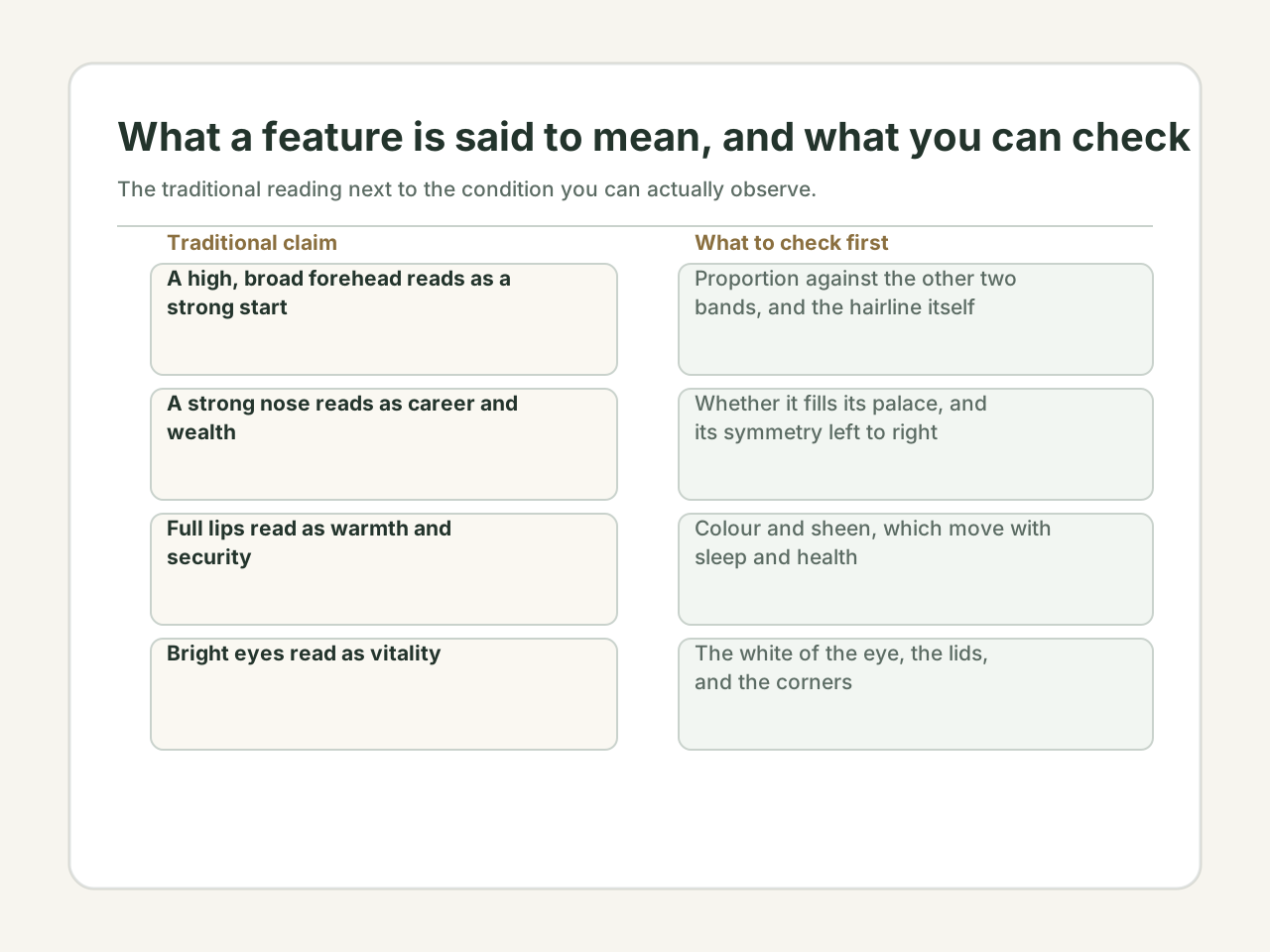
What changes and what does not
The most useful distinction in the whole framework is between the parts of the face that move and the parts that do not.
Bone and cartilage — the brow ridge, the bridge of the nose, the jaw angle, the cheekbones — do not change after adulthood short of injury or surgery. Anything read from these is being read from a fixed feature, and it will read the same at twenty-five and at sixty.
Soft tissue, skin and hair do change: weight, sleep, illness, grooming, and decades of expression. The tradition's short-term layer, 气色, is explicitly about this, and it is the layer a reader is supposed to update on every visit.
The confusion between the two is where most readings go wrong. A line that appeared after a hard year is read as though it had always been there; a feature stable for forty years is read as though it described last month. Both mistakes are the same mistake — treating the fixed layer and the changing layer as one surface.
The same face at twenty-five and at fifty
Take a man with bright eyes, thick but uneven brows, a straight nose, thin lips and well-formed ears. Read at twenty-five, the description is of someone alert, socially uneven, self-possessed, reserved in speech, and well started in life.
Read at fifty, three of the five are unchanged. The nose and the ears are the same features, because cartilage and shape do not move. The brows may have thinned at the outer ends, which the tradition reads as a change in the social field rather than in temperament. The eyes may have kept their brightness and gained a fixed crease at the outer corner; the mouth may have deepened at the corners. Under 气色 these are the changes that carry information, and they are read as the record of the last few years rather than as a verdict on the whole life.
What a careful reader does with the pair is compare. The stable features give the baseline; the changed ones give the recent history. A reading that treats the fifty-year-old lines as structural has collapsed the two layers, and it will describe a difficult decade as a permanent character.
The one claim the whole system rests on
Almost every popular account of 面相 rests on a single line: 相由心生 — the face is produced by the mind. It is the load-bearing claim, because it is what makes the practice more than physiognomy. If the face reflects the mind, then reading the face is reading the person, and the reading can be updated as the person changes.
It is also the claim with no test. Expression leaves marks; that much is uncontroversial, and the tradition's observation about smile lines and furrowed brows is sound. But the step from 'expression leaves marks' to 'the marks report character' is not observed anywhere — it is asserted, and everything downstream inherits the gap.
Which leaves the practice where it actually is: a vocabulary for describing how someone holds their face, with a long and specific history, attached to a set of claims about character that the vocabulary cannot carry. Used as description it is precise. Used as assessment it is a first impression with better words.
Disclaimer: This content is for informational and cultural reference purposes only. It does not constitute professional medical, legal, financial, or psychological advice. Readers should exercise their own judgment and consult qualified professionals for specific concerns.
Sources and review basis
Traditional references explain historical vocabulary and context. Official practical sources support only the observable safety, comfort, or environmental points noted in the article; they do not validate metaphysical claims.
Traditional reference
Huangdi Zhaijing (黄帝宅经)Wikisource digital text · Accessed 2026-07-14
Historical context for traditional residential orientation and spatial vocabulary. Modern recommendations are judged against real conditions.
Practical source
APA Dictionary of Psychology: Barnum effectAmerican Psychological Association · Accessed 2026-07-14
A psychology reference for why broad, favourable personality descriptions can feel personally accurate. It does not evaluate BaZi calculations themselves.