Face reading assigns meaning to positions, not to faces
面相 does not claim that a nose means anything by itself. It claims that a particular region of the face is the seat of a particular domain, and then reads that region's shape, proportion and lustre. The assignment is the whole system. Change the grid and the same face produces different sentences — which is why two readers can look at one person and disagree without either of them having misread anything.
Four grids recur, with a fifth layer over them. 三停 splits the face into three horizontal bands: hairline to brow, brow to the tip of the nose, nose tip to chin. 五岳 marks five peaks — the forehead as 南岳, the nose as 中岳, the chin as 北岳, the two cheekbones as 东岳 and 西岳. 五官 gives five features bureaucratic titles: 眉 is 保寿官, 眼 is 监察官, 鼻 is 审辨官, 口 is 出纳官, 耳 is 采听官. 十二宫 lays twelve life domains over twelve regions. Over all four sits 气色, which reads lustre and colour rather than shape, and is the only layer the tradition treats as short-term.
The grids overlap, and they do not agree. The nose is 中岳 under one, 审辨官 under another, 财帛宫 under a third. A reading that moves between grids without saying which one it is using will sound precise while being unfalsifiable, because any feature can be re-described under a grid that supports the conclusion already reached.
What each grid is for, and where it is weakest
Each grid answers a different question. Switching grids mid-reading is the most common way a 面相 consultation goes wrong:
| Grid | What it partitions | The question it answers | Where it is weakest |
|---|---|---|---|
| 三停 | Three horizontal bands | Which third of life is being discussed | Gives a period, not a trait |
| 五岳 | Five peaks, compared for height and fullness | Whether the structure is balanced | The comparison is visual and has no unit |
| 五官 | Five features, each with a classical title | What each feature is the seat of | The titles are administrative metaphors, not measurements |
| 十二宫 | Twelve domains over twelve regions | Which area of life is being discussed | Three of the twelve names differ from 紫微斗数, and readers mix the lists |
| 气色 | Lustre and colour, over time | What the current state is | Depends on lighting, sleep, health and the reader's eye |
The order a reading actually runs in
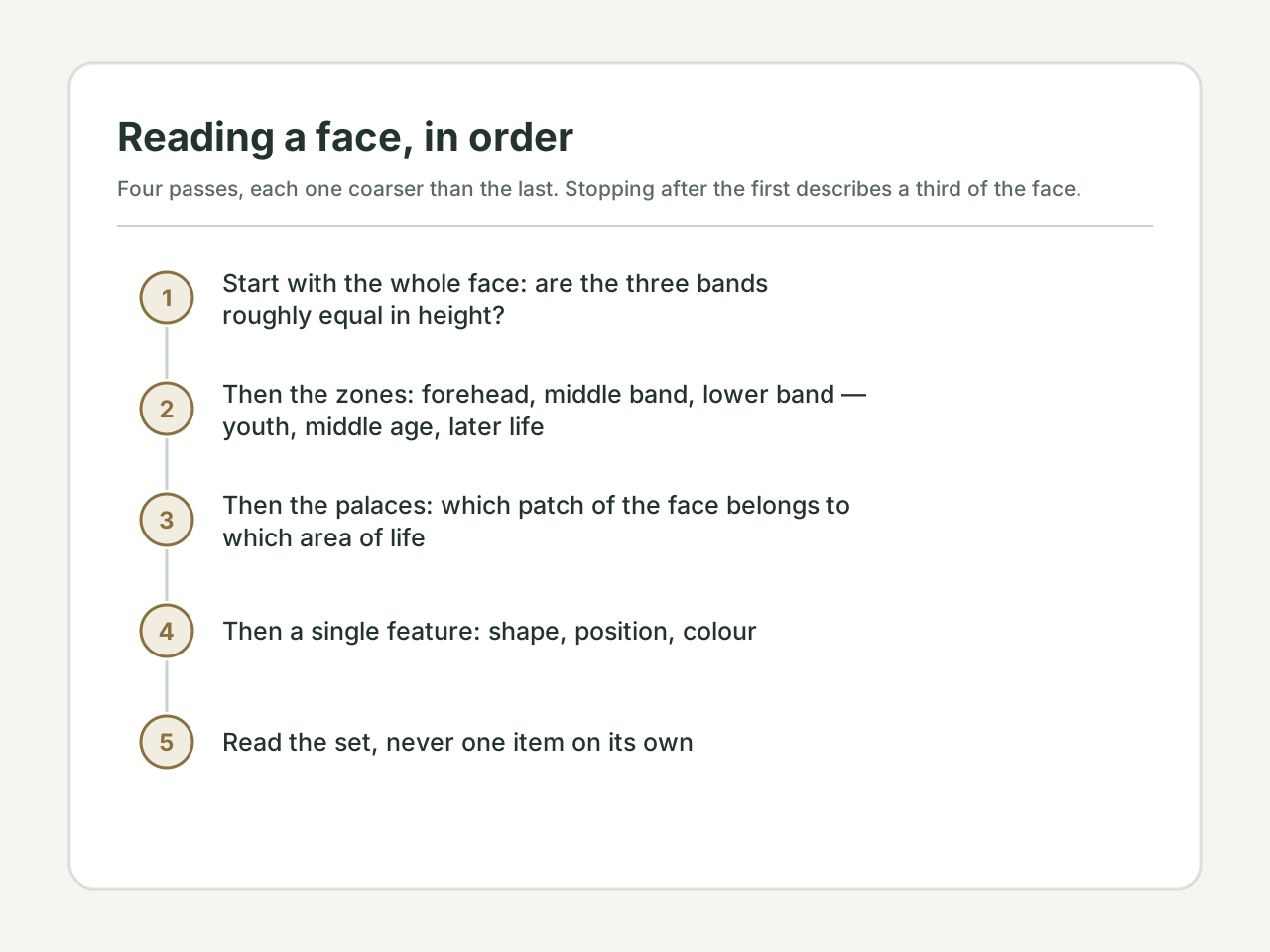
Practitioners differ on detail, but this sequence is common, and it is what keeps a reading from becoming a list of unrelated claims:
- Start with the whole face, before any feature. Proportion, symmetry and overall lustre set the baseline against which every later observation will be judged.
- Then 三停, because it locates the reading in a period of life. A statement about the brow means something different read as 上停 than read as part of 命宫.
- Then the one region the person actually asked about. A reading that begins with the question tends to answer it; a reading that begins with the face tends to describe it.
- Then the person's own account. The tradition's own instruction is that the face is read alongside what the subject says about their life, not instead of it — a reading that contradicts the subject is a bad reading, not a revelation.
- Then stop. A reading that keeps producing new observations after the question has been answered is generating material, not reading.
One face, read under three grids
Take a face with a broad, high forehead, a small nose on a low bridge, and a full, rounded chin. Under 三停 the reading is a strong 上停, a modest 中停 and a settled 下停: an early period with advantages, a middle period that did not convert them, a later period that holds.
Under 五岳 the same three facts read differently. 南岳 is high, 中岳 is low, 北岳 is full. The tradition's ideal is that the five peaks stand in proportion, so a low 中岳 against a high 南岳 is an imbalance rather than three separate verdicts — the nose is not bad, it is short against the forehead.
Under 十二宫 the nose becomes 财帛宫 and the forehead contains 官禄宫, so the same geometry becomes a statement about money and standing rather than about periods of life. None of the three readings contradicts the others; they answer different questions. The useful thing to notice is that the reader has to pick a grid before the face means anything, and the picking is where the interpretation enters.
That is also why the practice is hard to test. The claim is never 'this nose means this outcome'. It is 'this nose, under this grid, at this point in the sequence, means this'. A framework that flexible absorbs almost any result.
Using a reading without letting it become a verdict
The tradition's own use is narrow: the reader describes what is there in the vocabulary of one grid, and the subject decides whether the description matches their life. The description is the product. The forecast is not.
Two rules keep it at that. First, read only the region you were asked about, and say which grid you are using. Second, do not read a face that has not been offered — a face is not a public document, and a reading given to someone who did not ask is a judgement phrased as an observation.
What is left after those two rules is a structured way of talking about how a person presents themselves, which is not nothing. It is simply not a prediction, and the part of the tradition that claims to be one is the part with no way of being wrong.
Disclaimer: This content is for informational and cultural reference purposes only. It does not constitute professional medical, legal, financial, or psychological advice. Readers should exercise their own judgment and consult qualified professionals for specific concerns.
Sources and review basis
Traditional references explain historical vocabulary and context. Official practical sources support only the observable safety, comfort, or environmental points noted in the article; they do not validate metaphysical claims.
Traditional reference
Huangdi Zhaijing (黄帝宅经)Wikisource digital text · Accessed 2026-07-14
Historical context for traditional residential orientation and spatial vocabulary. Modern recommendations are judged against real conditions.
Practical source
APA Dictionary of Psychology: Barnum effectAmerican Psychological Association · Accessed 2026-07-14
A psychology reference for why broad, favourable personality descriptions can feel personally accurate. It does not evaluate BaZi calculations themselves.