Two Start of Spring in one lunar year, and none in the next
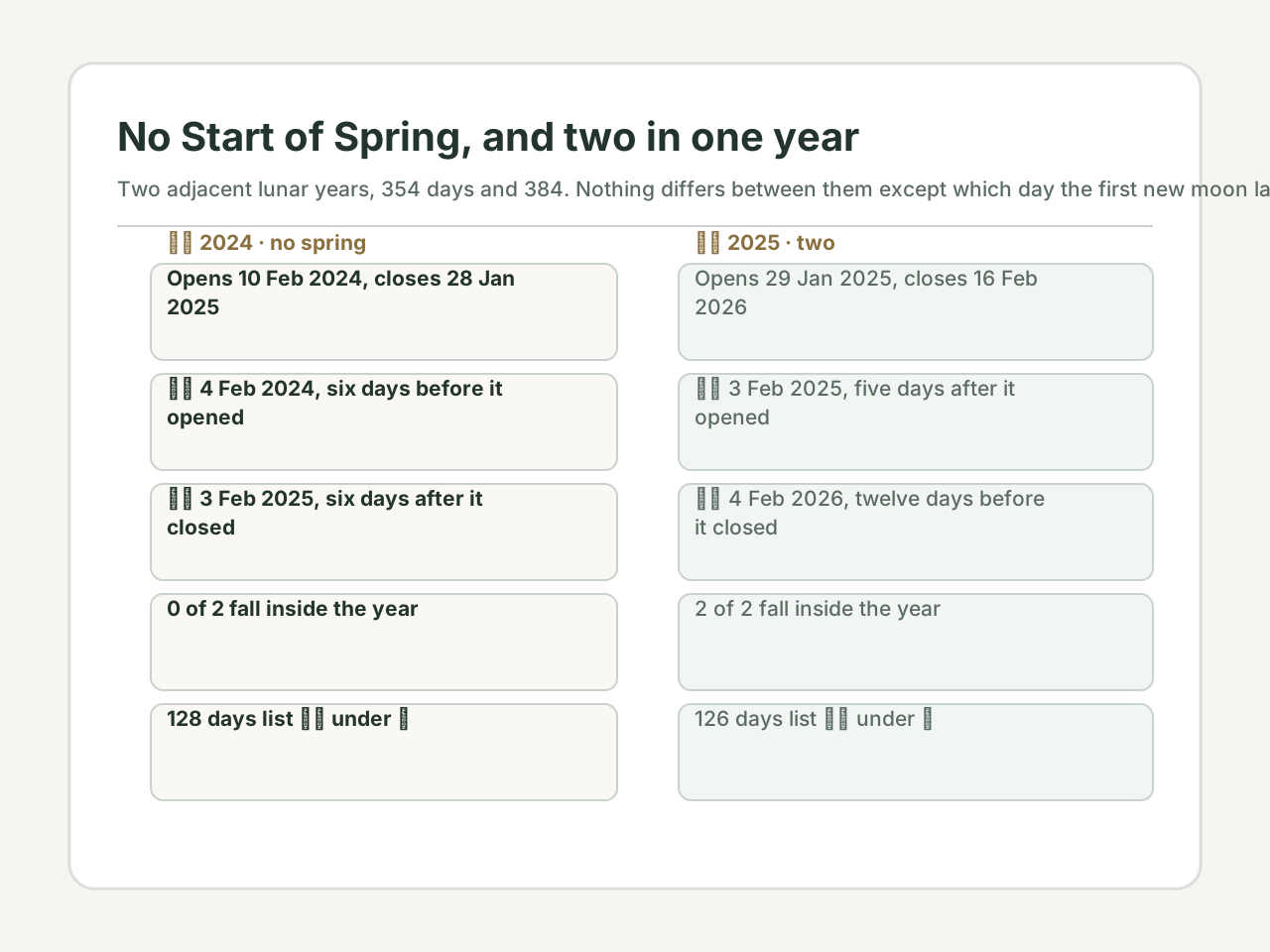
2025 was a 双春年, a double-spring year. The lunar year 乙巳 opened on 29 January 2025 and closed on 16 February 2026, 384 days later, and the Start of Spring fell inside it twice: on 3 February 2025, five days after it opened, and again on 4 February 2026, twelve days before it closed.
The year before was the opposite. 甲辰 opened on 10 February 2024 and closed on 28 January 2025, 354 days later. The Start of Spring of 2024 had already passed on 4 February, six days before that year began, and the one in 2025 did not arrive until 3 February, six days after it ended. Neither fell inside. That is a 无春年 — a year without spring, also called 盲年, a blind year, and in popular usage 寡妇年.
The two years are adjacent. Nothing about them differs except which day the first new moon of the year happened to land on.
Why: 354 days cannot hold two events 365 days apart
The Start of Spring is not a lunar event. It is a solar term, fixed to the sun's position at 315° of ecliptic longitude, and it returns every 365.24 days. A lunar year built from twelve lunar months runs 353 to 355 days. The thirteen-month lunar year — the one carrying a 閏月 — runs 383 to 385 days.
Put those two numbers side by side and the whole phenomenon falls out. A 354-day window cannot contain two events that sit 365 days apart. It can contain one, and only if the year opens in the roughly eleven-day stretch just after a Start of Spring. A 384-day window is longer than the gap, so it catches one at the start and one at the end.
The condition is therefore a length comparison, not a property of the year's character: a lunar year has two Start of Spring if and only if it has thirteen months. The 尚書 states the rule that produces those years — 期三百有六旬有六日,以閏月定四時成歲, a cycle of 366 days with leap months inserted so that the four seasons stay in place. The leap month exists to stop the lunar calendar drifting out of the seasons. Two Start of Spring is what that correction looks like from the inside.
The count over two hundred years
Across the two hundred lunar years from 1900 to 2099: 74 have thirteen months, and all 74 contain two Start of Spring. Of the 126 twelve-month years, 73 contain none and 53 contain one.
That is 37% double, 37% blind and 26% single. The 19-year Metonic cycle puts seven leap months into every nineteen years, which is 36.8% — the same number arriving by a different route.
The useful conclusion is not that blind years are rare. It is that a blind year is one of the two commonest shapes a lunar year takes. A label that applies to more than a third of all years is not separating anything about the people born or married inside them.
What the year label never reaches: the day table
The almanac apparatus that Chinese date selection actually uses works at the level of the day. Each day carries a 建除 value, a mansion from the twenty-eight 宿, a 冲煞 pair, a set of 彭祖百忌 and a 宜/忌 list. Nothing in that stack reads how many Start of Spring the year contains.
Counting with the same engine that renders this site's daily page: in 2024, a blind year, 128 of 366 days list 嫁娶 under 宜. In 2025, a double-spring year, 126 of 365 do. In 2026, 125. The year label moves the count by two days, and it moves it in the direction opposite to the folklore.
The 忌 column moves more, but for day reasons: 119 days in 2024, 129 in 2025, 145 in 2026. Between 1 September and 30 November 2026 alone, the table lists 嫁娶 as 宜 on 27 days.
Inside a double-spring year the two calendars already disagree
A double-spring year is also where the lunar year and the sexagenary year visibly come apart. 乙巳 began on 29 January 2025, but the 巳 year pillar began at the Start of Spring on 3 February — five days during which the lunar year had turned and the zodiac had not.
2026 shows the same seam from the other side. The Start of Spring fell on 4 February; 正月初一 fell on 17 February. For thirteen days the year pillar was already 丙午 while the lunar year was still 乙巳. Both statements are correct, because they answer different questions: one counts moons, the other counts the sun.
A year described as having two Start of Spring is a lunar year with both solar events inside the lunar frame — but only the first of them changes the year pillar. The second lands in a year that already has its stem and branch.
The word 寡妇, and what a label does to a memory
寡妇年 is a folk reading, and I cannot date its first use. What can be checked is that it is not part of the almanac material: the 宜忌 tables computed here contain no year-level prohibition on marriage, and a blind year's day table is as full of 宜嫁娶 days as any other.
The label survives because it is easy to remember and easy to confirm afterwards. The Barnum effect is the documented version of that mechanism: broad statements feel personally accurate, so a difficult first year of marriage will be read as evidence by anyone who was warned about the year in advance. The label does not create the outcome. It decides which outcome gets remembered and repeated.
If the date is already chosen
Work at the level where the tradition actually operates. Pick a day whose 冲煞 does not point at either family's 生肖 — a 冲 runs one branch against one branch, and there are twelve, so any given day clashes with exactly one of them. Then check the layer that decides whether a wedding works at all: who can travel, what the venue costs in that season, whether the date lands in a holiday week.
If someone insists the year is unlucky, the answer is arithmetic. The year is 354 days long instead of 384, and that is the whole difference. The 128 days in 2024 that the almanac marked 宜嫁娶 were marked that way in a year with no spring in it.
- Fix the day first: a 冲 lands on one branch, so check the date against both families' 生肖 before anything else.
- Then the practical layer: who can travel, what the venue costs that season, whether it falls in a holiday week.
- Only then the year. A double-spring year and a blind year have the same day table; the difference is 30 days of length.
Disclaimer: This content is for informational and cultural reference purposes only. It does not constitute professional medical, legal, financial, or psychological advice. Readers should exercise their own judgment and consult qualified professionals for specific concerns.
Sources and review basis
Traditional references explain historical vocabulary and context. Official practical sources support only the observable safety, comfort, or environmental points noted in the article; they do not validate metaphysical claims.
Traditional reference
Book of Documents, Canon of Yao (尚書·堯典)Wikisource digital text · Accessed 2026-10-26
The passage 期三百有六旬有六日,以閏月定四時成歲 states the rule the leap month exists for: a cycle of 366 days with intercalary months inserted so the four seasons stay in place. It is the classical statement of lunisolar intercalation, not a claim about any date being lucky.
Practical source
APA Dictionary of Psychology: Barnum effectAmerican Psychological Association · Accessed 2026-07-14
A psychology reference for why broad, favourable personality descriptions can feel personally accurate. It does not evaluate BaZi calculations themselves.