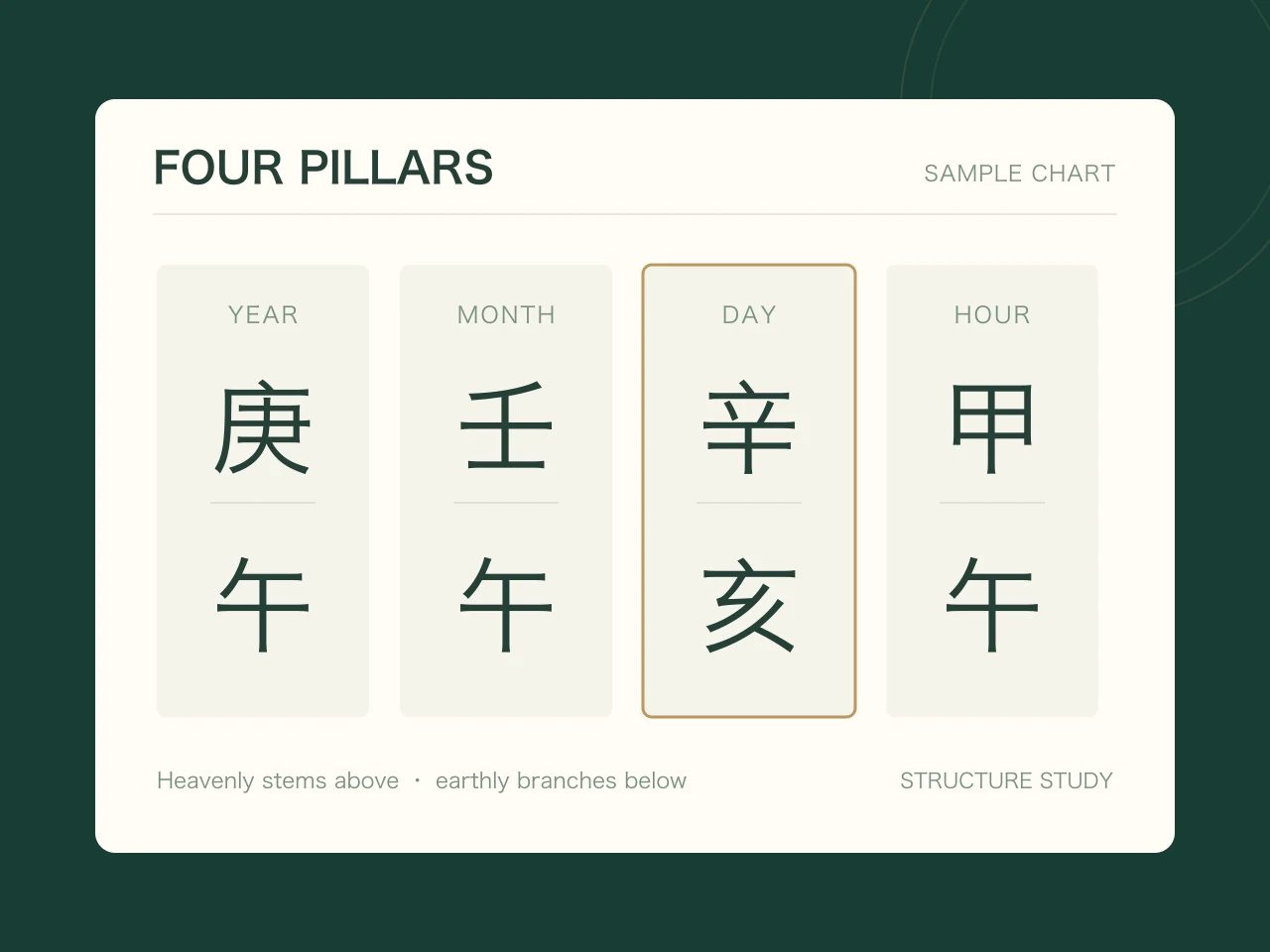
Strength is a measurement with a procedure
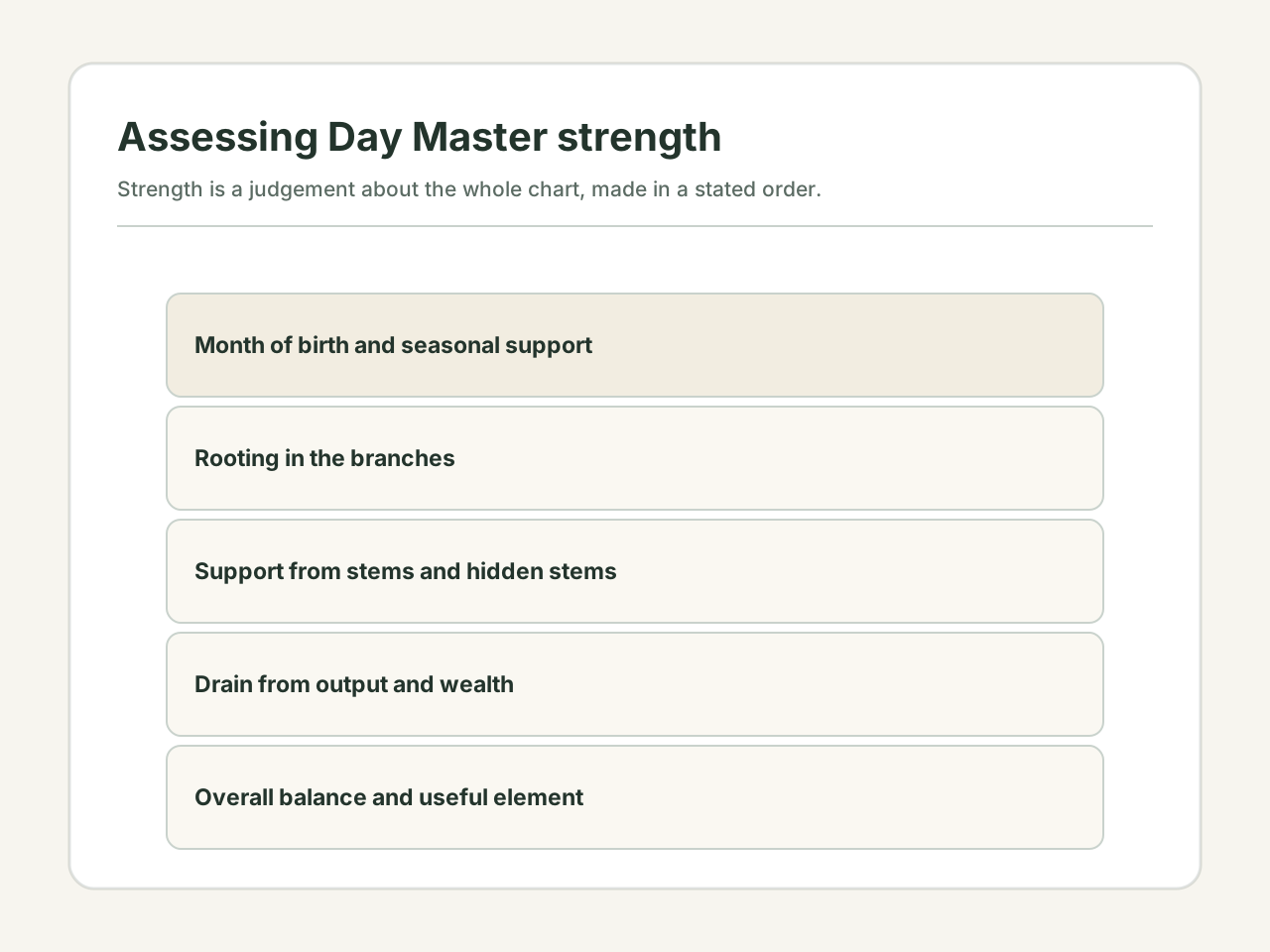
Day Master strength has a name and a procedure: 三得 — 得令, 得地, 得勢. The order matters more than the precision of any single factor, because the three are not weighted equally and one of them can settle the question on its own.
The word strength does damage here. A weak Day Master is not a weak person. It describes a chart where the element representing the self is outnumbered by the elements that drain, oppose or consume it. A strong Day Master describes the reverse. Neither is a verdict on character, and both can change across Luck Pillars.
The common failure is not a wrong factor but a skipped step: support and opposition get added up, a number comes out, and nobody asks whether this is a chart where counting applies at all. That question comes first, and it is answered further down.
得令: the season sets the baseline
得令 asks whether the Day Master is in its season. The classical shorthand is 旺相休囚死 and it is mechanical: the element ruling the season is 旺; the one it generates is 相; the one that generates it is 休; the one that controls it is 囚; the one it controls is 死.
| Season | 旺 (ruling) | 相 (it generates) | 休 (generates it) | 囚 (controls it) | 死 (it controls) |
|---|---|---|---|---|---|
| Spring 寅卯辰 | 木 | 火 | 水 | 金 | 土 |
| Summer 巳午未 | 火 | 土 | 木 | 水 | 金 |
| Autumn 申酉戌 | 金 | 水 | 土 | 火 | 木 |
| Winter 亥子丑 | 水 | 木 | 金 | 土 | 火 |
Reading the row, then the roots and the company
Find the birth season, read across, and locate the Day Master's element. 甲 or 乙 born in autumn lands in the 死 column, the weakest position on offer. 壬 or 癸 born in summer lands in 囚. Neither is a sentence — it is a starting position, and the next two factors can move it a long way.
得地 asks whether the Day Master has roots: a hidden stem in any branch that is the same element. Roots are not equal. A root in the day branch sits under the self and is the most immediate; a root in the month branch sits inside the season and is the strongest; a root in the year or hour branch is real but further away. One 本氣 root outweighs two 餘氣 roots, which is why counting roots without checking which stem each holds gives the wrong answer.
得勢 asks what the exposed stems add. 印 and 比 support; 官殺, 財 and 食傷 do not. The accounting is asymmetric in a way that matters: a supporting stem has to be able to reach the Day Master, and a stem that is clashed, or that sits on a branch controlling it, may be present without being effective.
A rough ordering covers most charts. 得令 outweighs the other two combined: a Day Master in season with no roots is still usually read as strong enough to carry 財 and 官. Where 得令 and 得地 point different ways the season carries more weight, but not decisively — a Day Master out of season with three or four roots scattered across the branches is not a weak chart, and treating it as one produces the wrong favourable elements.
Two caveats belong here. The four-season frame treats earth as a residual, but 土 holds its own term in the last eighteen days before each 節氣 change, and charts born in those windows need the earth column read separately. And the boundary is the solar term, not the calendar month: 立春 moves the month pillar regardless of what the Gregorian date says.
The charts where the score should not be computed
There is a class of chart where counting support and opposition is the wrong operation, because the chart is not trying to balance. Two cases.
專旺, also called 從強, is when one element and its generator dominate so completely that opposing them is counterproductive. There are five, named for the element: 曲直 for wood, 炎上 for fire, 稼穡 for earth, 從革 for metal, 潤下 for water. The test is strict — the season must support the element, the branches must form a combination or a clear majority for it, and the opposing element must be absent or rootless. A single rooted 官殺 stem disqualifies the chart, and the disqualification matters, because it reverses the favourable elements.
從格 is the mirror case: the Day Master has no root and no support, so it gives up and follows whatever dominates — 從財, 從殺, 從兒 or 從勢 depending on what that is. The test here is also strict, and the failure mode is common: one hidden-stem root in a branch is enough to keep the chart an ordinary weak chart, which needs support, rather than a 從 chart, which must not be given support.
The consequence is that the same chart read under the wrong framework gets its favourable elements exactly backwards. That is not interpretive taste. It is the difference between prescribing water for a 炎上 chart, which attacks the structure, and prescribing wood and fire, which feeds it.
Two 壬 Day Masters, eleven days apart
The first woman is born in 亥月, after 立冬. Water is 旺 in that season. She also has 申 in her day branch, which holds 庚 and 壬 — a 本氣 metal root that generates water — and 庚 on her year stem. 得令, 得地 and 得勢 all point the same way. Her chart is strong, and the useful reading is that she can carry 財 and 官 without being crushed by them. In practice she runs a department with a budget and a headcount, which is what 財 and 官 look like when the Day Master can hold them.
The second is born in 午月. Water is 囚 in summer, and 午 is fire — the element 壬 controls, which means the chart is dominated by what she has to spend energy managing rather than by anything that supports her. She has no metal stem and no water root: her branches are 午, 卯 and 寅, fire and wood. She is weak, and the classical name for the shape is 財多身弱, wealth-heavy and self-weak. The instruction is not to work harder at the 財. It is to add 印 and 比, which in practice means credentials, a partner, and fewer simultaneous commitments.
The two charts share a Day Master and nothing else. Any reading that starts from 壬 and stops has said nothing about either of them.
What the score is actually for
The score has one job: it decides which elements are favourable. Strong charts take 財, 官 and 食傷; weak charts take 印 and 比. Everything downstream — career advice, colour advice, which Luck Pillar counts as good — depends on that decision, which is why an error here propagates through the whole reading.
It does not decide character and it does not predict outcomes. A weak chart is not a person who cannot cope; it is a chart that does better with support than alone, which is true of most people in most decades.
And it is not permanent. A Luck Pillar can supply the root the natal chart lacks, or remove the support it relies on. The score describes the natal chart, not a life sentence — and the decade that changes it is usually the one people remember as the turning point.
Disclaimer: This content is for informational and cultural reference purposes only. It does not constitute professional medical, legal, financial, or psychological advice. Readers should exercise their own judgment and consult qualified professionals for specific concerns.
Sources and review basis
Traditional references explain historical vocabulary and context. Official practical sources support only the observable safety, comfort, or environmental points noted in the article; they do not validate metaphysical claims.
Traditional reference
Yuanhai Ziping (渊海子平)Wikisource digital text · Accessed 2026-07-14
A classical source for Four Pillars terminology, element relationships, and the Day Master framework.
Traditional reference
Sanming Tonghui (三命通会)Wikisource digital text · Accessed 2026-07-14
A historical compilation used to cross-check traditional BaZi concepts; it is not scientific validation.