Five taboos, five observable problems
Commercial feng shui taboos arrive as a list of prohibitions: the till must not face the door, no pillar in front of the entrance, no mirror behind the counter, no toilet visible from the sales floor, no staircase aimed at the doorway. The stated consequence is always the same shape. Money leaves as fast as it arrives, customers are driven off, the space leaks. What the list never states is the mechanism.
There is a way to sort the list. Take each taboo and try to rewrite it as one sentence about what a customer would actually encounter at that spot. If the sentence can be written, and then checked by standing there, the taboo is naming a real problem. If no such sentence can be written at all, the taboo is a symbol, and nothing follows from it in either direction.
Most of the list survives that translation, which is why it has lasted. The survivors describe retail design problems that already have names elsewhere: blocked sightlines, circulation conflicts, odour, noise, an exposed payment point. The ones that do not survive describe nothing a person can observe, so obeying them costs money and proves nothing.
Translating each taboo into a check
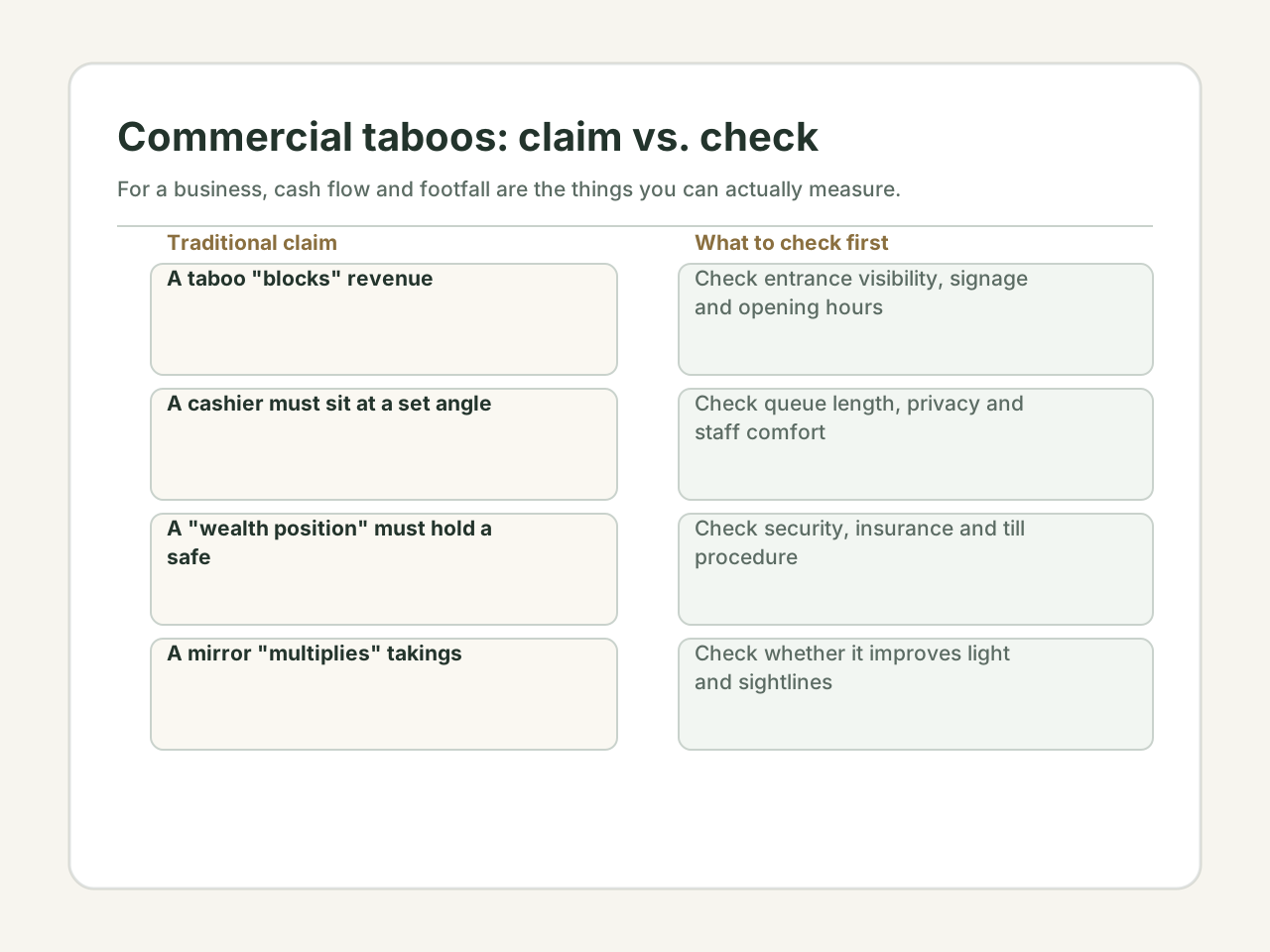
The columns run from the claim to the observation to the measurement. Only the last two can be argued with, and only the last one can be settled.
| Taboo | What the tradition claims | What is actually observable | How to check it |
|---|---|---|---|
| Till facing the door | Wealth leaves as quickly as it enters | The cashier's attention is pulled by every arrival; a customer entering sees the payment point before seeing any merchandise | Stand at the till and count how often the cashier's gaze breaks in ten minutes. Then stand at the door and note where your own first glance lands |
| Pillar in front of the entrance | The pillar produces sha qi and drives customers away | The effective width of the doorway is reduced by a structural column, and the door stops reading as a door from an angle | Photograph the frontage from the opposite pavement and from both obliques. Ask three people who have never been there to point at the entrance |
| Staircase facing the entrance | Qi rushes up the stairs and bypasses the ground floor | The first thing seen on entry is the staircase rather than the stock, and the upward line takes attention with it | Note where the eye lands in the first three seconds. Then time how long a visitor spends on the ground floor |
| Toilet visible from the sales floor | The toilet flushes wealth away | Odour, the sound of flushing, and the discomfort of choosing goods beside a bathroom door | Stand at the furthest shelf. Can you smell it, hear it, see it? Repeat at the busiest hour |
| Mirror behind the till | The mirror doubles the outflow of money | The mirror repeats the payment area in reflection, adding visual noise, and may expose a screen to the queue | Stand where customers stand and look at what the mirror shows. Then look at what it shows from the pavement |
Three that survive the translation
Of the five, three are worth acting on first, because each has a pass condition you can test in one visit rather than a feeling you have to trust.
- The entrance has to be unmistakable. The test is not brightness, it is identification: from ten metres across the street, can someone who has never been here point at the door within three seconds? If not, fix that before anything else on the list, because every other improvement sits behind it.
- The payment point has to be predictable. Two tests. Does the queue block the main aisle? Can the cashier see most of the sales floor from the till? A customer who has to ask where to pay has already been slowed at the one moment they had decided to buy.
- The back of house has to stay out of sight. The test is a single sweep: from any point on the main aisle, can you see cartons, cleaning supplies, or staff eating? If yes, the boundary is decorative rather than real, and no amount of front-of-house styling repairs it.
A restaurant entrance, measured before and after
A small restaurant on a suburban strip has good food, fair prices, and a half-empty dining room most evenings. The frontage has three problems that have nothing to do with energy. The door is recessed, so it sits in shadow while the neighbouring units are flush. The sign is small and unlit after dusk. A large potted plant stands in front of the doorway and eats half its width.
A consultant reads this as blocked sha qi at the entrance and prescribes a mirror, a wind chime, and a Pi Yao statue. The owner buys none of them. She moves the plant, adds lighting above the door, replaces the sign with a larger one, and puts a menu stand on the pavement so passers-by can see what the kitchen cooks. The door frame is painted a warmer colour to separate it from the render.
What makes this worth recording is how she measured it. For two weeks before and two weeks after, the front-of-house staff counted entries between 18:00 and 21:00 in half-hour blocks, and separately recorded the number of tables turned. Weather was noted each night, because rain moves the whole street.
The entry count rose, and the increase concentrated in the half-hours where passers-by had previously walked past without pausing. Table turns did not rise with it. That gap is the finding. The entrance work fixed visibility, which was a real defect, and did nothing for the second constraint, which was kitchen throughput at peak. Reporting a single combined growth figure would have hidden exactly the thing worth knowing: which problem was solved, and which one is still there.
The taboos do not come from one system
The list reads as one tradition but is at least three, and they disagree. The door, the approach, and the bright space just inside it belong to the form school (xingshi, 形势), which describes visible spatial relationships. Translated into retail terms, most of it holds up, because it was always talking about what a person can see and walk through.
The wealth corner is a different matter. The popular rule that it sits diagonally opposite the entrance is a folk reading of ming cai wei (明财位), the open wealth position. Flying star feng shui (feixing, 飞星) derives a wealth position from the period chart instead, and the two frequently point at different corners of the same room. When two methods disagree about the same room, neither is being used as a measurement.
The objects are a third layer again. Pi Yao, wind chimes, and bagua mirrors are folk material culture with no inspectable mechanism. They enter the list because they are cheap, visible, and easy to sell, not because they were ever part of a coherent spatial method.
The practical consequence of mixing the three is contradiction. The form school says an entrance should be open and unobstructed; the mirror tradition says hang something on the outside to deflect what faces you. Both cannot be right about the same doorway. Sorting by whether a claim can be observed is the only rule that resolves it, and it happens to put the form school first and the objects last.
A walk-through you can do in twenty minutes
Six checks in the order that matters. Each has a pass condition, and the failure column is deliberately about the cheapest intervention that addresses it rather than the most thorough one.
| Check | Pass condition | Cheapest fix if it fails |
|---|---|---|
| Entrance legibility | A stranger points at the door within three seconds from across the street | Lighting, a larger sign, removing whatever stands in front of the doorway |
| Doorway clear width | Meets the local accessibility standard: 915 mm in the US under ADA 2010, 1.20 m under China's GB 50763-2012 | Move display or seating out of the reveal; do not cut structure |
| First sightline | The first thing seen is merchandise, not the staircase or the till | Change display height and lighting before moving walls |
| Payment predictability | Customers do not ask where to pay, and the queue clears the main aisle | Relocate the till or mark the floor |
| Back-of-house boundary | No cartons, cleaning supplies, or staff meals visible from the main aisle | A screen, or a change to delivery timing |
| Odour and noise | The sales floor neither smells the toilet nor hears it flush | A closer door and better extraction |
Disclaimer: This content is for informational and cultural reference purposes only. It does not constitute professional medical, legal, financial, or psychological advice. Readers should exercise their own judgment and consult qualified professionals for specific concerns.
Sources and review basis
Traditional references explain historical vocabulary and context. Official practical sources support only the observable safety, comfort, or environmental points noted in the article; they do not validate metaphysical claims.
Traditional reference
Huangdi Zhaijing (黄帝宅经)Wikisource digital text · Accessed 2026-07-14
Historical context for traditional residential orientation and spatial vocabulary. Modern recommendations are judged against real conditions.
Practical source
CCOHS: Office ErgonomicsCanadian Centre for Occupational Health and Safety · Accessed 2026-07-14
Practical guidance for workstation setup, posture, reach, lighting, and office comfort.