The five phases name processes, not job titles
The oldest description of the five phases is a list of behaviours. The Great Plan chapter of the Book of Documents (尚書·洪範) gives each one a verb: water soaks and descends, fire flames and rises, wood bends and straightens, metal can be moulded and reshaped, earth accepts sowing and reaping. Every entry describes what a thing does. None of them names an industry, an office, or a profession.
The industry lists that circulate today were compiled much later, mostly in twentieth-century Chinese almanacs and in the Hong Kong and Taiwan fortune-telling manuals that followed them. They inherit the five labels from the classical text and nothing else. That is not automatically wrong, but it means the mapping has no source to be checked against — it is editorial convention wearing a classical costume.
One trade, three elements, depending on which question you ask
Ask what a trade is made of, what it does, and who it serves, and the same trade lands on different elements. This is not a flaw in any single book; it is what happens when a classification has no fixed axis.
A chef works with fire and water, sells a service, and handles food that came from earth. A banker moves metal (money, contracts) on behalf of people who mostly want water (liquidity, flow). A hospital is metal in its instruments, water in its diagnostics, and earth in its care work. Pick the axis and you pick the answer.
A scheme that can assign almost any trade to almost any element has stopped making predictions. It can still be a vocabulary for talking about work, which is how the vocabulary is used in what follows.
| Trade | By material | By function | By client relationship |
|---|---|---|---|
| Restaurant | Fire (cooking) | Earth (service) | Water (flow of guests) |
| Banking | Metal (contracts) | Water (liquidity) | Metal (enforcement) |
| Hospital | Metal (instruments) | Water (diagnosis) | Earth (care) |
| Construction | Earth (ground) | Wood (structure) | Metal (regulation) |
| Software | Metal (logic) | Fire (display) | Water (distribution) |
| Logistics | Water (movement) | Metal (scheduling) | Earth (warehousing) |
What the chart does specify: ten gods describe the shape of the work
The part of a Four Pillars chart that maps onto employment is not the element count. It is the ten gods — the relation between the day master and every other stem in the chart. Each relation describes a kind of activity, and kinds of activity translate into job shapes far more directly than elements translate into industries.
A chart with a prominent 正官 tends to read as work inside a rule structure: an institution, a licence, a rank. The same chart with 七杀 instead of 正官 reads as work under pressure that someone else sets: enforcement, competition, quotas, turnaround. Both are authority; the difference is whether the authority is procedural or adversarial.
Read the table as a vocabulary, not a verdict. A person can hold a 正官-shaped job and be miserable in it, and the chart will not say so.
| Ten god | Shape of the work |
|---|---|
| 正官 Direct officer | Rules, rank, licence, institutional procedure |
| 七殺 Seven killings | External pressure, enforcement, competition, deadlines |
| 正印 Direct resource | Study, teaching, accreditation, support role |
| 偏印 Indirect resource | Specialist technique, unusual method, narrow expertise |
| 正財 Direct wealth | Steady trading, salaried management, bookkeeping |
| 偏財 Indirect wealth | Venture income, multiple streams, negotiation |
| 食神 Eating god | Craft, product, service quality, patient output |
| 傷官 Hurting officer | Expression, design, technical breakage, disliking supervision |
| 比肩 Friend | Peer-level work, independent practice, same trade |
| 劫財 Rob wealth | Partnership, rivalry, shared stakes |
Strength decides whether you push out or prop up
Once the shape is known, the second question is capacity. A strong day master is read as being able to spend itself: output (食傷), commerce (財), and constraint (官殺) all become usable. A weak day master is read as needing support: learning and accreditation (印), and peers or partners (比劫).
Whether a day master is strong is decided first by the month, using the 旺相休囚死 table rather than a percentage. Spring: wood prospers, fire is next, water rests, metal is imprisoned, earth dies. Summer: fire prospers, earth is next, wood rests, water is imprisoned, metal dies. Autumn: metal prospers, water is next, earth rests, fire is imprisoned, wood dies. Winter: water prospers, wood is next, metal rests, earth is imprisoned, fire dies.
There is no defensible way to say the month pillar is worth forty per cent of strength. The tradition does not assign weights. It assigns seasons, roots, and allies, in that order.
Two charts, same day master, opposite advice
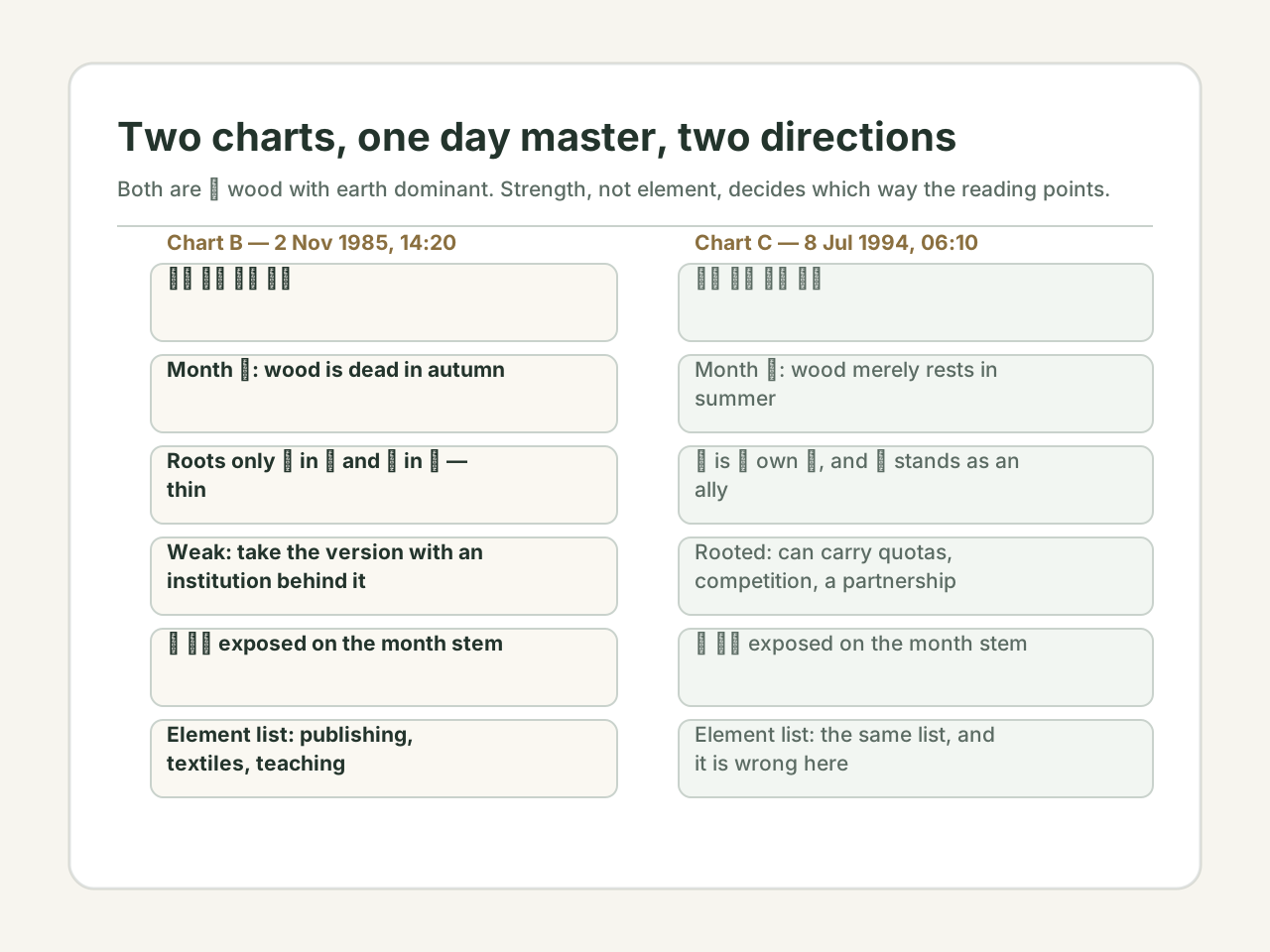
Both people below have 乙 wood as the day master. Both have earth as the dominant element. The reading points them in different directions, and the reason is strength, not element.
Chart B — 2 November 1985, 14:20: 乙丑 丙戌 乙巳 癸未. Month 戌 is autumn, where wood is dead. Counts are wood 2, fire 2, earth 3, metal 0, water 1, with metal absent. 丙 hurting officer sits on the month stem; earth appears three times, which reads as wealth; 癸 indirect resource sits on the hour stem. The only roots are 癸 inside 丑 and 乙 inside 未 — thin. This is a weak day master carrying a lot of output and a lot of wealth.
The element-only reading sends this person to wood industries: publishing, textiles, horticulture, teaching. The ten-god reading says something narrower and more useful: the work involves producing something (傷官) that someone pays for (財), and a specialist credential (偏印) is what makes the production sellable. Because the day master is weak, the same work should be done inside an institution that carries the cash-flow risk. Freelancing the identical job would be the same activity with a worse fit.
Chart C — 8 July 1994, 06:10: 甲戌 辛未 乙未 己卯. Same 乙 wood, but the month is 未, summer, where wood merely rests. Counts are wood 3, fire 0, earth 4, metal 1, water 0, with fire and water absent. 甲 rob wealth stands on the year stem and 卯 on the hour branch is 乙's own 祿 — a root plus an ally. 辛 seven killings is exposed on the month stem, and 己 indirect wealth on the hour stem.
Same element, and the advice inverts. This chart has a root and an ally, so it can carry external pressure: quotas, competition, enforcement, a role where someone else sets the number. It can also carry partnership, which the first chart should avoid. A wood-industry list would have given both people the same answer, which is how you can tell the list is not doing any work.
Where the element vocabulary still earns its place
Elements are a compact way to describe work environment rather than work content. Noise, pace, whether the day is ordered or improvised, whether you are mostly alone or continuously interrupted — these are real variables that predict job satisfaction better than industry does, and the five labels are a short handle for them.
The handle is only useful if it is checked. Someone who says they need water-shaped work usually means they need long uninterrupted stretches. That is a testable claim: look at the jobs already held, and see which ones had those stretches. The chart proposes the question; the work history answers it.
What a chart cannot decide about a career
It cannot produce an income figure, a promotion date, or a forecast about an industry. Sector demand is a macroeconomic variable with no term in a birth chart, and anyone who maps a personal chart onto a sector cycle is inventing a link.
It also cannot be used as a veto. Turning down an offer because the company is metal-shaped, when metal is what the chart calls unfavourable, is a decision made on a premise that cannot be tested — and the cost of being wrong is a real job.
The honest use is narrower: the chart narrows the question from what should I do with my life to what shape of work have I already done well, and in what conditions. The second question has answers you can check.
Three ways to use this without treating it as a test
First, pick the shape before the trade. Read the ten gods for the kind of activity — output, enforcement, study, trade, partnership — and only then look at industries that contain that activity. Starting from an industry list starts from the least reliable layer.
Second, let strength set the risk budget. A weak day master reading does not mean do not start a business; it means do not be the person holding the cash-flow risk alone. Employment, partnership, or a contract with a floor are the same work with the risk moved elsewhere.
Third, use the elements for environment and verify against your own history. If the chart says water and your three happiest jobs were all quiet and uninterrupted, that is a real pattern. If they were not, the reading was wrong, and the work history wins.
Disclaimer: This content is for informational and cultural reference purposes only. It does not constitute professional medical, legal, financial, or psychological advice. Readers should exercise their own judgment and consult qualified professionals for specific concerns.
Sources and review basis
Traditional references explain historical vocabulary and context. Official practical sources support only the observable safety, comfort, or environmental points noted in the article; they do not validate metaphysical claims.
Traditional reference
Book of Documents, “The Great Plan” (尚書·洪範)Wikisource digital text · Accessed 2026-10-25
The chapter that gives each of the five phases a behaviour rather than a list of trades, and derives the five flavours from those behaviours. Cited because it is the earliest place the scheme is stated, and because it contains no industry classification at all.
Traditional reference
Yuanhai Ziping (渊海子平)Wikisource digital text · Accessed 2026-07-14
A classical source for Four Pillars terminology, element relationships, and the Day Master framework.
Traditional reference
Sanming Tonghui (三命通会)Wikisource digital text · Accessed 2026-07-14
A historical compilation used to cross-check traditional BaZi concepts; it is not scientific validation.