What an opening date is measured against
An opening date is checked in two passes. The first is the 冲 check used everywhere else: the candidate day's branch against the owner's year branch, which removes about one day in twelve. The second is specific to business — the day's stem against the element the trade is assigned. A restaurant is Fire, a technology firm is Water, property is Earth, and the day's stem is read as feeding or draining that element.
The second pass is where practitioners diverge most, because assigning an element to a trade is conventional rather than fixed. A bakery can be read as Fire (the oven) or as Earth (the grain). Once the premise is arguable, so is the conclusion, and two consultants can hand the same owner opposite dates without either of them making an arithmetic mistake.
Neither pass says anything about whether the business works. The first month's revenue is set by the queue at the counter, whether the card terminal connects, whether the rota covers the dinner service, and whether the supplier delivers on Tuesday. Those are all fixable, and none of them are on the calendar.
Two passes, one of which is arguable
The checks are usually presented as a single procedure. They are not the same kind of claim:
| Pass | Input | What it rules out |
|---|---|---|
| Owner's year branch (冲) | The candidate day's branch against the owner's year branch. Six opposing pairs cover the twelve branches. | About one day in twelve. Mechanical, and identical for every practitioner |
| Owner's 本命日 | Whether the day's branch equals the owner's year branch | One day in twelve, and treated as a preference rather than a rule |
| Industry element | The day's stem, read as generating or controlling the element assigned to the trade | Nothing on its own — it orders the survivors. The trade's element is a convention, so the ranking inherits that uncertainty |
| Almanac 宜忌 | The day's line in the 通书 — 宜开市, 忌开市 | Days marked 忌开市, if you are using an almanac at all |
Two consecutive days, opposite readings
A chef is opening a restaurant in March 2027. She was born in 1986 — 丙寅, year branch 寅. Her trade is Fire. The fit-out finishes on Friday 12 March, so the two realistic opening days are Monday the 15th and Tuesday the 16th.
15 March 2027 is 癸巳. Its branch is 巳: no clash with her 寅, but 寅 and 巳 are two legs of the 寅-巳-申 刑, so the day carries an objection. Its stem is 癸, which is Water, and Water controls Fire — the day's stem works against the trade's element.
16 March 2027 is 甲午. Its branch is 午: no clash with 寅, and 寅 and 午 are half of the 寅-午-戌 Fire frame, which reads as support. Its stem is 甲, which is Wood, and Wood generates Fire. Both passes point the same way.
One day apart, opposite verdicts — which is the point. The check is not measuring the quality of the week or the month; it reads a single stem and a single branch, and those change every twenty-four hours. She opens on the Tuesday, and the date is the least consequential decision she makes that month. What decides the restaurant is whether the kitchen can plate forty covers an hour, and she finds that out in the first fortnight.
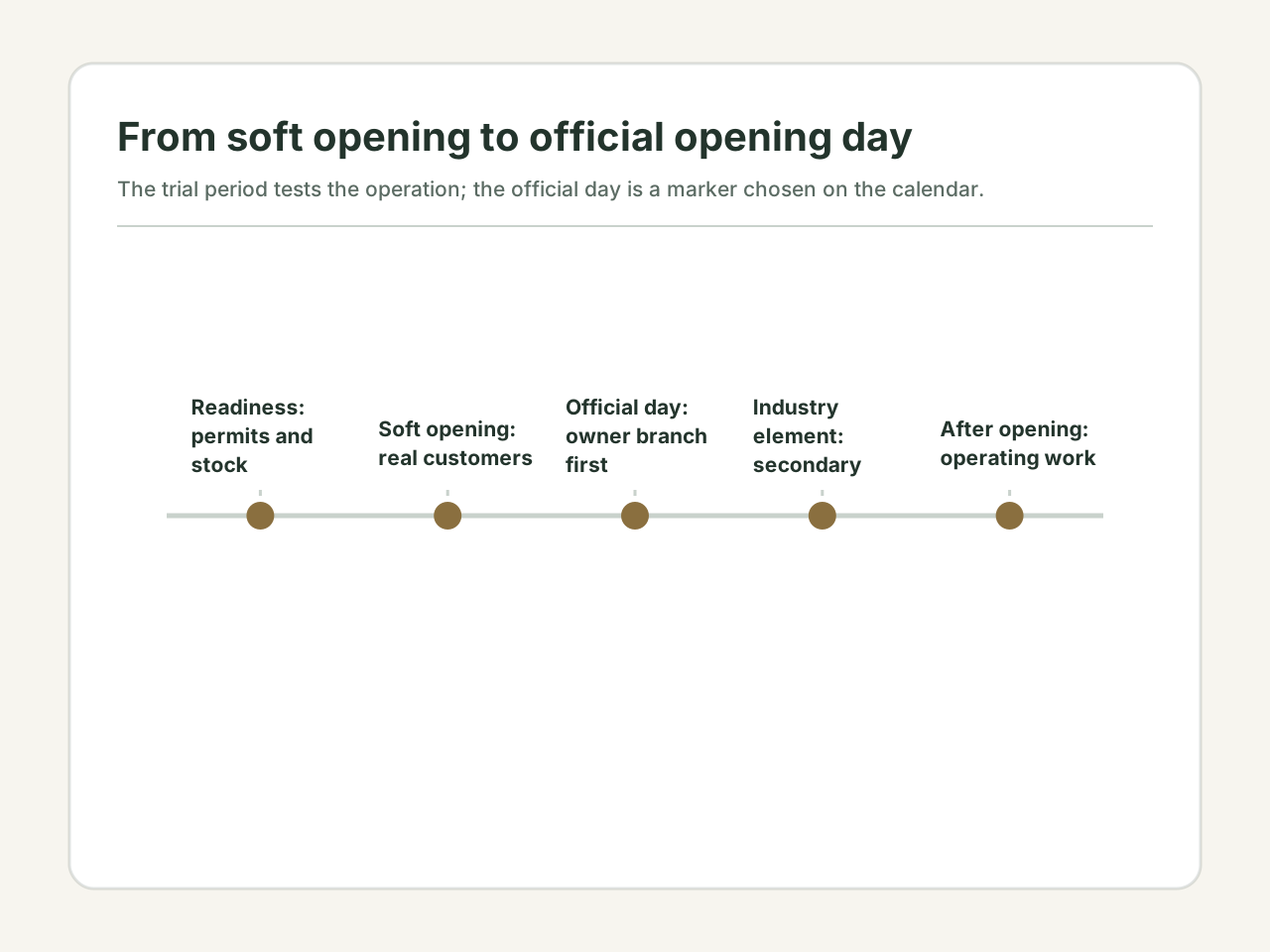
A soft opening before the official opening day
Most businesses now run a soft opening — a quiet trial period with real customers but no announcement — and the traditional check applies to the official day rather than to the trial. Separating the two removes most of the pressure. The trial period is where the queue, the payment terminal, the kitchen timings and the staffing rota get tested; the official day is a marker, and it can be chosen on the calendar without also carrying the question of whether the business works.
- Run a trial period with real transactions before the official day, so the opening becomes a repetition of something that already worked once
- Filter the official date against the owner's year branch first; the industry-element comparison is a secondary refinement, not a substitute for readiness
- Keep the opening-day programme reversible: something short, easy to extend or end, with a written list of who handles what
- Write down who the date is for — a marker for staff and customers — so that a slow first month is not read as a verdict on the day
When the lease, not the calendar, sets the date
In practice the opening date is usually fixed before anyone looks at a calendar. The lease starts on the first of the month, the fit-out runs over, the health inspection is booked for a Thursday, and the supplier's first delivery lands on a Tuesday. The date is a constraint, not a choice.
The traditional response to a forced date is not to fight it. The 宜忌 line in the almanac describes what a day is suited to; it does not invalidate a lease. What practitioners do is choose the soft-opening window freely — that part is genuinely under the owner's control — and treat the official day as the marker it is.
If you want one number to watch instead of a date, watch the first month's repeat rate: the share of customers who come back within thirty days. It is the earliest honest signal of whether the business works, and no opening date moves it.
Disclaimer: This content is for informational and cultural reference purposes only. It does not constitute professional medical, legal, financial, or psychological advice. Readers should exercise their own judgment and consult qualified professionals for specific concerns.
Sources and review basis
Traditional references explain historical vocabulary and context. Official practical sources support only the observable safety, comfort, or environmental points noted in the article; they do not validate metaphysical claims.
Traditional reference
Yuxia Ji (玉匣記)Wikisource digital text · Accessed 2026-10-15
A household almanac whose 入宅 and 移徙 sections show how traditional date selection for moving house was organised. It documents a convention, not evidence that a date changes an outcome.
Practical source
APA Dictionary of Psychology: Barnum effectAmerican Psychological Association · Accessed 2026-07-14
A psychology reference for why broad, favourable personality descriptions can feel personally accurate. It does not evaluate BaZi calculations themselves.