A business name has two jobs that pull against each other
A business name is asked to be distinctive and to be easy, and those two requirements point in opposite directions. Distinctiveness is judged at a register: the name has to be unlike anything already recorded in the class you trade in, and unlike the words that simply describe what you sell. Easiness is judged in the mouth and on a sign: it has to survive a bad phone line and be readable from across a street.
The tension is real, and it explains why most workable names look the way they do — a familiar word in an unfamiliar combination, rather than either an ordinary phrase or an invented string. An invented string passes the register and fails the phone line. A plain description passes the phone line and fails the register. The five-phase reading sits outside both tests, which is why it belongs at the end rather than at the start.
The classical text gives behaviours, not industries
The earliest written statement of the five phases is a chapter of the Book of Documents, and the first thing it does is give each phase a behaviour: water soaks and descends, fire flames and rises, wood bends and straightens, metal yields and changes, earth accepts and grows. Everything else in the chapter — the flavours, the seasons — is derived from those behaviours.
- What the chapter does not contain is an industry classification. No trade is assigned to a phase, and nothing is said to attract anything.
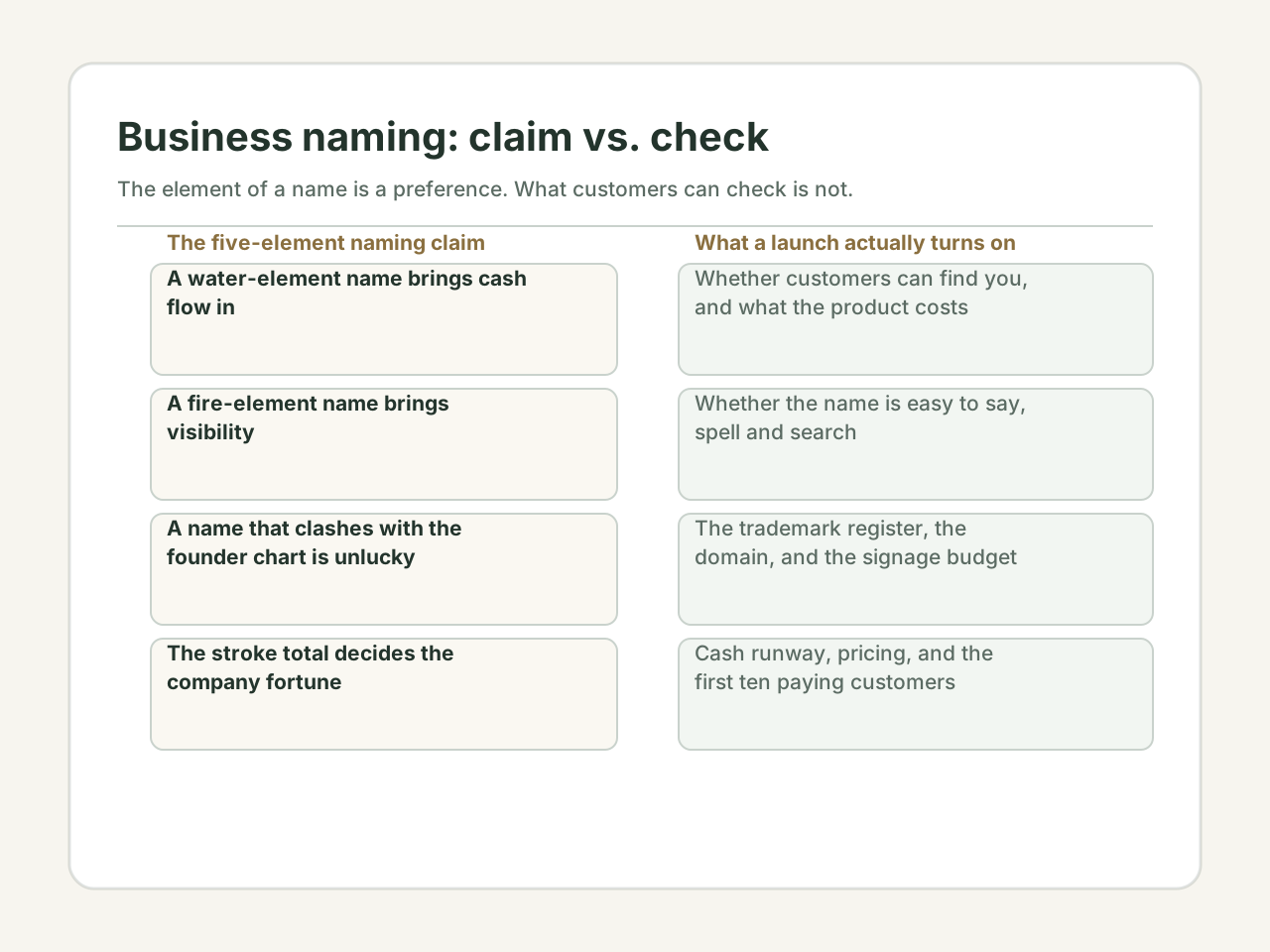
- The trade associations used in business naming — water for shipping and cash flow, fire for food and visibility, metal for finance and machinery, wood for education and growth, earth for property — were assembled much later by practitioners. They are a mnemonic, not a derivation.
- The text is worth reading precisely because it marks where the scheme stops. Quoting it in support of an industry map means quoting a chapter that says something narrower.
The register: 45 classes, and a refusal you cannot argue with
Trademark classification divides goods and services into 45 classes — 34 for goods, 11 for services — and a name is cleared class by class. That number matters because cost scales with it: a shop that sells prepared food and also packages tea is in more than one class, and each one is a separate application and a separate search.
The harder constraint is not availability but distinctiveness. Article 11 of the Trademark Law of the People's Republic of China refuses registration to signs that lack distinctive character, and specifically to signs that merely describe the quality, principal raw material, function, use, weight or quantity of the goods. The practical consequence is uncomfortable: the name that tells a customer most directly what you sell is the name the register is most likely to refuse.
Take three names a teahouse might consider, and apply the rule rather than a preference:
| Name | What it says | How it fares |
|---|---|---|
| 岩茶记 | Names the product directly — rock tea, recorded | Descriptive of the goods; the weakest position at the register |
| 小满 | A solar term, with no link to tea | Distinctive, but already carried by an established beverage brand |
| 水云间 | Evocative, with no product claim | Distinctive and clear of the trade |
The sign: legibility has a ratio, not a taste
Shopfront lettering follows a rule of thumb that has been in use for a century: about one unit of character height for every 120 units of viewing distance. In metric that is roughly 2.5 cm of height per 3 m. A sign read from 5 m needs characters around 4 cm high; one read from 30 m across a road needs about 25 cm.
Two adjustments apply to Chinese. The first is stroke density: legibility depends on separating strokes, not on overall height, so a character with many strokes needs to sit at the upper end of the range while a sparse one survives at the lower end. The second is that the rule is for a reader who is looking; a sign meant to be caught in peripheral vision, on a passing vehicle, needs to be larger again.
This is the check that eliminates names cheaply. Write the three shortlisted names at the height the sign will actually be, pin the sheet to a wall, and walk back until you cannot read them. The distance at which each one fails is a number, and it will not be the same for all three.
The shortening happens without you
Customers abbreviate. A name of four characters or more gets cut to two in speech, and the two that survive are chosen by the people saying it, not by the founder. That is why the test worth running is not how the full name sounds but which fragment it leaves behind.
The test is simple and takes a minute: say the name to someone who has not heard it, wait a day, and ask them to repeat it. What comes back is the name you will actually be called. If that fragment is dull, ambiguous, or collides with a competitor, the full name is already lost — no amount of signage recovers a name that the street has shortened into something else.
Where the element reading fits
Once a shortlist has survived the register, the sign and the shortening test, an element reading is a legitimate way to choose between names that all work. It is a tie-breaker, and it should be applied in that order for a plain reason: every test above can eliminate a candidate outright, and the element reading cannot.
- Check the register first, in the classes you will actually trade in, plus the company-name register and the domain.
- Check the sign at the size it will be made, and at the distance it will be read from.
- Check the fragment the name will be shortened to, by asking someone to repeat it a day later.
- Check the sound over a bad line and the spelling to a stranger.
- Only then compare what is left on element, if that matters to you.
What the element of a name cannot settle
Four limits, stated plainly:
- It cannot make a product competitive. Price, quality, location and word of mouth decide whether a shop survives its second year.
- It cannot override a trademark. An element reading does not make an unavailable name usable, and it does not make a descriptive one registrable.
- It cannot settle the chart question. Two advisers read the same chart and name different useful elements, which is why this filter should never be the only one.
- It cannot be checked. Nothing about a name's element can be tested against an outcome, so the honest position is that it is a preference the founder holds, not a property the business has.
The order, by what it costs to find out
The register search costs money and a week. The sign test costs a sheet of paper. The shortening test costs a day of waiting. Run the cheap ones first, because they remove candidates before you pay for the expensive one — and because a name that fails the paper test never needed a search at all.
What none of this does is guarantee a good business. A name clears the way; it does not sell anything. The useful thing a founder can say about a name is not that it is auspicious but that it passed four tests they can describe, which is a claim someone else can check.
Disclaimer: This content is for informational and cultural reference purposes only. It does not constitute professional medical, legal, financial, or psychological advice. Readers should exercise their own judgment and consult qualified professionals for specific concerns.
Sources and review basis
Traditional references explain historical vocabulary and context. Official practical sources support only the observable safety, comfort, or environmental points noted in the article; they do not validate metaphysical claims.
Traditional reference
Book of Documents, “The Great Plan” (尚書·洪範)Wikisource digital text · Accessed 2026-10-25
The chapter that gives each of the five phases a behaviour rather than a list of trades, and derives the five flavours from those behaviours. Cited because it is the earliest place the scheme is stated, and because it contains no industry classification at all.
Practical source
APA Dictionary of Psychology: Barnum effectAmerican Psychological Association · Accessed 2026-07-14
A psychology reference for why broad, favourable personality descriptions can feel personally accurate. It does not evaluate BaZi calculations themselves.