Twelve names on a fixed cycle
The twelve stages (十二长生) put every heavenly stem on a twelve-step scale against the twelve earthly branches. The order never varies, for any stem: 长生 birth, 沐浴 bathing, 冠带 capping, 临官 office, 帝旺 peak, 衰 decline, 病 illness, 死 death, 墓 tomb, 绝 extinction, 胎 conception, 养 nurture.
The names trace a human life, which is exactly why the table gets read as a life story. It is not one. Each name records a position on a cycle — where a stem sits relative to its own high point. 死 means the stem has passed that high point at that branch. It says nothing about the person whose chart happens to contain the branch.
| Stage | What it marks |
|---|---|
| 长生 | The branch where the element first appears |
| 沐浴 | New, unstable, still being washed clean |
| 冠带 | Taking shape, not yet load-bearing |
| 临官 | Strong enough to hold a post — a real root |
| 帝旺 | The peak; the element at full strength |
| 衰 | Past the peak, still visible |
| 病 | Weakening, no longer carrying weight |
| 死 | The stem's own high point is behind it here |
| 墓 | Stored — a container, not a grave |
| 绝 | The cycle's quietest point |
| 胎 | Conceived, not yet present |
| 养 | Being fed, not yet able to act |
Where the cycle starts is set by the element
Wood is born at 亥, fire at 寅, metal at 巳, water at 申. Earth is the exception that generates most of the argument. The table printed in the common handbooks gives earth the fire palace — 戊 born at 寅 with 丙, 己 born at 酉 with 丁, 火土同宫. A second tradition gives earth the water palace at 申, 土水同宫. Both are in print, and they disagree about every earth stem, so a reading that quotes one without naming it is quoting a preference.
Yang stems step forward through the branches, yin stems step backward. The 甲 row is the reference row, and every other yang stem is the same row shifted to its own birth branch:
| Branch | Stage for 甲 (yang wood) |
|---|---|
| 亥 | 长生 |
| 子 | 沐浴 |
| 丑 | 冠带 |
| 寅 | 临官 |
| 卯 | 帝旺 |
| 辰 | 衰 |
| 巳 | 病 |
| 午 | 死 |
| 未 | 墓 |
| 申 | 绝 |
| 酉 | 胎 |
| 戌 | 养 |
Yin stems run the other way, and not everyone agrees
Because yin stems step backward, 乙 wood is born at 午 and dies at 亥 — the exact reverse of 甲. The same two branches, opposite verdicts, for two stems of the same element:
- The reversed reading is the mainstream one, and it is what most software prints.
- The 同生同死 school rejects it: 亥 is water, water feeds wood, so calling 乙 dead at 亥 reads the convention instead of the relationship. On that view both stems share the 甲 row.
- The defence of the reversal is that a yin stem is a different phase of the element and should not borrow the yang stem's calendar.
| Branch | 甲 (yang wood) | 乙 (yin wood) |
|---|---|---|
| 亥 | 长生 | 死 |
| 午 | 死 | 长生 |
| 寅 | 临官 | 帝旺 |
| 卯 | 帝旺 | 临官 |
Two charts, one day master, two opposite errors
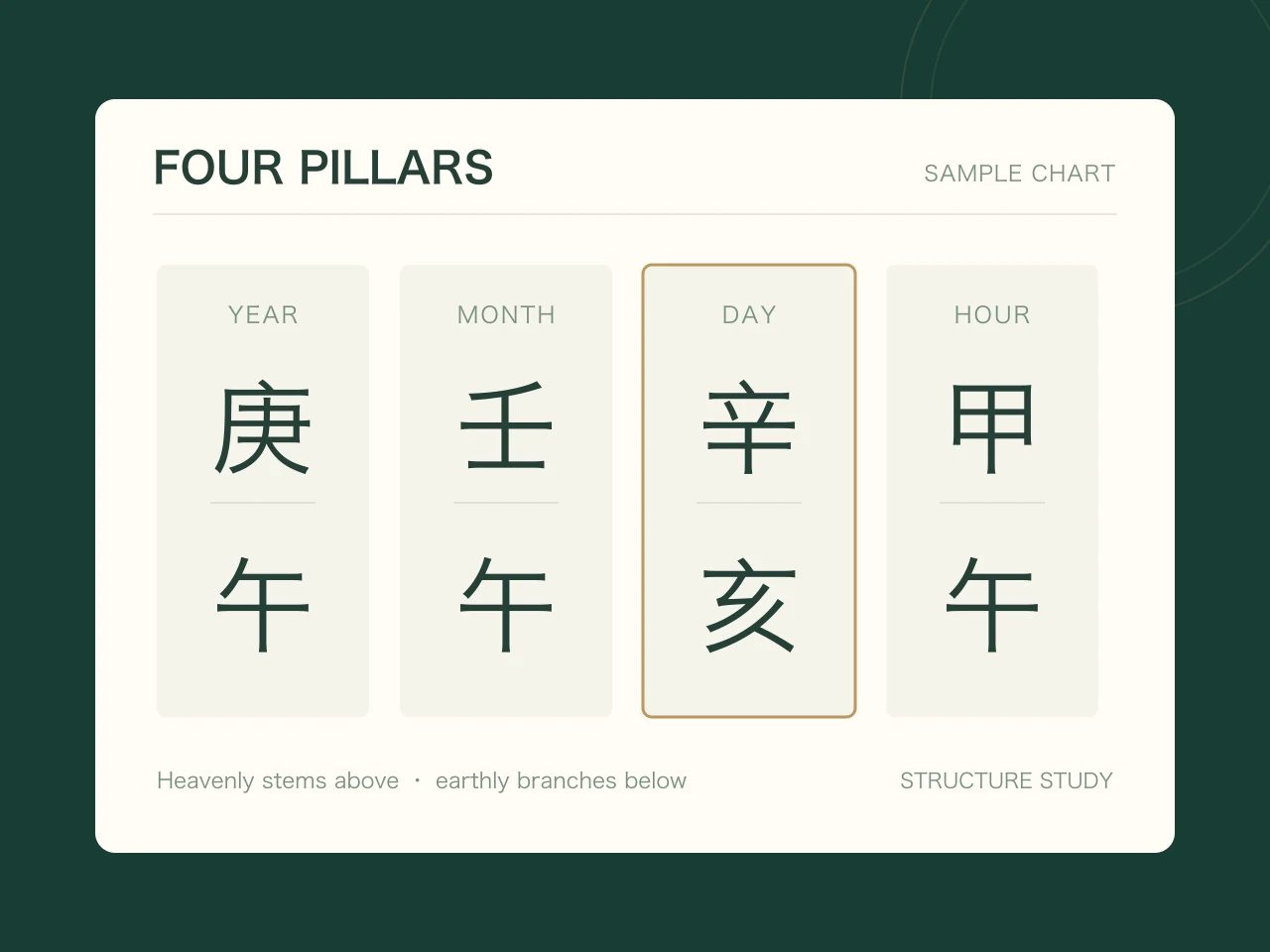
Both charts below have a 乙 day master, the same 庚 year stem, and the same 10:00 hour. Only the month and the day differ, which makes the variable easy to see.
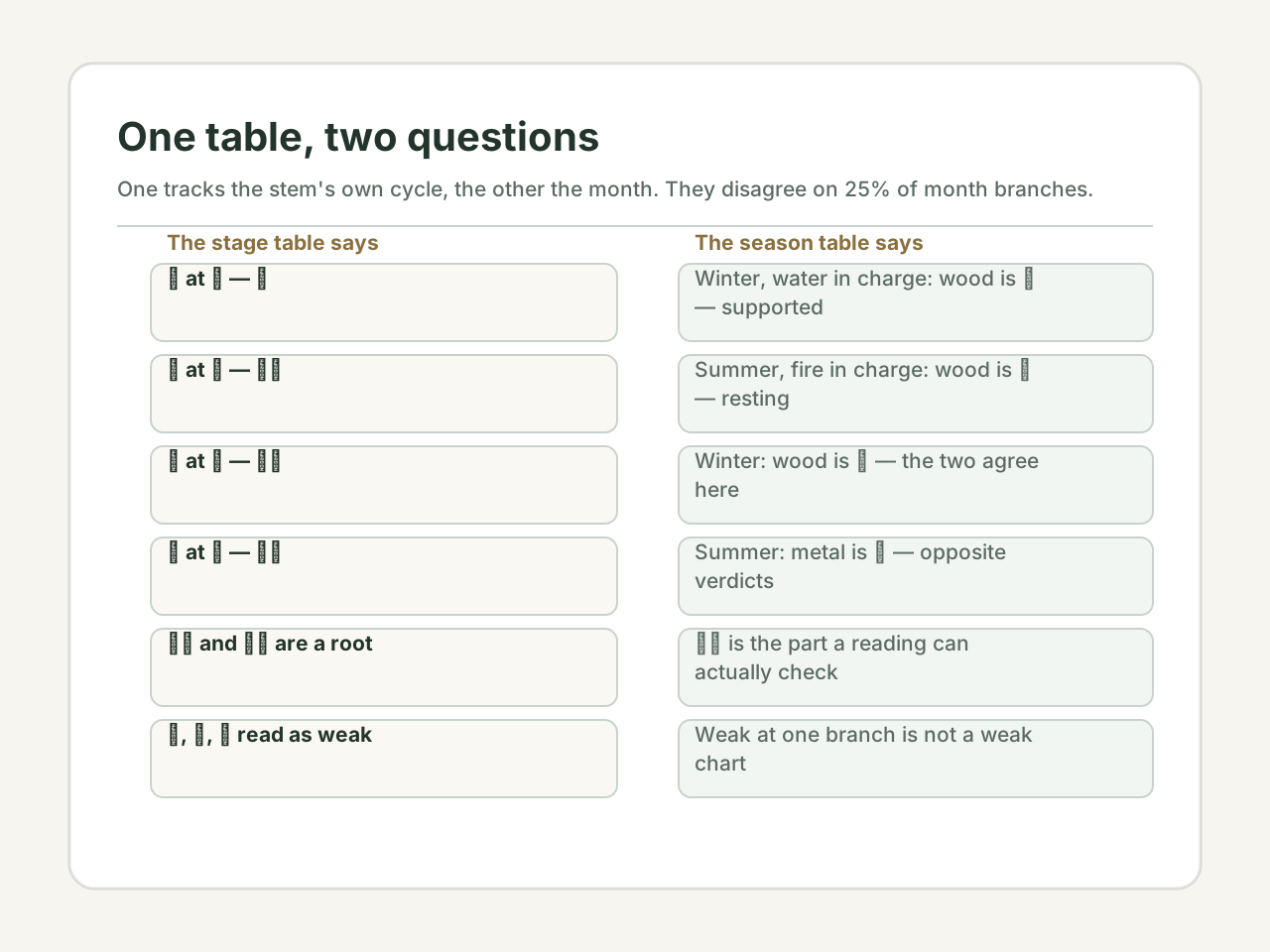
In chart A the table is harsher than the chart. 乙 sits at 死 in the month branch and at 绝 in the day branch — the two positions a reading leans on most. Yet 亥, the branch holding that 死, hides 壬 (正印) and 甲 (劫财). The branch the table calls the day master's death is the branch carrying its resource. Winter puts wood in 相, the state just below the season's ruler, because water is what generates wood.
In chart B the table is more generous than the chart. 乙 sits at 长生 in the month — the best label in the set — but 午 is summer, fire in charge, and wood there is 休: it has done its generating and is resting. 午 hides 丁 (食神) and 己 (偏财), neither of which supports 乙. The real root is the day branch 卯, where 乙 is 临官, and 卯 hides 乙 and nothing else.
| Chart A | Chart B | |
|---|---|---|
| Birth data | 16 Nov 1990, 10:00, UTC+8 | 19 Jun 1990, 10:00, UTC+8 |
| Four pillars | 庚午 · 丁亥 · 乙酉 · 辛巳 | 庚午 · 壬午 · 乙卯 · 辛巳 |
| Month branch | 亥 — winter, water in charge | 午 — summer, fire in charge |
| 乙 at the month | 死 | 长生 |
| Season verdict for wood | 相 — supported | 休 — resting |
| What actually supports 乙 | 壬 and 甲 hidden inside 亥 | 乙 inside 卯, the day branch |
| Stage at the day branch | 绝 | 临官 |
The two tables disagree on a quarter of month branches
Set the stage table against the season table — 旺相休囚死, the ranking of an element inside a season — and count how often they agree about whether the month supports the day master. Across ten stems and the eight branches whose season is unambiguous, eighty combinations, they disagree twenty times: 25%.
The disagreements are not scattered. They cluster at each stem's own birth and bathing positions, and they run right across the yin rows: 乙 at 巳 is 沐浴 while wood is 休; 丁 at 酉 is 长生 while fire is 囚; 庚 at 巳 is 长生 while metal is 死; 戊 at 寅 is 长生 while earth is 死. Even the yang stems disagree, because 长生 is a position in a cycle, not a claim about the season.
That is the whole point of the mismatch. The stage table answers one question — which phase of its own cycle is this stem in at this branch. The season table answers a different one — what does this month do for this element. Neither is wrong. Reading one as the answer to the other is the error.
The four earth months 辰 戌 丑 未 are left out on purpose: whether earth rules in them or dies in them is itself contested, and mixing a contested convention into a count would make the count worthless.
Where the table does earn its place
Two stages carry most of the practical weight, because they describe a root rather than a mood:
- 临官 and 帝旺 are the two stages that count as 得地 — the day master genuinely standing on that branch. 乙 at 卯 is 临官; 甲 at 寅 is 临官 and at 卯 帝旺.
- 墓 is storage, not death. 甲 is at 墓 in 未, and 未 hides 乙 — the tomb branch contains the element it is supposed to have buried.
- In luck pillars the table has its commonest real use: each decade's branch gives the day master a stage, and that is the one place almost every school applies it.
- As a qualifier on 神煞 and on 十二运 readings, the stage is a label on a branch, not a measure of the chart.
A four-step check
Applied to chart A, this takes about two minutes:
- Look up the stage at all four branches, not just the month. Chart A reads 长生 at the year, 死 at the month, 绝 at the day, 沐浴 at the hour — a spread that already shows the label is position-dependent.
- Treat 临官 and 帝旺 as a root claim and check it against the hidden stems. A stage of 帝旺 on a branch that hides nothing supportive is a label without a root.
- When the stage and the season disagree, keep both and give each its own job: the season for how much the month supports the day master, the stage for where in its cycle the stem sits.
- Name the yin-stem convention you used. On chart A the answer for 乙 at 亥 flips from 死 to 长生 depending on it, and a reading that does not say which table it used cannot be checked.
Where the label should stop
死, 绝 and 墓 are cycle names. A chart whose day master sits at 死 in the month is not a death sentence, a health warning, or a date, and the classical compendia that print the table do not treat it as one. The table has twelve rows and two inputs — a stem and a branch. It cannot see the other three pillars, the season, or the roots, which is why it disagrees with the season table a quarter of the time.
What it can do is tell you where a root is and where it is not, in a form you can check by hand. Everything past that is interpretation, and the version of it that arrives with a price — a ritual to move a day master out of 死, an object to open a 墓 — is not reading the table at all.
Disclaimer: This content is for informational and cultural reference purposes only. It does not constitute professional medical, legal, financial, or psychological advice. Readers should exercise their own judgment and consult qualified professionals for specific concerns.
Sources and review basis
Traditional references explain historical vocabulary and context. Official practical sources support only the observable safety, comfort, or environmental points noted in the article; they do not validate metaphysical claims.
Traditional reference
Yuanhai Ziping (渊海子平)Wikisource digital text · Accessed 2026-07-14
A classical source for Four Pillars terminology, element relationships, and the Day Master framework.
Traditional reference
Sanming Tonghui (三命通会)Wikisource digital text · Accessed 2026-07-14
A historical compilation used to cross-check traditional BaZi concepts; it is not scientific validation.
Practical source
APA Dictionary of Psychology: Barnum effectAmerican Psychological Association · Accessed 2026-07-14
A psychology reference for why broad, favourable personality descriptions can feel personally accurate. It does not evaluate BaZi calculations themselves.