Two coordinates, and one that has to come first
Relationship reading uses two coordinates. The spouse palace is the day branch, the seat directly under the Day Master. The spouse star is an element: for a male chart, 財; for a female chart, 官.
The star cannot be named before the Day Master is known, because 財 and 官 are defined relative to it. A sentence like her spouse star is the fire element is incomplete at best. Fire is 正官 for a 辛 Day Master and 七殺 for a 庚 Day Master, and for a 甲 Day Master fire is 食傷 — output, not a spouse star at all. Getting this wrong is not a nuance; it changes which star is being read.
This is the single most common error in English-language relationship articles, and it is easy to check. Take the Day Master, find the element that controls it for a female chart or that it controls for a male chart, then split by polarity.
The spouse star for all ten Day Masters
The same four stems serve every chart; which one is the spouse star depends on the Day Master and on sex. For a male chart, read the two 財 columns. For a female chart, read the two 官 columns.
| Day Master | 正財 | 偏財 | 正官 | 七殺 |
|---|---|---|---|---|
| 甲 | 己 | 戊 | 辛 | 庚 |
| 乙 | 戊 | 己 | 庚 | 辛 |
| 丙 | 辛 | 庚 | 癸 | 壬 |
| 丁 | 庚 | 辛 | 壬 | 癸 |
| 戊 | 癸 | 壬 | 乙 | 甲 |
| 己 | 壬 | 癸 | 甲 | 乙 |
| 庚 | 乙 | 甲 | 丁 | 丙 |
| 辛 | 甲 | 乙 | 丙 | 丁 |
| 壬 | 丁 | 丙 | 己 | 戊 |
| 癸 | 丙 | 丁 | 戊 | 己 |
Palace and star: one seat or two
The palace and the star are different coordinates, and they can coincide. When the spouse star sits in the day branch, the two readings collapse into one and the tradition calls the star 得位 — in position. When the star sits elsewhere, in the month or hour pillar, or only as a hidden stem, the reading splits: the palace describes the partnership as lived, and the star describes the person or the theme.
A third case is easy to miss and worth naming. The day branch can hold a star that is not a spouse star at all. For a 辛 Day Master the day branch 酉 is 辛's 祿, so the spouse palace is occupied by 比肩 — a peer, not a partner. That is a structural statement about the palace, and it reads differently from a palace holding 正官.
The four checks that do the work
Once the palace and the star are located, four checks carry almost all of the reading. They are mechanical, and two readers using the same conventions should reach the same answer.
First, what the day branch meets in the decade and the year: a 沖 destabilises, a 合 binds, a 害 irritates, and a 三合 can pull the palace into a frame with two other branches. Second, whether the spouse star is supported or suppressed — a star that is 合 away, 沖 away, or sat on by a controlling element is not doing the work its name suggests. Third, what the day branch does with the month and hour branches, since those are the palaces that surround it. Fourth, whether the star appears on the stem layer at all or only as a hidden stem, which decides whether the theme is visible or latent.
- Palace struck, star intact — the partnership is under pressure while the person remains available to it. The classical reading is turbulence rather than ending.
- Palace intact, star absent — the theme is present in the chart but has no object. Common in charts where no 財 or 官 stem appears anywhere, including among the hidden stems.
- Palace holding a peer — 比肩 or 劫財 in the day branch. The seat is occupied by an equal, which the tradition reads as competition or as partnership between equals, depending on the rest of the chart.
- Star in position, palace struck — the person is clearly defined and the relationship is not. The reading moves to timing: which decade or year presses the palace.
Compatibility is three separate claims
The compatibility question is usually asked as one thing and is actually three, with very different evidential standing.
The zodiac pairing — horse and rat clash, so the match is bad — uses the year branches, which is one branch out of four and describes family background rather than the two people. It is the weakest of the three and the most widely circulated. The day-branch comparison is the traditional core, because the day branch is the spouse palace in both charts; two day branches that 沖 are in direct opposition, and two that 合 are bound. The third claim, that the two charts' elements complement each other, depends entirely on which 用神 method the reader uses, so two practitioners can reach opposite conclusions from identical data without either making a mistake.
None of the three produces a score. A number out of a hundred requires a weighting that the tradition does not supply, and supplying one is a modern invention dressed in old clothes.
A worked example: 辛 Day Master with 酉 in the day branch
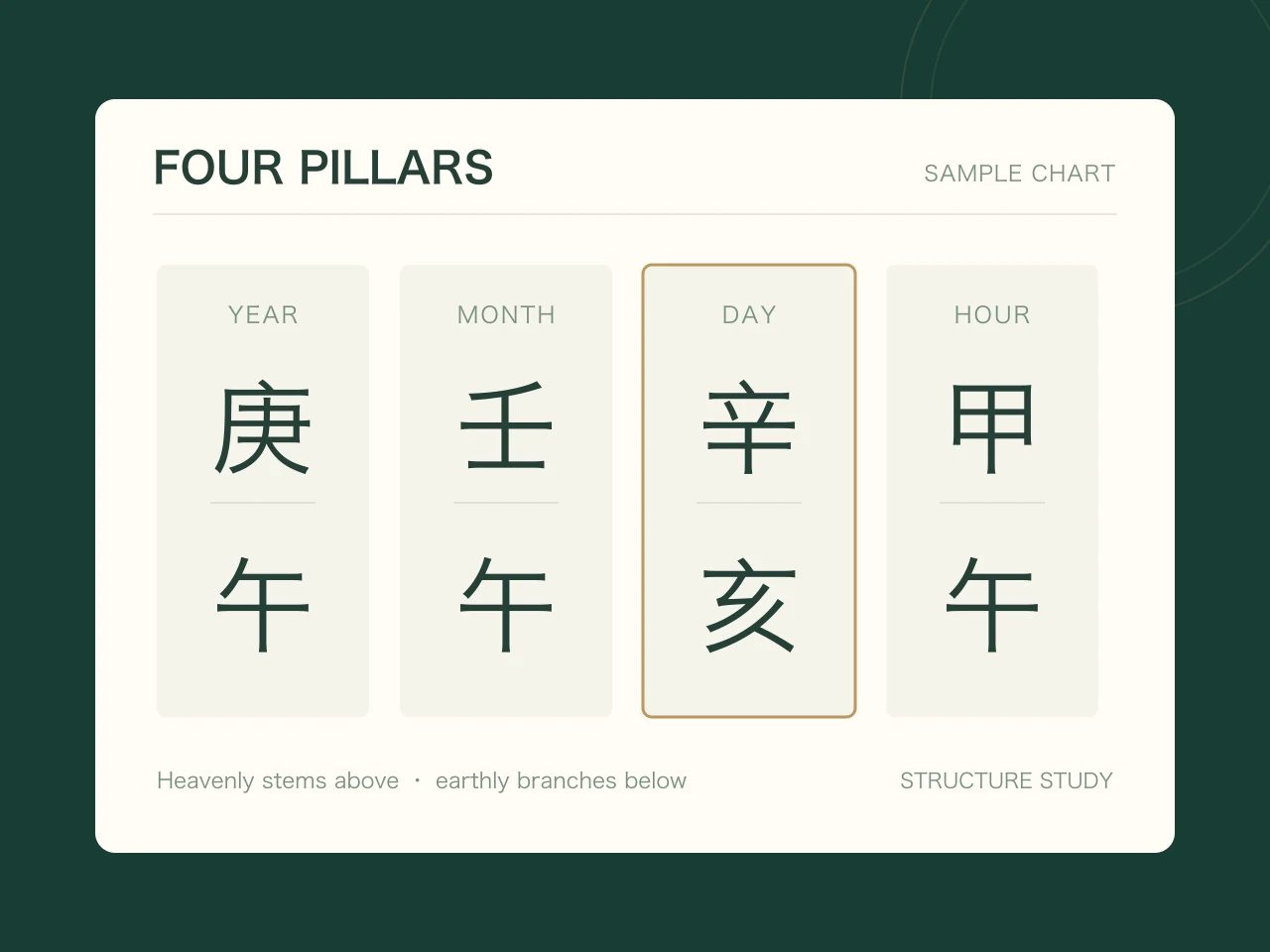
A woman has 辛 as her Day Master and 酉 as her day branch. Her spouse star is 官, and for 辛 that is 丙 正官 or 丁 七殺 — not fire in general. Her day branch 酉 is 辛's 祿, so the spouse palace holds 比肩 rather than a spouse star: palace occupied by a peer, star elsewhere or absent.
In 2023 the year pillar was 癸卯. 卯 沖 酉 strikes the day branch directly, and 癸 for a 辛 Day Master is 食神. So the year reads as output pressing the spouse palace: something the person is producing, saying, or wanting collides with the seat of partnership. That is a specific and checkable statement.
What it does not say is that a marriage ended in 2023. Plenty of people with that configuration had a difficult conversation, a house move, or a year of unusual candour. The chart named the pressure and the palace. It did not name the outcome, and the outcome is not recoverable from the branches.
What the tradition cannot promise
It cannot predict divorce, and any reading that does has moved past the model into assertion. It cannot score compatibility, for the reason given above. And it cannot describe a partner's appearance, profession, or temperament with any reliability, because the star indicates a category of relation rather than a person.
There is also a specific failure mode worth knowing about. Broad statements about being devoted but guarded, or wanting closeness while fearing it, feel accurate to almost everyone who reads them. That is the Barnum effect, and relationship readings are unusually exposed to it because the subject matter is already emotionally loaded. The test is whether a statement could be wrong: a reading that names the palace, the star, and the relation can be checked and sometimes fails. A reading that describes your inner weather cannot fail, which is precisely why it is worth less.
Disclaimer: This content is for informational and cultural reference purposes only. It does not constitute professional medical, legal, financial, or psychological advice. Readers should exercise their own judgment and consult qualified professionals for specific concerns.
Sources and review basis
Traditional references explain historical vocabulary and context. Official practical sources support only the observable safety, comfort, or environmental points noted in the article; they do not validate metaphysical claims.
Traditional reference
Yuanhai Ziping (渊海子平)Wikisource digital text · Accessed 2026-07-14
A classical source for Four Pillars terminology, element relationships, and the Day Master framework.
Traditional reference
Sanming Tonghui (三命通会)Wikisource digital text · Accessed 2026-07-14
A historical compilation used to cross-check traditional BaZi concepts; it is not scientific validation.
Practical source
APA Dictionary of Psychology: Barnum effectAmerican Psychological Association · Accessed 2026-07-14
A psychology reference for why broad, favourable personality descriptions can feel personally accurate. It does not evaluate BaZi calculations themselves.