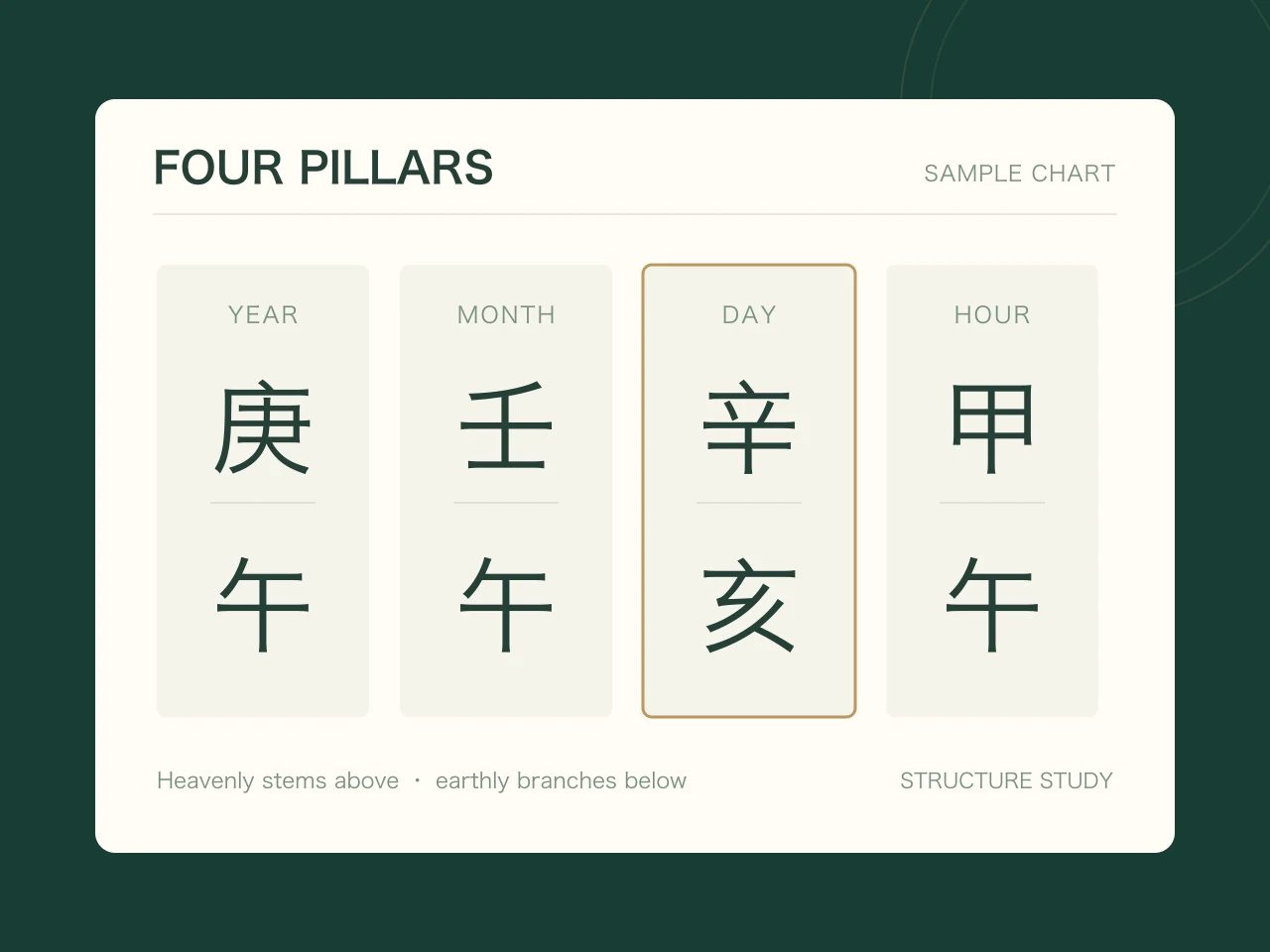
The mapping is a doctrine, and its organ names are not organs
The five-element health mapping is not a modern overlay added to the birth chart. It comes from the 五行 doctrine set out in the 素問, the inner canon of Chinese medicine, where each of the five 藏 is tied at once to an element, a season, a tissue, an orifice, an emotion, a taste and a colour. 《素問·陰陽應象大論》 lists the whole set in one pass, and later commentaries mostly rearrange it rather than add to it.
The load-bearing point is what those organ names mean. 肝 in that system is defined by function — 主疏洩, governing free movement; 藏血, storing blood; 主筋, governing the sinews; 開竅於目, opening into the eyes — not by the organ a hepatologist images. Two different objects share one word. A chart that counts 木 is not measuring liver function; it is counting how much of the birth moment fell into the wood category.
Once that is clear the question changes shape. It is no longer whether the mapping is scientifically valid, but whether the two things being compared are the same kind of thing. They are not, and the four places where the join fails are worth naming individually.
Five columns, one row per element
The 表里 pairs are the channel pairing: each 藏 is matched to one 腑 and the pair shares a meridian. 心包 with 三焦 makes a sixth pair that most tables drop, because 心包 has no element of its own and so cannot occupy a row.
| Element | 藏 | 腑 (表里) | 五體 | 五竅 | 五志 | 五味 | 五色 |
|---|---|---|---|---|---|---|---|
| Wood | 肝 | 膽 | 筋 | 目 | 怒 | 酸 | 青 |
| Fire | 心 | 小腸 | 脈 | 舌 | 喜 | 苦 | 赤 |
| Earth | 脾 | 胃 | 肉 | 口 | 思 | 甘 | 黃 |
| Metal | 肺 | 大腸 | 皮毛 | 鼻 | 悲 / 憂 | 辛 | 白 |
| Water | 腎 | 膀胱 | 骨 | 耳 | 恐 | 鹹 | 黑 |
Where earth goes: two systems, two answers
The 五行 need five seasons and the year has four. Chinese medicine solves this by inserting 長夏, late summer, as earth's season. It is a genuine part of the classical scheme rather than a rounding error, and it is why the medical calendar has five seasons while the agricultural one has four.
命理 solves the same problem differently. Earth is strong in each of the four earth months — 辰, 戌, 丑, 未 — and the 旺相休囚死 table treats 土 as 相 through summer and 旺 only inside those four months. There is no 長夏 anywhere in the chart.
The consequence is worth stating without softening: a chart's 土 count and a 脾 reading in medicine are produced by different rules from different premises. They are not one quantity with two names, and a page that maps them directly is drawing an analogy, not deriving a result.
Excess and deficiency push in two directions
《素問·五運行大論》 states the mechanism in a single line: 氣有餘則制己所勝而侮所不勝; 其不及則己所不勝侮而乘之, 己所勝輕而侮之. An element that is excessive over-controls what it normally controls and pushes back against what normally controls it. An element that is deficient gets attacked from both ends at once.
That is why 乘 and 侮 are not two words for the same thing. 乘 is over-acting along the normal control line; 侮 is that line reversed. A reading that uses only 克 misses half the machinery.
A chart makes it concrete. Born 25 June 2001 at 10:00: 辛巳 甲午 己未 己巳. The Day Master is 己, the month branch 午, and 己 sits at 臨官 in 午 — verified against the twelve-stage table rather than assumed.
Count only the visible characters and the chart reads 木 1, 火 3, 土 3, 金 1, 水 0. Count the hidden stems too and it reads 木 2, 火 7, 土 7, 金 3, 水 0: 巳 hides 丙庚戊 and appears twice, 午 hides 丁己, 未 hides 己丁乙.
Seven fire is the excess, and it acts both ways — 火 乘 金 and 火 侮 水. Water here is not weak but absent, zero even after hidden stems, which is rarer than a low count and should be said precisely. Earth at seven is not a deficiency either, because 火生土: the earth is fed by the excess, so in this frame the spleen side is the over-supplied one rather than the starved one.
The seasonal table has already answered half the question
旺相休囚死 assigns every element a strength from the month alone. In summer 火 is 旺, 土 相, 木 休, 水 囚, 金 死. Every chart born in a 午 month therefore carries 金死 and 水囚, and carries them identically.
So the sentence 'born in summer, therefore the lungs and kidneys are the weak points' is the calendar restated, not a reading of a person. The chart-specific part is the count — zero water. The seasonal part is shared with everyone born in the same month, which is roughly one twelfth of the population.
| Season | 旺 | 相 | 休 | 囚 | 死 |
|---|---|---|---|---|---|
| Spring | 木 | 火 | 水 | 金 | 土 |
| Summer | 火 | 土 | 木 | 水 | 金 |
| Autumn | 金 | 水 | 土 | 火 | 木 |
| Winter | 水 | 木 | 金 | 土 | 火 |
What a chart cannot supply
Chinese medical diagnosis runs on 四診: 望, reading spirit, colour, form and bearing; 聞, listening to voice and breathing and noting odour; 問, the ten questions; 切, pulse and palpation. A birth chart supplies none of the four. It supplies a classification of one moment, the moment of birth, and nothing about the state of the body now.
That is the whole gap, and it is structural rather than a matter of evidence. The chart is not attempting the same task badly; it is attempting a different task. It also explains why the same chart can be read as a lung tendency in someone whose lungs are fine — the chart was never measuring the lung, so no result about the lung could contradict it.
When the reading and the clinic point different ways
The order of precedence is the one thing worth being dogmatic about. Symptoms that persist, that change, or that fit a known warning pattern go to a clinician first. A chart is not a reason to wait, and it cannot rule anything out.
- A cough lasting more than three weeks, or any blood in it.
- Weight lost over weeks without intending to lose it.
- Night sweats, or a low fever that keeps coming back.
- Chest pain, or breathlessness on mild exertion.
- A change in bowel habit that does not settle.
- Any lump that is new, hard, or still growing.
The half of it that is not about the body
If a reading makes you anxious about a particular organ, the anxiety is the part with real consequences. It changes sleep, attention and appetite in ways no element count does. Acting on it means getting the test that settles the question, not re-reading the chart until the worry subsides.
The useful version of this practice is narrower than the popular one and more honest: it names which categories the birth moment over-weighted, and it leaves the state of your body to the four examinations that can actually observe it.
Disclaimer: This content is for informational and cultural reference purposes only. It does not constitute professional medical, legal, financial, or psychological advice. Readers should exercise their own judgment and consult qualified professionals for specific concerns.
Sources and review basis
Traditional references explain historical vocabulary and context. Official practical sources support only the observable safety, comfort, or environmental points noted in the article; they do not validate metaphysical claims.
Traditional reference
Yuanhai Ziping (渊海子平)Wikisource digital text · Accessed 2026-07-14
A classical source for Four Pillars terminology, element relationships, and the Day Master framework.
Traditional reference
Sanming Tonghui (三命通会)Wikisource digital text · Accessed 2026-07-14
A historical compilation used to cross-check traditional BaZi concepts; it is not scientific validation.
Practical source
US NIH/NHLBI: Healthy Sleep HabitsNational Heart, Lung, and Blood Institute, NIH · Accessed 2026-07-14
Health background for sleep routines and bedroom conditions; it does not endorse directional feng shui claims.