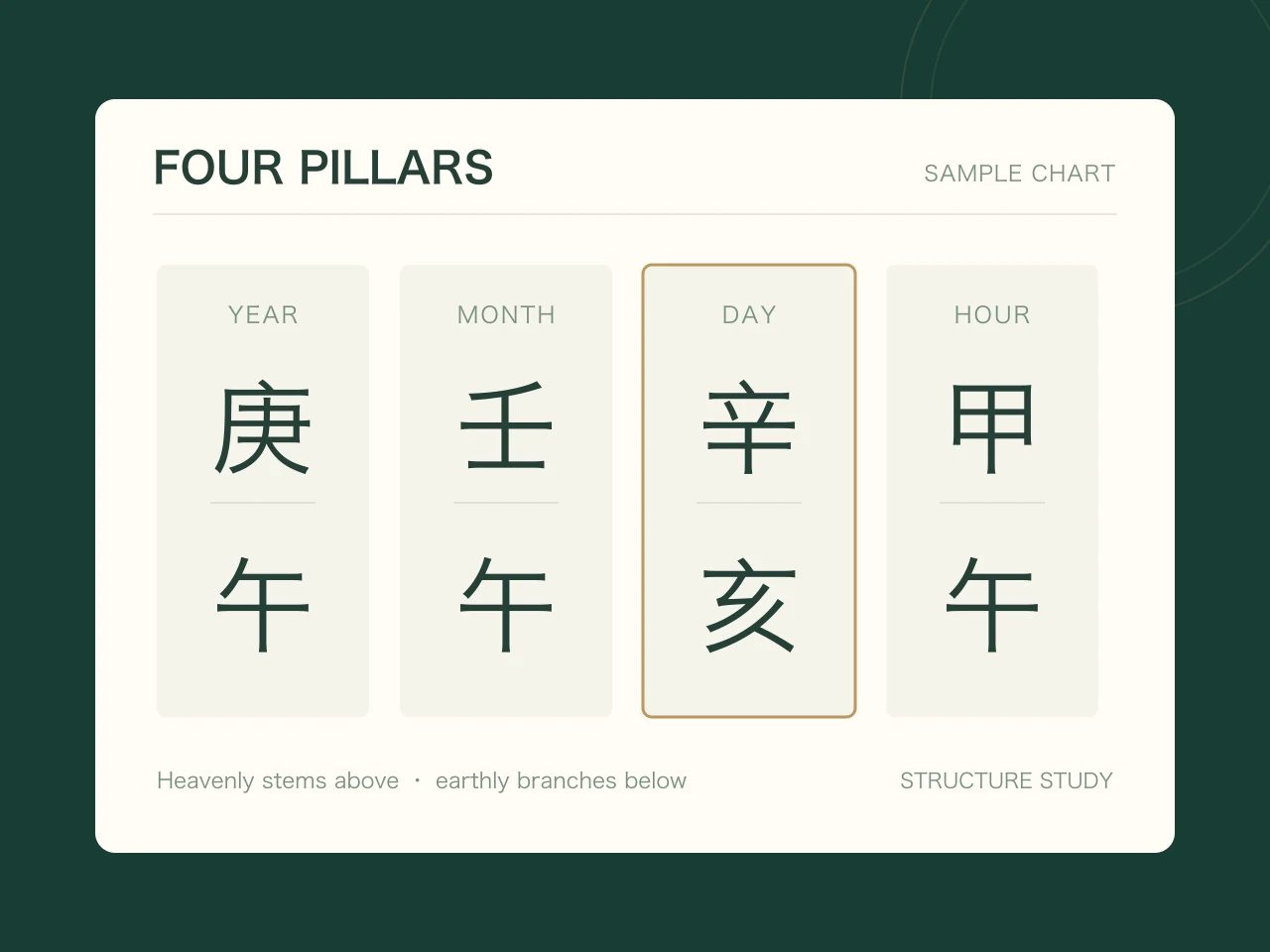
Which stars get read, and which get left out
Career readings usually pull from three groups: 食傷 for output and craft, 財 for money and management, 官殺 for authority and structure. That leaves out 印, which covers credentials, mentors, institutional backing, and the ability to absorb a field before working in it — and in practice 印 is what separates a career that compounds from one that restarts every few years.
There is a reason the omission is common. 印 is the least dramatic of the five: it does not produce, it does not earn, it does not command. It accumulates. A chart with strong 印 and weak 食傷 tends to read as over-prepared and under-published, which is a real career pattern and not a flattering one, so introductions skip it.
Four groups to read, then: 印 for what you can absorb and who backs you, 食傷 for what you can produce, 財 for what you can convert into money, 官殺 for what you can be trusted with. Career questions are usually questions about which of the four is short.
Work style is a relation, not a job title
What follows is what each star contributes to work, stated as a style rather than a job. The last column is the part usually left out, and it is the part that makes the reading checkable: every one of these tendencies has a characteristic way of failing.
| Star | What it contributes | Work style | Where it goes wrong |
|---|---|---|---|
| 正印 | Credentials, formal training, institutional backing | Learns the field properly before acting; good inside a structure that rewards depth | Over-prepared, waits for permission, accumulates qualifications instead of work |
| 偏印 | Idiosyncratic knowledge, cross-domain synthesis | Comes at a field sideways and finds connections insiders miss | Theory without output; expertise nobody can use |
| 食神 | Steady production, craft, taste | Builds quality slowly and enjoys the building | Comfort; output that never gets sold |
| 傷官 | Innovation, rule-breaking, performance | Improves things by refusing to accept the current version | Friction with whoever owns the process; right and unemployed |
| 正財 | Contractual income, assets, management | Runs a budget, keeps commitments, prefers predictable returns | Hoarding; refuses the bet that would have paid |
| 偏財 | Opportunity, variable income, deal flow | Spots and closes; comfortable with uncapped upside | Speculation; income that arrives in spikes and leaves the same way |
| 正官 | Role, obligation, regulated authority | Takes responsibility inside a defined scope and is trusted with more | Rigidity; mistakes the procedure for the purpose |
| 七殺 | Pressure, competition, authority without a rulebook | Performs when the stakes are real and the path is undefined | Overload; treats every situation as a fight and burns out |
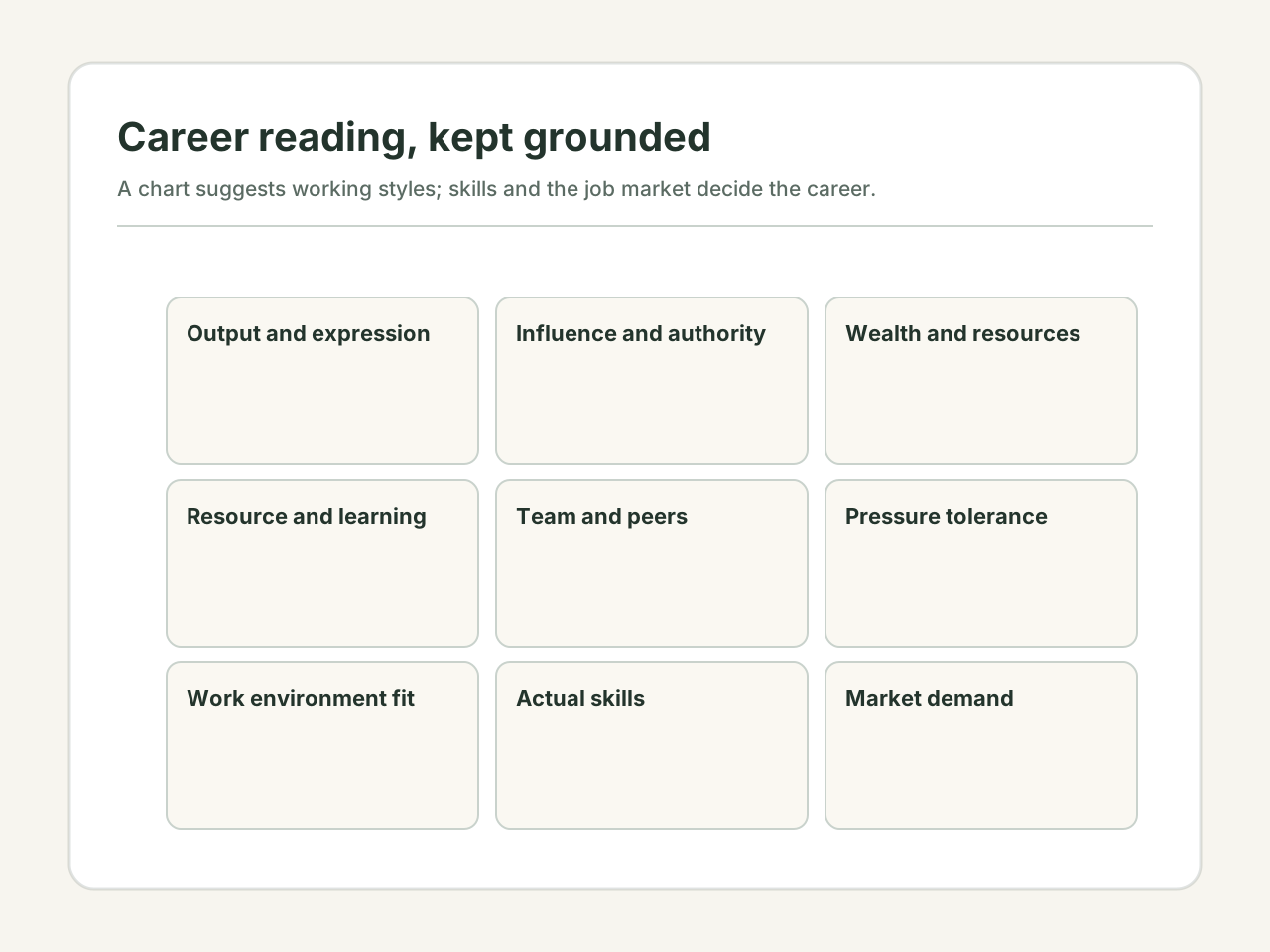
The stem shows, the branch decides
A Luck Pillar is a stem and a branch, and the two do different work. The stem is what shows on the surface — the visible theme of the decade, the thing the person and everyone around them notices. The branch is what is actually underneath: it holds hidden stems, and the hidden stems decide what the decade is really made of.
This is where most career timing goes wrong. A pillar gets read from its stem because the stem is the half with a name, and the branch is treated as decoration. In practice a 財 stem over a 殺 branch is a decade that looks like money and behaves like pressure.
The other thing a pillar does is act on the natal chart rather than replace it. It can supply a root the chart lacked, complete a combination the natal branches only half-formed, or clash with the branch that was holding something in place. Which of those happens depends on where the pillar's branch sits relative to the natal branches, not on the pillar's label.
Starting age is computed, not chosen. The distance from birth to the relevant 節氣 in days, divided by three, gives the age at which the first pillar begins, and the sequence then advances by ten. A first pillar at eight means a birth roughly twenty-four days from the term. Direction follows the year stem's polarity and the person's gender: 阳男 and 阴女 run forward from the month pillar, 阴男 and 阳女 run backward.
A 丙辰 decade for a weak 壬
A man has 壬 as his Day Master, born in 午月, with no metal stem and no water root. He is weak. His first Luck Pillar began at eight, so the fourth begins at thirty-eight, and it is 丙辰.
Read from the stem, 丙 is yang fire and 壬 controls fire, so this is a 財 pillar — a money decade. That is the reading he acted on: he left a salaried role and started a consultancy.
Read properly, 丙 is 偏財 and 辰 is not decoration. 辰 is a yang earth branch holding 戊, 乙 and 癸. For a 壬 Day Master, 戊 is 七殺, 乙 is 傷官 and 癸 is 劫財. The ruling stem of the branch is 戊, so the pillar is 偏財 over 七殺: fluid money on the surface, unregulated pressure underneath.
For a weak 壬 that is close to the worst combination available. 財 drains a Day Master that is already outnumbered, and 七殺 attacks it directly with nothing in between — no 印 to convert the pressure into structure, no 比 to share the load. The 癸 hidden in 辰 is a 劫財 root, the one piece of support in the pillar, and it is a 餘氣 at the bottom of a branch whose ruling stem is doing the damage.
The decade was not a money decade. It was a decade of being asked to carry money and pressure without support, which is a describable condition and, on his account, what it felt like. The error was not in the chart. It was in reading one character of a two-character pillar.
What a career reading cannot do
A career reading can describe how someone works and what they are short of. It cannot tell them what to do, because it does not know the market, the offer on the table, the family situation, or what the person is actually good at.
The useful output is a question, not an instruction. If 印 is short, the question is whether the next move should buy credentials rather than salary. If 食傷 is short, whether the work produces anything visible. If 財 is short, whether the income is contractual or opportunistic. Those are answerable. You should be a designer is not.
And the reading is falsifiable in a way that makes it worth doing properly. A chart read as 偏財 over 七殺 predicts a decade that feels like unbacked pressure. If the decade instead felt like easy money, the reading was wrong, and the correction is available — check the branch, check the strength, check whether the pattern holds. A reading that cannot be wrong is not a reading.
Disclaimer: This content is for informational and cultural reference purposes only. It does not constitute professional medical, legal, financial, or psychological advice. Readers should exercise their own judgment and consult qualified professionals for specific concerns.
Sources and review basis
Traditional references explain historical vocabulary and context. Official practical sources support only the observable safety, comfort, or environmental points noted in the article; they do not validate metaphysical claims.
Traditional reference
Yuanhai Ziping (渊海子平)Wikisource digital text · Accessed 2026-07-14
A classical source for Four Pillars terminology, element relationships, and the Day Master framework.
Traditional reference
Sanming Tonghui (三命通会)Wikisource digital text · Accessed 2026-07-14
A historical compilation used to cross-check traditional BaZi concepts; it is not scientific validation.
Practical source
APA Dictionary of Psychology: Barnum effectAmerican Psychological Association · Accessed 2026-07-14
A psychology reference for why broad, favourable personality descriptions can feel personally accurate. It does not evaluate BaZi calculations themselves.