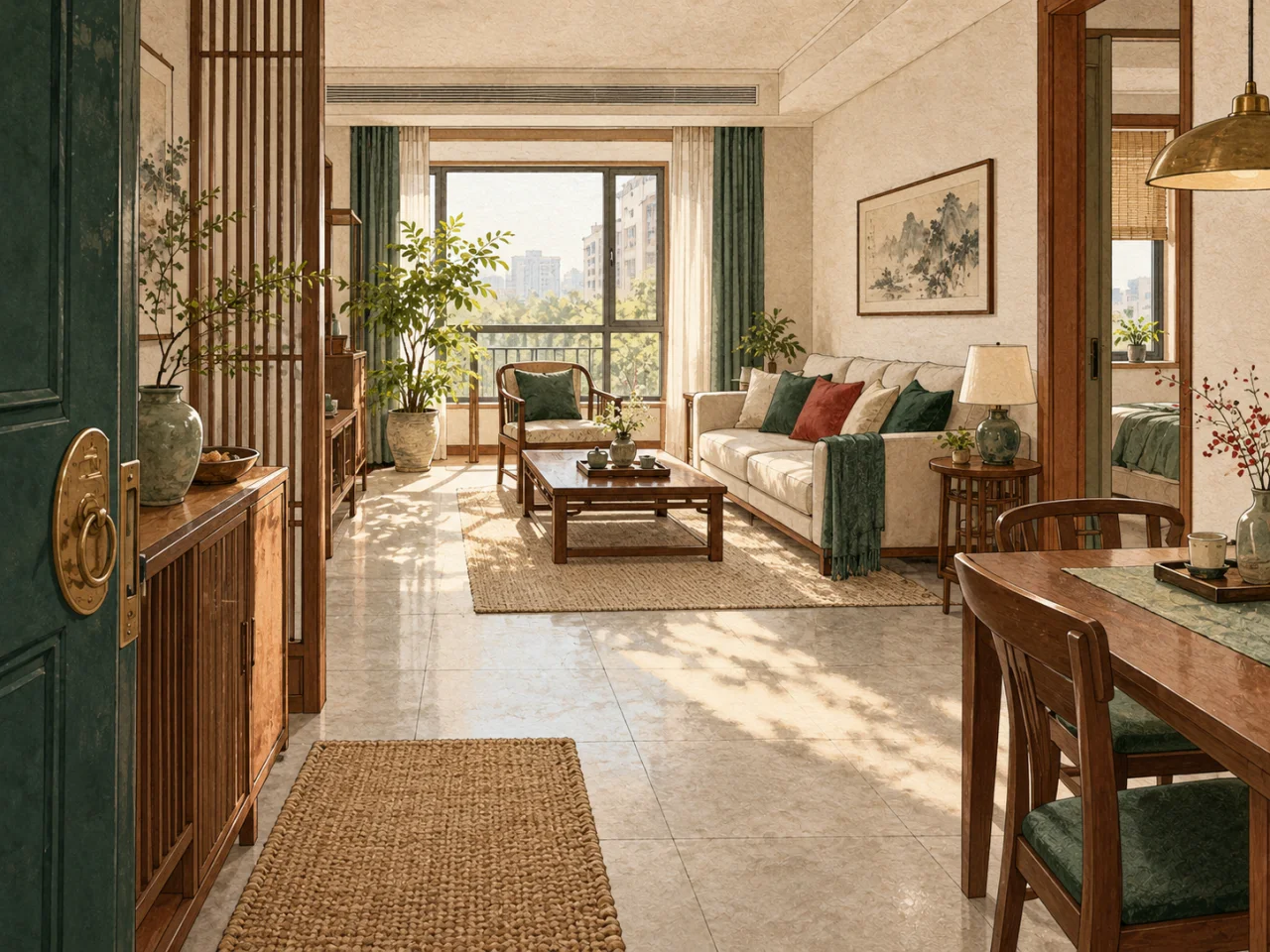
A balcony is the one opening in a flat that meets the floor
Every other opening sits high in a wall. A balcony is the only one that meets the floor, and that single difference governs how it behaves: air moves across it in a layer along the slab rather than through a gap in a wall, so whatever stands on the slab sits directly in that flow. This is the whole basis of the traditional instruction to keep a balcony clear. It is not a metaphor. A balcony stacked to waist height blocks the most effective opening the flat has.
The test takes three seconds. Stand in the doorway and look: is there a continuous stretch of floor at least 60 cm deep? Can two people stand on the balcony at the same time without one of them moving something first? Is there a surface at seat height within reach? If any of those answers is no, the balcony is currently doing a different job, and no number of plants or wind chimes changes that.
One more thing worth knowing: a balcony does not substitute for cross-ventilation. A single opening moves air by turbulence, not by through-flow, and it does far less than two openings on opposite walls. If the balcony is the flat's only opening, its one job is to stay unobstructed, because it is carrying the entire air exchange on its own.
Depth decides what the balcony can be
Advice that ignores dimensions produces rooms nobody wants to sit in. What fits is set almost entirely by depth, measured from the door or window to the inside face of the parapet:
| Depth | What actually fits | What to leave out |
|---|---|---|
| Under 0.9 m | Standing only, or a narrow bench against the parapet. Planters hung on the rail rather than standing on the floor | Chairs. Anything you have to walk around. A table |
| 0.9–1.4 m | One folding chair facing outward, a small side table, floor planters at each end | Two chairs facing each other — there is nowhere to put your knees |
| 1.4–2.0 m | Two chairs and a small table, or a bench plus planters. This is the depth at which a balcony starts working as a room | Dining sets, loungers, anything that has to stay out in the rain permanently |
| Over 2.0 m | A small table for two, a lounger, layered planting | Treating it as storage because there is 'space left over' |
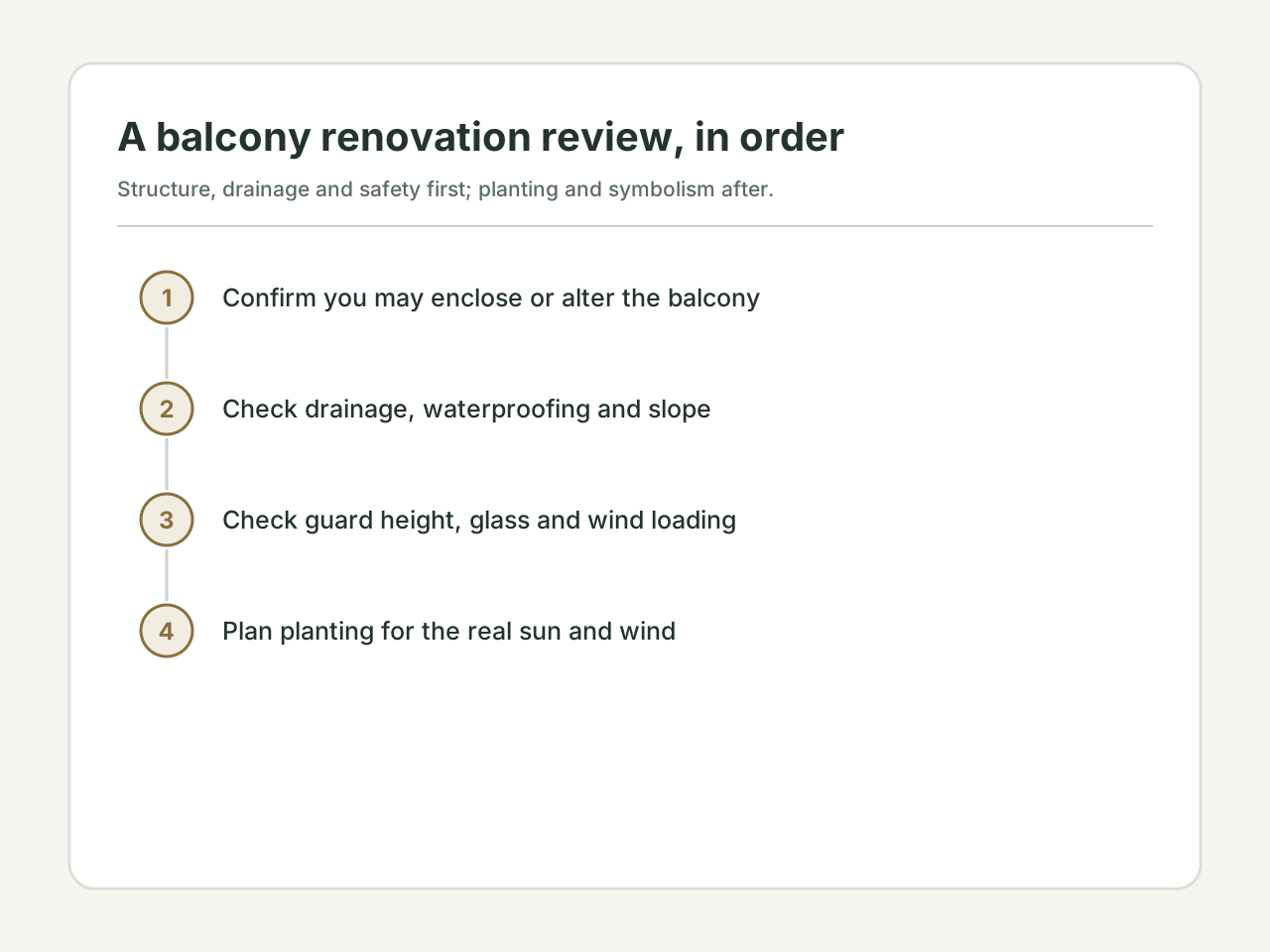
Three ways a balcony stops working, and how each one is reversed
Almost every balcony that has been abandoned fails in one of three ways. None of them needs a renovation to reverse, and all three are visible from the doorway.
| Failure | What it looks like | How to reverse it |
|---|---|---|
| Storage creep | Boxes, a folded drying rack, cleaning equipment, a bicycle, things kept 'for later' — usually starting at the end nearest the door and growing outward | Empty it in one pass, then put back only what is used outdoors. If storage is genuinely needed, use a weatherproof bench that doubles as seating, so the volume has a job of its own |
| Plants that died and stayed | Bare soil, brown stems, faded plastic, pots with no saucer | Remove them the same day. Two healthy plants suited to the light beat ten that are barely surviving. A dead plant is a daily reminder of something you did not do |
| Enclosure | Glass panels, plastic sheeting, or grilles turning the balcony into an extra room | Decide which it is. An enclosed balcony is an interior room: insulate it, ventilate it, furnish it as one. If you want a balcony, take the enclosure down. The half-state — glazed but still full of stored objects — gets the drawbacks of both |
The fourth failure is quieter: the balcony as drying room
Laundry on a rail is normal and not a problem in itself. A rack that never comes down is a different matter: it occupies the volume a chair would occupy and blocks the same opening a stored bicycle would block. The usual reason it stays up is that folding and unfolding it is annoying, which is a solvable problem — wall-mounted racks that fold flat cost little and take ten seconds to open.
If drying has to happen on the balcony, hang at the ends rather than across the middle, keep the rail height above head level, and take everything down once it is dry. The test from the doorway still applies: if you cannot see a clear stretch of floor, the drying has taken over the room.
Match plants to the light you actually get
Plant advice for balconies usually stops at 'add greenery'. The variable that decides whether the greenery lives is orientation, and it can be estimated without a light meter:
- South-facing: six hours or more of direct sun in summer. Rosemary, lavender, succulents, geraniums, most culinary herbs. Water more often than feels reasonable — a pot in full sun on a seventh floor can dry out in two days.
- East-facing: three to five hours of morning sun. The most forgiving aspect. Ferns, hostas, peace lilies, mint, most leafy greens.
- West-facing: strong afternoon sun plus heat stored in the wall behind it. Harder than east. Succulents and sun-tolerant shrubs, and shade the pots themselves rather than only the leaves.
- North-facing: under two hours of direct sun, sometimes none at all. Shade-tolerant species only — ferns, ivy, snake plant, cast-iron plant. Anything that flowers will disappoint.
- Wind at height dries a pot faster than sun does. Above roughly the fifth floor, add a screen or group the pots so they shelter each other.
- Wet soil is heavy. A saturated 40 cm pot can weigh 30–40 kg; check what the slab and the parapet fixings are rated for before hanging anything on the rail.
- Keep thorns away from seating. The traditional reason is that thorns create sha qi; the practical reason is that you will brush against them reaching for a cup.
One balcony cleared in a single Saturday
A couple on the seventh floor had a 3 m by 1.5 m balcony that had stopped being a room. Two broken chairs, a rusted barbecue, a mop and bucket, four bags of donations that had been waiting six months, and a dying plant in a cracked pot. They had not stood on it in a year. The curtain stayed drawn, because the curtain hid it.
Clearing it took one Saturday and produced a rule they still use: nothing crosses the threshold unless it is used outdoors. The chairs went to the tip, the donations were finally donated, the mop and bucket went back to the cupboard where they belonged. What came out was a small outdoor rug, two folding chairs, a side table, and two large pots — a yucca and a Boston fern — chosen for a west-facing aspect.
The cost was about £120. What changed was not the couple's fortune. It was that a two-square-metre strip of the flat stopped being a reproach and became the only place they drink coffee on a Saturday morning.
What improves, and what does not follow
The gains from clearing a balcony are modest and measurable: more daylight through the adjoining window once the curtain stays open, restored air movement through the flat's largest opening, and somewhere to stand outside that does not require going down to the street. Those are worth having on their own terms.
What does not follow is anything about income, career, or relationships. A balcony is not a mechanism for those, and advice that claims otherwise is selling the metaphor rather than the room. If there is no balcony, the same logic applies to the largest window: clear the sill, clean the glass, and put one plant where it actually receives light. That captures most of the benefit. The remainder is floor area, and floor area is the one thing advice cannot supply.
Disclaimer: This content is for informational and cultural reference purposes only. It does not constitute professional medical, legal, financial, or psychological advice. Readers should exercise their own judgment and consult qualified professionals for specific concerns.
Sources and review basis
Traditional references explain historical vocabulary and context. Official practical sources support only the observable safety, comfort, or environmental points noted in the article; they do not validate metaphysical claims.
Traditional reference
Huangdi Zhaijing (黄帝宅经)Wikisource digital text · Accessed 2026-07-14
Historical context for traditional residential orientation and spatial vocabulary. Modern recommendations are judged against real conditions.
Practical source
US EPA: Indoor Air QualityUnited States Environmental Protection Agency · Accessed 2026-07-14
Practical background for ventilation, pollutants, combustion sources, and indoor air concerns.