One pillar per year, on a sixty-year loop
The annual pillar (流年) is simply the stem-branch pair of the current year. It advances one step per year through the sixty-cycle: 2025 is 乙巳, 2026 is 丙午, 2027 is 丁未, 2028 is 戊申. The same pair returns every sixty years, which is why a reading of your sixtieth year can borrow from your first.
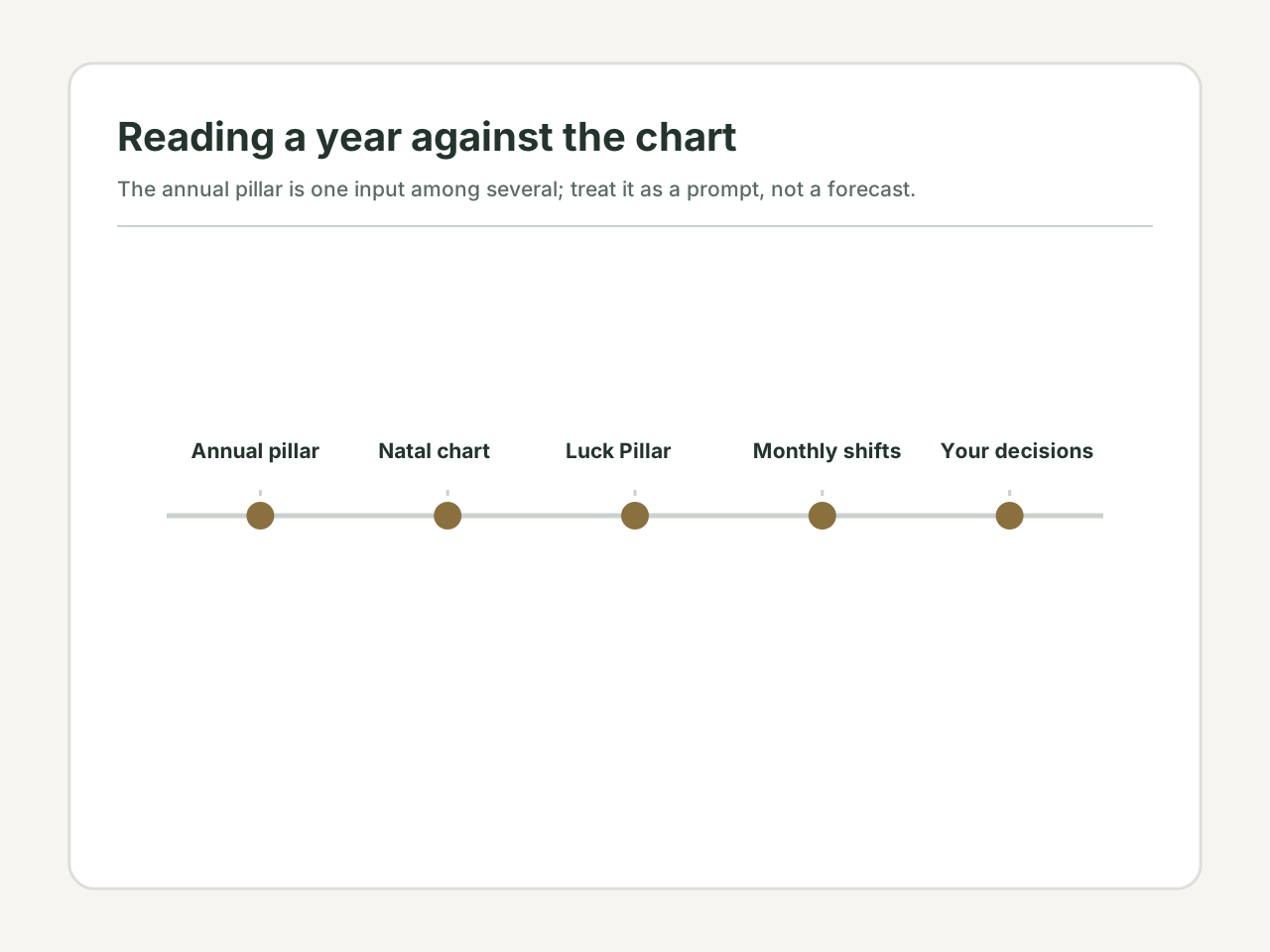
Because it changes every year, the annual pillar is the most mobile layer in the system and the easiest to over-read. It is one pair of characters laid over a fixed chart and a ten-year pillar. Everything it can say depends on what those two layers already establish.
Three layers, three different jobs
The chart is fixed at birth. The decade pillar changes every ten years. The annual pillar changes every year. Each layer answers a different question, and mixing them is the most common mistake in year readings.
A year cannot create a structure the natal chart lacks. It can only press on what is already there. If the chart has no 財 structure, a 財 year activates a theme without supplying the thing itself, which in practice reads as money being discussed rather than received.
| Layer | Changes | Answers | Cannot do |
|---|---|---|---|
| 命局 natal chart | never | What structures exist at all | Say when anything happens |
| 大運 decade | every 10 years | Which palace and element the decade supplies or attacks | Override the natal structure |
| 流年 annual | every year | Which palace is touched this year, and by which ten god | Create a structure the chart lacks |
The stem is a ten god; the branch is a relation
Read the annual stem against the Day Master and you get a ten god for the year. Read the annual branch against each natal branch and against the decade branch and you get relations. Those two operations are the whole of the year layer; everything else is commentary.
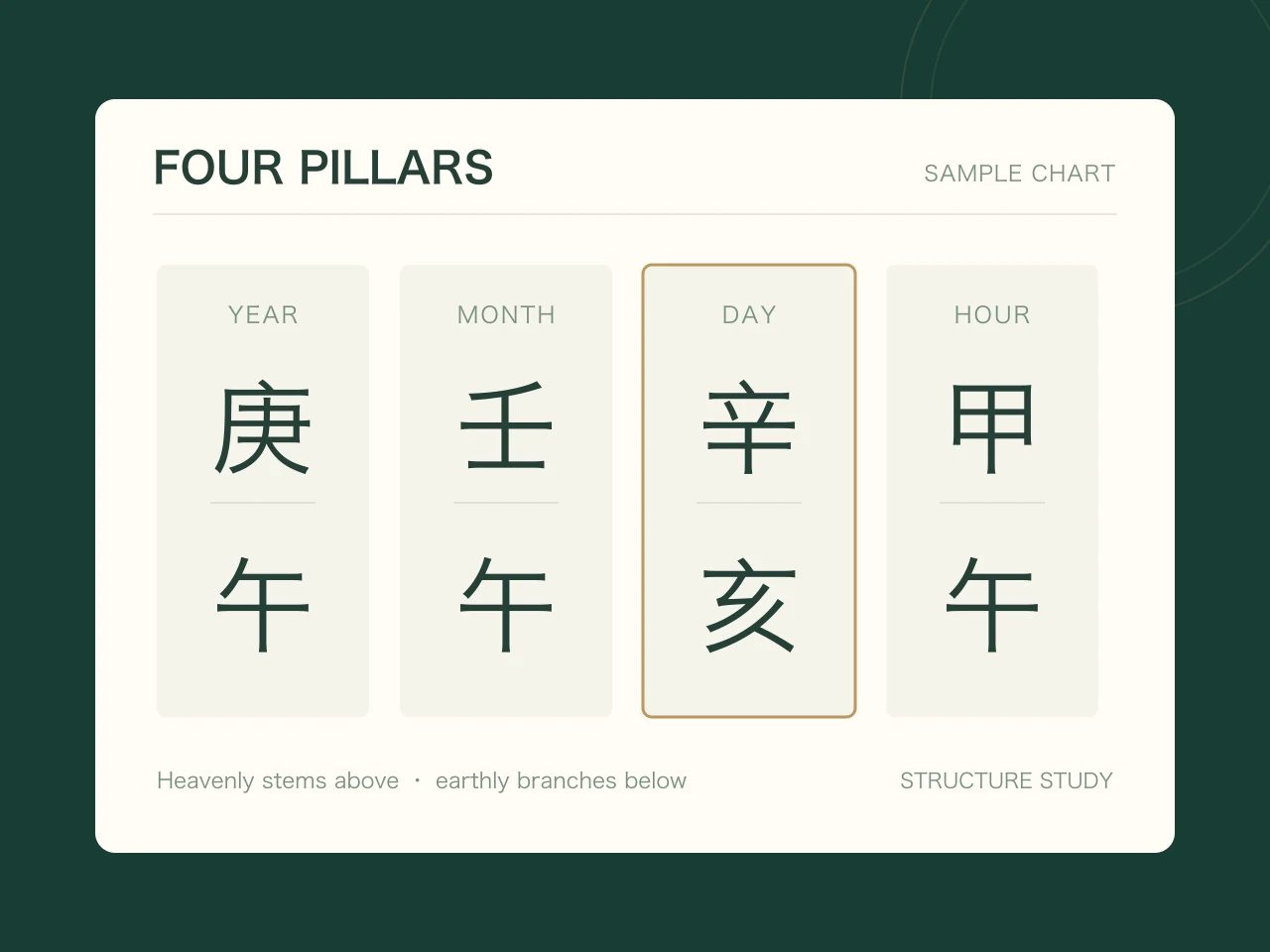
For a 乙 Day Master, 2026 丙午 resolves as 丙 傷官 — 乙 generates 丙 at opposite polarity — over 午, which is 乙's 長生 and also a duplicate of the year branch 午 in the sample chart used here. So the same year is simultaneously an output year, a stage-of-growth year, and a 伏吟 of the family palace, which is three separate statements rather than one mood.
The branch relations are finite and can be memorised, which is the useful part. They are also the part most often asserted without checking, so they are worth keeping in front of you while reading.
| Relation | Pairs | What it does in a year reading |
|---|---|---|
| 六沖 clash | 子午 · 丑未 · 寅申 · 卯酉 · 辰戌 · 巳亥 | Direct opposition. The palace is destabilised and the theme becomes unavoidable |
| 六合 combine | 子丑 · 寅亥 · 卯戌 · 辰酉 · 巳申 · 午未 | Binds two branches; the pair is read as one unit, often with a transforming element |
| 六害 harm | 子未 · 丑午 · 寅巳 · 卯辰 · 申亥 · 酉戌 | Friction that stays under the surface; smaller than a clash and harder to name |
| 三合 triple | 申子辰 · 亥卯未 · 寅午戌 · 巳酉丑 | Two natal branches plus the year branch can close a full frame, changing the chart's balance |
| 三會 direction | 寅卯辰 · 巳午未 · 申酉戌 · 亥子丑 | Seasonal grouping; the strongest of the branch combinations when all three are present |
太歲 is about the year branch, not the whole chart
The five forms of 犯太歲 — 值, 沖, 刑, 害, 破 — are relations between the annual branch and the branch of your birth year. That is one branch out of four, and the birth-year branch describes family background and early environment rather than the person's own working life.
This is why the annual ritual of checking whether the year clashes with your zodiac sign answers a much narrower question than it appears to. A chart can take a 沖 year on the year branch and a 合 year on the day branch in the same twelve months, and the second is usually the one a person feels.
The practice is not meaningless. It is a reminder that one specific palace is being pressed. The error is treating it as a verdict on the year, which the tradition itself does not support once the other three branches are on the table.
A worked year: 2026 against a 1990 chart
Take 庚午 丁亥 乙酉 辛巳, born 16 November 1990, male. His pillars run 戊子 from 1997, 己丑 from 2007, 庚寅 from 2017. In 2026 he is in 庚寅, the third decade.
The year 丙午 brings 丙 傷官 against the decade's 庚 正官. That is the classical 傷官見官 configuration, and its standard reading is friction with authority — a role, a rule, or a superior that stops fitting. The year branch 午 adds three things the stem does not: it is 乙's 長生, it 半合 the decade's 寅 into fire, and it duplicates the natal year branch 午.
Put together, the year says something narrower and more useful than bad year. Authority is the contested ground, output is the instrument, and the family palace is being repeated rather than struck. Whether that becomes a resignation, a promotion refused, a public argument, or an uneventful year of private frustration is not in the characters. What is in the characters is where to look.
When the year repeats the decade
歲運並臨 is the case where the annual pillar and the decade pillar are the same pair of characters — a 丙午 year inside a 丙午 decade. The tradition singles it out because the two layers stop qualifying each other. The decade's theme is delivered at full strength inside one year, with no second reading to dilute it.
It is not an omen by itself. What it removes is the usual hedging. A decade that reads as 傷官見官 delivers 傷官見官 twice over in that year, which is why older texts describe such a year as one to be careful in rather than one to fear.
The same logic applies when a year both combines with one natal branch and clashes another. Both relations are real, and they land in different palaces. A reading that keeps the dramatic one and discards the other is choosing which half of the chart to look at, and it should say so out loud rather than present the choice as the chart's own verdict.
What a year reading can and cannot do
It can name the palace that is touched, the ten god that is activated, and the relation that connects them. Those are three specific claims, and they can be checked against the chart by anyone using the same conventions. That is more than most yearly horoscopes offer, and it is the whole of what the method actually delivers.
It cannot rank probabilities, assign dates inside the year, or turn a 沖 into an event. A clash says two branches oppose each other; it does not say a relationship ends. The gap between those two sentences is where most of the harm in this genre gets done, and closing it requires evidence the chart does not contain.
Disclaimer: This content is for informational and cultural reference purposes only. It does not constitute professional medical, legal, financial, or psychological advice. Readers should exercise their own judgment and consult qualified professionals for specific concerns.
Sources and review basis
Traditional references explain historical vocabulary and context. Official practical sources support only the observable safety, comfort, or environmental points noted in the article; they do not validate metaphysical claims.
Traditional reference
Yuanhai Ziping (渊海子平)Wikisource digital text · Accessed 2026-07-14
A classical source for Four Pillars terminology, element relationships, and the Day Master framework.
Traditional reference
Sanming Tonghui (三命通会)Wikisource digital text · Accessed 2026-07-14
A historical compilation used to cross-check traditional BaZi concepts; it is not scientific validation.